
Read summarized version with
I’ll never forget the moment I realized how badly we needed a knowledge base.
It was 2am on a Saturday. A critical customer issue had just escalated, and I found myself frantically searching through Slack messages, Google Docs, and email threads trying to find the solution I knew someone had documented somewhere.
Except it wasn’t anywhere. Or it was everywhere. Honestly, I couldn’t tell which was worse.
After an hour of searching, I found the answer buried in a DM from six months ago. By then, the customer was furious. I was exhausted.
This is unsustainable, I thought. And I was right.
I’m Yuval, founder and CEO of Glitter AI. That late-night panic search convinced me to finally build a proper knowledge base. Not a fancy one, just something that would help my team (and future me) find answers without losing their minds.
Here’s everything I learned about creating a knowledge base that people actually use.
What Is a Knowledge Base (And Why You Need One)
A knowledge base is a structured collection of information where people can find answers, solve problems, and learn about processes without having to ask someone else. Whether you’re building an online knowledge base for customers or a company knowledge base for your team, the core purpose remains the same.
Think of it like a library for your company’s collective brain. Instead of that critical information living in different people’s heads or scattered across 47 different tools, it all lives in one searchable, organized place.
But here’s the thing: most knowledge bases aren’t great.
They’re either too complicated to use, filled with outdated information nobody trusts, or so disorganized that finding anything takes longer than just asking someone directly.
A good knowledge base is different. It’s the first place people check when they have a question. It gets updated regularly. It’s organized in a way that actually makes sense. And it saves your team massive amounts of time.
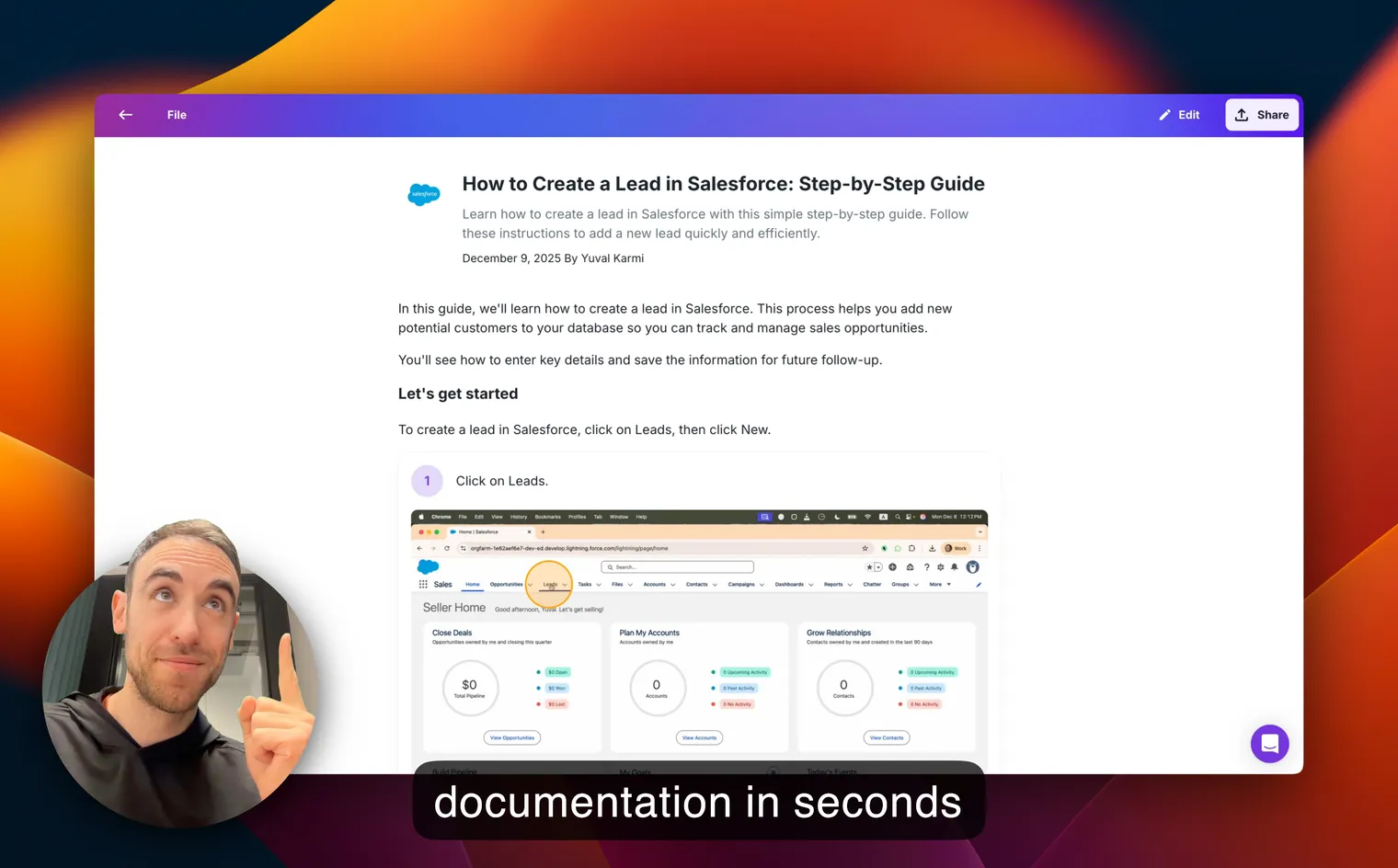
Teach your co-workers or customers how to get stuff done – in seconds.

The Real Cost of NOT Having a Knowledge Base
Let me share some numbers that might get your attention.
According to research by Panopto, the average U.S. enterprise loses $47 million per year due to inefficient knowledge sharing. That breaks down to $42.5 million in lost productivity and $4.5 million in inefficient onboarding.
Think about that for a second. $47 million. Annually. Just from people not being able to find the information they need.
For Fortune 500 companies specifically, poor knowledge management costs $31.5 billion annually. Not millions. Billions.
And it’s not just the big guys. At my first startup, before we had a proper knowledge base, I watched the same problems happen over and over:
- Support team answering the same questions dozens of times per day
- New employees taking months to get up to speed instead of weeks
- Critical processes breaking when key people went on vacation
- Teams reinventing solutions that someone else already figured out
- Hours wasted searching for information that should take seconds to find
The Panopto study found that U.S. knowledge workers waste 5.3 hours every week either waiting for vital information from colleagues or recreating existing knowledge, which is exactly the kind of loss you can quantify with knowledge sharing metrics.
That’s more than a full workday. Every single week. Just because information isn’t accessible.
But when you create a knowledge base that actually works? Everything changes. Questions get answered instantly. Onboarding becomes smooth. Teams move faster. Knowledge doesn’t disappear when someone leaves.
I saw this transformation firsthand when we finally built our knowledge base at Glitter AI. Our support tickets dropped by 40% in the first month alone.
Types of Knowledge Bases You Should Know About
Before you start building, it helps to understand the different types of knowledge bases and what they’re designed for.
External Knowledge Base (Customer-Facing)
This is what most people think of when they hear “knowledge base.” A public help center where customers can find answers to their questions.
What goes in it:
- Product documentation and user guides
- FAQs and common troubleshooting steps
- Setup instructions and getting started guides
- How-to articles and tutorials
- API documentation (for technical products)
Example: Think of Intercom’s Help Center or Notion’s support docs. Clean, searchable, designed for self-service support.
I built our external knowledge base first because I was drowning in support tickets asking the same questions repeatedly. Creating comprehensive guides for common issues immediately freed up hours every week.
Internal Knowledge Base (Employee-Facing)
This is for your team. A centralized place where employees can find company processes, policies, and institutional knowledge. Sometimes called a team knowledge base or corporate knowledge base, it’s essential for keeping everyone aligned.
What goes in it:
- Standard operating procedures and documented workflows
- Company policies and guidelines
- Training materials and onboarding resources
- Project documentation and meeting notes
- Sales collateral and pitch decks
At Glitter AI, our internal knowledge base is our single source of truth, structured with a bit of knowledge mapping so people can see how processes connect. When someone asks “How do we handle X?” the answer is always “Check the knowledge base.”
Specialized Knowledge Bases
Depending on your organization, you might also need:
IT Knowledge Base:
- System configurations and technical documentation
- Troubleshooting workflows and ticket resolutions
- Software licenses and access credentials
- Security protocols and compliance procedures
HR Knowledge Base:
- Benefits information and leave policies
- Onboarding checklists and employee handbooks
- Performance review processes
- Organizational charts and team structures
Product Knowledge Base:
- Feature specifications and roadmap information
- Release notes and changelog
- Technical architecture docs
- Integration guides
Most companies need a mix of these. Start with whichever type will have the biggest impact on your team’s productivity.
Build process documentation that's actually easy to find and use
How to Create a Knowledge Base: Step-by-Step Guide
Alright, enough theory. Here’s exactly how to build a knowledge base that people will actually use.
Step 1: Define Your Purpose and Audience
Before you write a single article or pick a tool, get crystal clear on why you’re building this knowledge base and who it’s for.
I made the mistake of skipping this step initially. I just started dumping information into Notion without thinking about the end users. Six months later, our “knowledge base” was a disorganized mess that nobody used.
Ask yourself:
What’s the primary goal?
- Reduce support tickets?
- Speed up employee onboarding?
- Preserve institutional knowledge?
- Enable self-service for customers?
- Document internal processes?
Who will use it?
- Customers looking for product help?
- New employees during onboarding?
- Support teams answering questions?
- Sales teams learning about products?
- Entire company for general reference?
What problems will it solve?
- Repeated questions taking up team time?
- Knowledge loss when employees leave?
- Inconsistent answers to the same questions?
- Long ramp-up time for new hires?
Get specific. “Help people find stuff” is not a clear purpose. “Reduce customer support tickets by 50% by enabling self-service for the top 20 most common questions” is.
Step 2: Audit Your Existing Content
Trust me, you already have way more knowledge than you think. It’s just scattered everywhere.
Here’s what I did when we started building our knowledge base:
Inventory everything:
- Google Docs, Notion pages, Confluence wikis
- Slack messages and email threads with important info
- Training materials and onboarding docs
- Support ticket solutions and troubleshooting guides
- Meeting notes and project documentation
- Screen recordings and tutorial videos
Identify what’s valuable: Not everything deserves a place in your knowledge base. Focus on information that:
- Gets referenced repeatedly
- Is critical for doing jobs correctly
- Would cause problems if it disappeared
- Takes significant time to find currently
Note what’s missing: Where are the gaps? What critical knowledge exists only in people’s heads? These are your highest-priority articles to create.
When I did this audit at Glitter AI, I discovered we had 127 Google Docs with process information scattered across different folders. Some were duplicates. Some contradicted each other. Many were outdated.
The audit was painful but necessary. It showed me exactly what we had and what we needed to create.
Step 3: Choose Your Knowledge Base Software
This is where people usually get stuck. There are so many knowledge base tools out there.
Here’s my honest take: the best knowledge base software is the one your team will actually use. Don’t get paralyzed by feature comparisons. If you’re looking for simple knowledge base software that just works, focus on ease of use and search quality over fancy features.
For external/customer knowledge bases:
Zendesk Guide - Solid platform that integrates with Zendesk Support. Great for reducing ticket volume. Can feel heavy for smaller teams.
Intercom - Beautiful, modern help centers. Excellent search functionality. Solid choice if you’re already using Intercom for support.
HelpScout - Simple, clean knowledge base builder. Easy to set up, reasonable pricing. Good for small to mid-size companies.
Document360 - Stand-alone knowledge base software with strong analytics. Good if you want something separate from your support stack.
For internal knowledge base tools:
Notion - My personal favorite for internal docs. Flexible, collaborative, great search. Can get messy if you don’t maintain structure.
Confluence - Industry standard for technical documentation. Powerful but has a learning curve. Best for larger engineering teams.
Guru - AI-powered knowledge base that surfaces answers in your workflow. Integrates with Slack, Chrome, etc. Great for distributed teams.
Slab - Clean, simple knowledge base focused on speed and search. Less feature-heavy than Confluence, easier to use.
For process documentation specifically:
Glitter AI - I built it to solve this exact problem. Screen record yourself doing a task while explaining it, and AI generates step-by-step guides. Best for documenting actual workflows.
Scribe’s click capture - Automatically captures clicks and creates written guides. Good for simple, repetitive processes.
Loom video clips - Quick video recordings. Great for one-off explanations but harder to keep organized at scale.
I’ve tried most of these. At Glitter AI, we use Notion for our internal knowledge base and Glitter AI for documenting our processes. For our customer-facing help center, we built a custom solution, but if I were starting today I’d probably use Intercom or HelpScout.
The most important factors:
- Ease of use - If it’s hard to add content, nobody will
- Search quality - If people can’t find answers, the knowledge base is useless
- Accessibility - Can everyone who needs access get to it easily?
- Maintenance - How easy is it to update outdated information?
Pick something simple and get started. You can always migrate later if needed.
Step 4: Create an Information Architecture
This is fancy consulting speak for “organize your stuff logically.”
Before you start writing articles, map out the information architecture of how your knowledge base will be structured. Good organization is the difference between a knowledge base people use and one they abandon in frustration.
Start with top-level categories:
For a customer knowledge base, you might organize by:
- Getting Started
- Account & Billing
- Features & How-Tos
- Troubleshooting
- Integrations
- API Documentation
For an internal knowledge base, you might organize by:
- Department (Sales, Engineering, Customer Success, etc.)
- Function (Onboarding, Processes, Tools, Policies)
- Lifecycle (Pre-sale, Implementation, Support, Renewal)
Create logical subcategories:
Under each top-level category, break things down further. For example, under “Features & How-Tos” you might have:
- Core Features
- Advanced Features
- Mobile App
- Desktop App
Keep hierarchy shallow:
Try to keep your structure to 2-3 levels deep maximum. If someone has to click through 5 levels to find an answer, your organization is too complex.
Use clear, descriptive labels:
“Getting Started” is better than “Introduction” “Billing & Payments” is better than “Money Stuff” “Common Questions” is better than “FAQ”
I recommend sketching this out on paper or in a simple outline before you start building. It’s way easier to reorganize a text outline than to restructure a knowledge base with 100 articles already in it.
Teach your co-workers or customers how to get stuff done – in seconds.
Step 5: Develop a Style Guide
Consistency matters more than you think.
When your knowledge base has articles written by 15 different people using different terminology, formatting, and tone, it feels disjointed and unprofessional. Readers lose trust.
Create a simple style guide that covers:
Voice and tone:
- Formal or conversational?
- First person (“we”) or second person (“you”)?
- How technical should language be?
Formatting standards:
- How to format headings (Title Case or Sentence case?)
- When to use bold, italics, code formatting
- How to structure step-by-step instructions
- When to include screenshots vs. text-only
Terminology: Different teams often use different words for the same things. Standardize this:
- Is it a “workspace” or a “project”?
- “User” or “member” or “customer”?
- “Dashboard” or “home screen”?
Visual elements:
- Screenshot formatting (full screen vs. cropped)
- How to annotate images (arrows, highlights, etc.)
- When to use GIFs or videos
- Image alt text standards
At Glitter AI, our style guide is literally a single Notion page. It’s not elaborate. But it ensures that whether I write an article or someone else does, it feels consistent.
Don’t overcomplicate this. A simple one-page guide beats no guide at all.
Step 6: Create Your Core Content
Now comes the actual writing part.
Start with your highest-impact content. The articles that will provide the most value to the most people.
For customer knowledge bases, prioritize:
- The top 20 most common support questions
- Getting started / first-time setup guides
- Common error messages and how to fix them
- Account management (billing, passwords, settings)
- Feature documentation for most-used features
For internal knowledge bases, prioritize:
- Critical processes that are done frequently
- Onboarding documentation for new hires
- Processes that only one person knows (knowledge loss risk!)
- Compliance and security procedures
- Company policies people reference regularly
Writing tips that actually matter:
Use action-based titles:
- “How to reset your password” (good)
- “Password information” (bad)
Start with the answer: Don’t bury the solution in paragraph five. Lead with the solution, then provide context.
Keep it simple: Write at an 8th-grade reading level. Short sentences. Short paragraphs. Clear language.
Use visuals liberally: Screenshots, GIFs, and videos make instructions way easier to follow. A five-second screen recording beats three paragraphs of text every time.
Break up walls of text: Use headings, bullet points, numbered lists, and white space. Nobody reads dense paragraphs.
Include examples: Show, don’t just tell. Include real examples, sample data, before/after screenshots.
I like to use the “mom test.” If I sent this article to my mom (who is not technical), could she follow it? If not, simplify.
Step 7: Add Search and Navigation Features
The best content in the world is useless if people can’t find it.
Implement solid search:
Most knowledge base platforms come with built-in search, but you can optimize it:
- Use descriptive titles that match what people actually search for
- Include synonyms and alternative terms in article body
- Tag articles with relevant keywords
- Create redirects for common misspellings
Create multiple navigation paths:
People find information differently:
- Some browse by category
- Some use search
- Some look at “popular articles”
- Some scan recent updates
Support all of these. At Glitter AI, our knowledge base has:
- Category browsing on the homepage
- Search bar (obviously)
- “Most Popular” articles section
- “Recently Updated” feed
- Related articles at the bottom of each page
Use intelligent linking:
Link liberally between related articles. When you mention a concept that has its own article, link to it. This helps with both SEO and user experience.
Implement analytics:
You need to know what people are searching for and whether they’re finding it. Track:
- Most common searches
- Searches with no results (content gaps!)
- Most viewed articles
- Articles with high bounce rates (confusing content?)
- Time spent on articles
I check our knowledge base analytics monthly. It’s amazing how much you learn about what users actually need vs. what you thought they needed.
Step 8: Enable User Feedback and Ratings
Your knowledge base needs a feedback loop.
Add “Was this helpful?” widgets:
At the bottom of every article, include a simple thumbs up/down or “Yes/No” question: “Did this answer your question?”
This tells you which articles are working and which aren’t.
Allow comments or questions:
Some knowledge base platforms let users leave comments or ask follow-up questions. This is gold. You learn exactly where your documentation is confusing or incomplete.
Create easy update pathways:
When someone spots outdated or incorrect information, they should be able to report it instantly. Don’t make them fill out a 10-field form.
At Glitter AI, we have a simple “Report an issue” button on every article. It pops up a quick form that goes straight to whoever owns that documentation area.
Act on feedback quickly:
If an article has a 20% helpful rating, fix it immediately. If three people ask the same question in comments, add that information to the article.
Feedback is only valuable if you actually use it to improve.
Turn screen recordings into searchable knowledge base articles automatically
Step 9: Implement a Maintenance Schedule
Here’s the harsh truth: most knowledge bases die from neglect.
You launch with enthusiasm, everything is up-to-date and beautiful, and six months later it’s a wasteland of broken links and outdated screenshots. Nobody trusts it anymore, so nobody uses it.
Assign ownership:
Every article should have an owner. Someone responsible for keeping it accurate. This doesn’t mean they write everything, but they’re the point person for updates.
At Glitter AI:
- Product team owns feature documentation
- Customer Success owns support articles
- Operations owns internal process docs
- HR owns policy documentation
Set review cycles:
Different content needs different review frequencies:
- Critical processes: Review quarterly
- Product documentation: Review with each release
- Policies and procedures: Review annually
- Troubleshooting guides: Review when relevant issues spike
Make updates easy:
If updating an article requires submitting a ticket and waiting for approval from three people, it won’t happen. Empower article owners to make updates directly.
Track staleness:
Many knowledge base platforms can flag articles that haven’t been updated in X months. Use this feature. If something hasn’t been touched in a year, either update it or archive it.
Communicate updates:
When you make significant updates to important articles, let people know. We have a “Knowledge Base Updates” Slack channel where we post major changes.
I block 30 minutes every Friday afternoon for knowledge base maintenance. It’s not glamorous, but it keeps our documentation trustworthy.
Knowledge Base Best Practices I Learned the Hard Way
Let me save you from some mistakes I made:
Start Small and Expand
Don’t try to document everything at once. Start with your top 10-20 most critical articles and do them really well. Then expand gradually.
I tried to build a comprehensive knowledge base in my first two weeks. I burned out, the quality was inconsistent, and it took months to clean up the mess.
Optimize for Scanning, Not Reading
People don’t read knowledge base articles. They scan for the specific piece of information they need.
Use:
- Clear headings that tell them what’s in each section
- Bullet points and numbered lists
- Bold text for key information
- Screenshots that show the answer visually
- “Jump to section” links for long articles
Write for Your Actual Audience
I wasted weeks writing detailed technical documentation for features our customers never used, while leaving our top support issues undocumented.
Check your support tickets, user analytics, and sales calls. What are people actually asking about? Document that first.
Video > Text for Complex Processes
Some things are just easier to show than explain.
When I’m documenting how to set up a complex integration, a 2-minute screen recording with voice-over works so much better than 15 paragraphs of text.
This is why I built Glitter AI the way I did. You just do the task while explaining it, and the AI turns it into documentation. No need to choose between video or text; you get both.
Make Content Shareable
Your knowledge base articles should have:
- Direct URLs that are clean and descriptive
- Social sharing buttons
- Easy copy/paste formatting
- PDF export option (some people prefer printing)
Our support team constantly shares knowledge base articles with customers. Making this easy saves everyone time.
Don’t Forget Mobile
More people than you’d think access knowledge bases on mobile devices.
Make sure your articles are:
- Readable on small screens
- Images zoom when tapped
- Navigation works on mobile
- Search works smoothly on mobile
I didn’t prioritize this initially and got frustrated feedback from field employees who couldn’t access our internal knowledge base from their phones.
Celebrate Contributors
If you want people to contribute to your knowledge base, recognize them for it.
At Glitter AI, we:
- Shout out people who create great documentation in team meetings
- Track contribution metrics in performance reviews
- Have a monthly “Best New Article” award (it’s just recognition, but people love it)
Make creating knowledge valuable to people’s careers, and they’ll do it.
Popular Knowledge Base Tools Compared
Since choosing the right tool matters a lot, here’s a more detailed comparison based on my experience:
Notion (What I Use Internally)
Pros:
- Incredibly flexible, you can organize however you want
- Beautiful, modern interface
- Great collaboration features
- Reasonable pricing
- Works well for both wikis and databases
Cons:
- Can get messy if you don’t maintain structure
- Search isn’t as powerful as dedicated knowledge base tools
- Can feel overwhelming with so many features
- Not ideal for external/customer-facing knowledge bases
Best for: Internal knowledge bases, team wikis, startup documentation
Confluence
Pros:
- Industry standard for technical documentation
- Powerful organization and permissions
- Excellent version control
- Strong integration with Jira and other Atlassian tools
Cons:
- Steep learning curve
- Can feel clunky and dated
- Expensive for larger teams
- Overkill for simple use cases
Best for: Large engineering teams, enterprise companies, technical documentation
Zendesk Guide
Pros:
- Purpose-built for customer support
- Excellent integration with Zendesk Support
- Strong analytics and reporting
- Good SEO features
Cons:
- Expensive
- Locked into Zendesk ecosystem
- Setup can be complex
- Overkill if you don’t need full support suite
Best for: Companies already using Zendesk, customer-facing help centers
Guru
Pros:
- AI-powered suggestions surface knowledge in your workflow
- Integrates with Slack, Chrome, etc.
- Verification system keeps content trustworthy
- Great for distributed teams
Cons:
- Pricing can get expensive
- Less suitable for external/customer knowledge bases
- Learning curve for advanced features
Best for: Internal knowledge sharing, remote teams, sales enablement
Document360
Pros:
- Stand-alone solution (not tied to support platform)
- Clean, professional appearance
- Good analytics
- Can create internal and external knowledge bases
Cons:
- Less known than competitors
- Smaller ecosystem and integrations
- Some features feel basic
Best for: Companies wanting dedicated knowledge base software without full support platform
The honest truth? I’ve seen successful knowledge bases built on all of these platforms. The tool matters less than the commitment to maintaining it.
How to Measure Knowledge Base Success
You can’t improve what you don’t measure.
Here are the metrics I track for our knowledge base:
Usage Metrics
Total searches: Are people using the search function? Increasing searches typically means more usage (good!), but might also indicate navigation is confusing.
Article views: Which articles get the most traffic? These are your highest-value content.
Time on page: Are people spending enough time to read the article, or bouncing immediately?
Search success rate: What percentage of searches return useful results? Low success rate means content gaps.
Content Quality Metrics
Helpfulness ratings: What percentage of users mark articles as “helpful”? Target: 80%+ for critical articles.
Comments and questions: Are users asking clarifying questions? This reveals gaps in your content.
Bounce rate: Are people leaving immediately after landing on an article? Might indicate content doesn’t match their search.
Business Impact Metrics
Support ticket deflection: Are support tickets decreasing as knowledge base usage increases?
Time to resolution: Are issues getting resolved faster because people can self-serve?
Onboarding time: For internal knowledge bases, is new hire productivity improving?
Customer satisfaction: For external knowledge bases, does CSAT correlate with knowledge base usage?
I review these metrics monthly and make adjustments based on what I learn. If an article has low helpfulness ratings, I rewrite it. If searches for a topic return no results, I create that content.
Data-driven knowledge base management beats guessing every time.
Teach your co-workers or customers how to get stuff done – in seconds.
Common Knowledge Base Mistakes to Avoid
Let me save you from painful mistakes:
Mistake 1: Building It and Assuming People Will Use It
Just because you built a knowledge base doesn’t mean people will magically start using it.
You need to:
- Train people on how to use it
- Make it the first place they go for answers
- Reward people who contribute to it
- Remind people it exists (regularly!)
Mistake 2: Prioritizing Quantity Over Quality
100 mediocre articles are worse than 20 excellent ones.
Focus on creating comprehensive, accurate, well-formatted content for your highest-impact topics. Then expand gradually.
Mistake 3: Using Jargon and Technical Language
Unless your audience is exclusively technical experts, write in plain language.
Explain acronyms. Define technical terms. Use simple words. Your knowledge base should be accessible to everyone who needs it.
Mistake 4: Ignoring Visual Content
Walls of text don’t get read.
Add screenshots, GIFs, diagrams, videos. Whatever helps people understand faster. Visual content is especially critical for “how-to” articles.
Mistake 5: No Clear Ownership
When everyone is responsible for the knowledge base, nobody is.
Assign clear owners for each content area. Make knowledge base maintenance part of someone’s actual job, not just “if you have time.”
Mistake 6: Letting It Get Stale
Outdated information is worse than no information. It destroys trust.
Implement regular review cycles. Flag stale content. Make updates easy. This is not optional if you want people to actually use your knowledge base.
Mistake 7: Forgetting Mobile Users
Test your knowledge base on mobile devices. If it’s painful to use on a phone, you’ll lose a significant portion of potential users.
I learned this when our field technicians told me they couldn’t access our process docs from job sites. Mobile optimization became a priority immediately after that.
Real-World Knowledge Base Examples That Work
Let me show you some knowledge bases I actually reference and what makes them effective:
Stripe’s Documentation
Stripe’s API documentation is legendary for a reason:
- Code examples in multiple languages
- Clear, concise explanations
- Excellent search
- Interactive API explorer
- Beautiful design that doesn’t sacrifice usability
What they do well: They optimize for developers who are in a hurry. Everything is scannable, searchable, and actionable.
Notion’s Help Center
Notion’s help center is clean and well-organized:
- Clear categorization
- Lots of GIFs showing features in action
- Embedded videos for complex topics
- Simple language despite complex product
What they do well: They use visuals liberally. Almost every article has screenshots or GIFs showing exactly what to do.
Intercom’s Help Center
Intercom practices what they preach:
- Fast, powerful search
- Suggested articles based on context
- Clean, minimal design
- Great mobile experience
What they do well: The search is incredibly fast and almost always returns relevant results. That’s the whole ballgame for knowledge bases.
Glitter AI’s Internal Wiki
Our internal knowledge base (okay, I’m biased):
- Organized by department and function
- Every critical process has a video walkthrough
- Clear ownership for each section
- Updated weekly
- Searchable with tags
What we do well: We use Glitter AI’s own product for process documentation, so every workflow has a video guide with AI-generated step-by-step instructions. New hires can literally watch someone do the process while reading the steps.
The Future of Knowledge Bases
Here’s where I think knowledge bases are heading:
AI-Powered Search and Answers
Instead of searching and reading articles, you’ll ask questions in natural language: “How do I change my billing information?” and get instant, conversational answers pulled from your knowledge base.
ChatGPT and Claude are already doing this. The next generation of knowledge base tools will have this baked in.
Automatic Content Generation
Tools that automatically generate documentation as people work, capturing processes in real-time rather than requiring manual documentation.
This is exactly what I built Glitter AI to do. You just do your job while explaining what you’re doing, and documentation gets created automatically.
Video-First Documentation
Text isn’t going away, but video is becoming the primary format for showing people how to do things. It’s faster to create and easier to understand.
Expect knowledge bases to prioritize video content with AI-generated transcripts and searchable captions.
Contextual Knowledge Delivery
Instead of searching a knowledge base, the information will come to you based on what you’re doing. Working in Salesforce? Relevant knowledge base articles pop up automatically.
Tools like Guru are already doing this. It’ll become standard.
Continuous Learning Systems
Knowledge bases that learn from user behavior and automatically improve. If users always search for X after reading article Y, the system learns to suggest X proactively.
The best part? Most of this technology exists today. Adopting it early gives you a significant competitive advantage.
Frequently Asked Questions
What is a knowledge base?
A knowledge base is a centralized repository of information designed to help people find answers to questions without needing to ask someone else. It's a structured collection of articles, guides, and documentation that serves as a single source of truth for company, product, or process information.
How long does it take to create a knowledge base?
Creating a basic knowledge base with 10-20 core articles can be done in a few days, but building a comprehensive knowledge base is an ongoing process that can take months. The key is to start small with high-impact content and expand gradually rather than trying to document everything at once.
What should I include in a knowledge base?
Include your most frequently asked questions, getting started guides, common troubleshooting steps, process documentation, and any information that people regularly need to reference. For internal knowledge bases, add company policies, onboarding materials, and standard operating procedures.
What's the difference between a knowledge base and a wiki?
A knowledge base is typically more structured and purpose-built for specific use cases (customer support, employee onboarding), while a wiki is a more flexible, collaborative documentation system. Knowledge bases often have better search, analytics, and user feedback features, whereas wikis prioritize collaborative editing and flexibility.
How do you organize a knowledge base?
Organize your knowledge base by creating clear top-level categories relevant to your audience (like Getting Started, Features, Troubleshooting), then breaking these into logical subcategories. Keep the hierarchy shallow (2-3 levels maximum), use descriptive labels, and implement strong search functionality. Test your organization with actual users to ensure it makes sense.
What are the best knowledge base tools?
The best knowledge base tools include Notion and Confluence for internal documentation, Zendesk Guide and Intercom for customer-facing help centers, and specialized tools like Glitter AI for process documentation. The best choice depends on your specific needs, team size, budget, and whether you need internal or external knowledge sharing.
How do you maintain a knowledge base?
Maintain your knowledge base by assigning clear ownership for each content area, implementing regular review cycles (quarterly for critical content), making updates easy to submit, tracking content staleness, and acting quickly on user feedback. Schedule dedicated time for maintenance and make it someone's actual responsibility, not just "if you have time."
How do you measure knowledge base effectiveness?
Measure knowledge base effectiveness by tracking usage metrics (article views, searches, time on page), content quality metrics (helpfulness ratings, bounce rate), and business impact metrics (support ticket deflection, onboarding time, customer satisfaction). Focus on 2-3 metrics that align with your goals and review them regularly to guide improvements.
Start Building Your Knowledge Base Today
Look, I’m not going to pretend that building a knowledge base is quick or easy.
It’s not.
It takes time, effort, and ongoing commitment. You’ll make mistakes. Your first version won’t be perfect. People might not use it immediately.
But here’s what I know for sure: the cost of not having a knowledge base is way higher than the effort of creating one.
Every time someone wastes an hour searching for information, every time a new hire struggles for weeks because nothing is documented, every time knowledge walks out the door when an employee leaves. That’s the real cost.
Start small. Pick your top 10 most critical pieces of information and document them well. Get feedback. Improve. Expand gradually.
Make it easy. Use tools that reduce friction. If creating content is painful, people won’t do it.
Maintain it. A stale knowledge base is worse than no knowledge base. Build in review cycles from day one.
Measure results. Track what people search for, what they view, what they find helpful. Let data guide your improvements.
And remember: the best time to start documenting your team’s knowledge was five years ago. The second best time is right now.
If you’re serious about creating a knowledge base for internal process docs specifically, I built Glitter AI to make this effortless. Screen record yourself doing a task while talking through it, and AI generates comprehensive documentation automatically. No more choosing between creating documentation and actually getting work done.
But whether you use Glitter AI, Notion, Confluence, or a simple Google Doc, just start documenting. Your future self (and your team) will thank you.
Yuval / Founder & CEO, Glitter AI