

Read summarized version with
I almost lost a major client because our best sales engineer kept everything in his head.
He was brilliant. Knew our product inside out. Could demo features I didn’t even know existed. But when he went on vacation for two weeks, the information silos he’d quietly created left the rest of the sales team basically helpless. Deals stalled. Demos got rescheduled. Prospects got frustrated.
That’s when I realized we didn’t just have a documentation problem. We had a culture problem.
I’m Yuval, founder and CEO of Glitter AI. After running two startups, I’ve learned that building a knowledge sharing culture isn’t about implementing better tools or writing more documentation. It’s about creating an environment where people actually want to share what they know.
Here’s what actually works when you’re trying to build a culture of knowledge sharing.
What Is a Knowledge Sharing Culture (And Why Most Companies Don’t Have One)
A knowledge sharing culture is an organizational environment where sharing expertise, insights, and information is not just encouraged but expected and rewarded. It’s where people default to documenting and teaching rather than hoarding knowledge.
Sounds simple, right?
But here’s the reality: most companies say they want knowledge sharing, but their actual culture punishes it.
When knowledge is power, people hoard it to stay valuable. When mistakes get punished, nobody shares what went wrong. When documentation takes hours and there’s no recognition for doing it, why would anyone bother?
Real knowledge sharing culture means:
- People actively knowledge share without being asked
- Asking questions is seen as smart, not stupid
- Documenting processes is valued as much as doing the work itself
- Knowledge contributors are recognized and rewarded
- Information flows freely across teams and departments through exchanging knowledge openly
The difference between companies with and without this culture is significant. I’ve seen it firsthand.
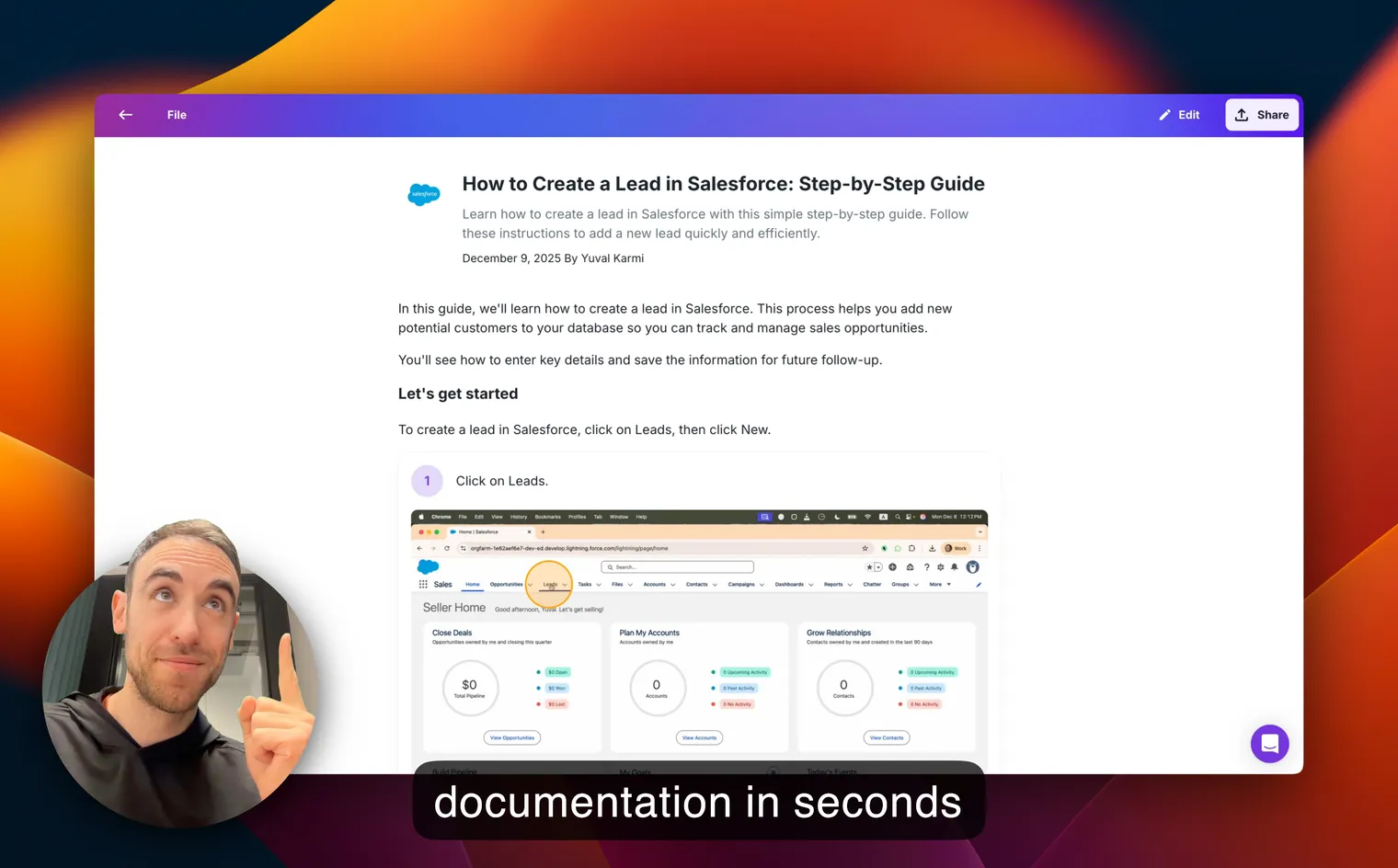
Teach your co-workers or customers how to get stuff done – in seconds.

Why Building a Knowledge Sharing Culture Actually Matters
Let me share some numbers that should get leadership’s attention.
84% of employees say psychological safety is among the most important work factors. Not salary. Not benefits. The ability to feel safe sharing, asking questions, and admitting mistakes.
Companies that follow knowledge sharing best practices see:
- 25% faster project completion times
- 40% reduction in time spent searching for information
- 3x faster onboarding for new employees
- Significantly lower turnover rates
Fortune 500 companies lose $31.5 billion annually due to poor knowledge sharing. That’s not a typo. Billion with a B.
But the real cost isn’t just money. It’s the institutional knowledge that walks out the door when someone quits. The repeated mistakes because nobody documented what didn’t work. The bottlenecks when only one person knows how to do something critical. This is why knowledge sharing business impacts go far beyond productivity.
At my first startup, I watched our best customer success manager quit with two weeks notice. She had years of knowledge about client relationships, onboarding processes, and troubleshooting quirks in our system. All of it lived exclusively in her head.
It took us six months to recover to the same level of customer satisfaction we had before she left.
Never again.
The Psychology Behind Knowledge Sharing (Why People Don’t Share)
Before we get into how to build a knowledge sharing culture, let’s talk about why people resist it.
Fear of Becoming Replaceable
This is the big one. People think: “If I share everything I know, what makes me valuable?”
I get it. It’s a real fear, especially in uncertain job markets or companies with poor job security.
But here’s what I’ve learned from watching this play out in practice: the people who share knowledge freely become more valuable, not less.
They become the go-to experts. They get pulled into important projects. They build stronger relationships across teams. They’re the first ones leadership thinks of for promotions because they multiply the team’s effectiveness.
At Glitter AI, the people I’ve promoted fastest are the ones who taught others, documented their work, and made themselves “replaceable” in their current role so they could take on bigger challenges.
Lack of Time
Your team is already overwhelmed. Adding “write documentation” to the to-do list feels like asking them to work weekends.
This is a real constraint. If knowledge sharing requires significant extra time, it won’t happen consistently.
The solution isn’t demanding more time. It’s making knowledge sharing effortless and integrated into existing workflows. More on this later.
No Recognition or Reward
If people spend time creating guides that help new hires get up to speed or teaching others, and nobody notices or cares, why would they keep doing it?
Knowledge sharing competes with visible, measurable work. If it’s not valued in performance reviews, celebrated publicly, or tied to advancement, it loses to more “important” tasks every time.
Fear of Looking Stupid
In cultures where mistakes are punished and perfection is expected, people won’t share partial knowledge, ask “dumb” questions, or admit they don’t know something.
This fear kills knowledge sharing faster than anything else.
Information Hoarding as Power
In some organizations, knowing things others don’t know is literally the source of someone’s power and influence.
If the culture rewards gatekeeping and punishes transparency, you’ll never build real knowledge sharing.
Create documentation automatically while doing the work
The Foundation: Psychological Safety
You can’t build a knowledge sharing culture without psychological safety. Full stop.
Psychological safety means people feel comfortable taking interpersonal risks: asking questions, admitting mistakes, sharing half-formed ideas, and challenging the status quo without fear of embarrassment or punishment.
Remember that 84% statistic? Employees rank psychological safety among the most critical work factors. It’s right up there with compensation and growth opportunities.
What Psychological Safety Looks Like
In teams with high psychological safety:
- Someone admits in a meeting “I don’t understand this, can you explain?”
- People share what they tried that didn’t work
- Junior employees challenge senior decisions respectfully
- Mistakes are treated as learning opportunities, not failures
- “I need help” is a normal sentence
In teams without it:
- People pretend to understand rather than ask questions
- Only successes get shared; failures stay hidden
- Disagreement is seen as insubordination
- People cover up mistakes instead of reporting them
- Asking for help is viewed as weakness
How to Build Psychological Safety
Model vulnerability from the top. If you’re a leader, you need to visibly make mistakes, admit when you don’t know something, and ask for help. I started my team meetings by sharing something I screwed up that week. It completely changed the dynamic.
Respond positively to questions. Never make someone feel stupid for asking. Even if it’s the third time they’ve asked. Even if it seems obvious. Thank them for asking because it probably helps others too.
Separate learning from performance consequences. Make it clear that trying something new and failing is different from consistently poor performance. Create spaces where experimentation is explicitly encouraged.
Call out fear-based behaviors. If you notice people avoiding sharing because they’re afraid, address it directly. “I notice we’re not getting many questions in these meetings. What would make it feel safer to ask?”
Celebrate productive failures. When someone tries something that doesn’t work but learns from it, celebrate that publicly. We have a “Good Fails” Slack channel at Glitter AI where people share valuable lessons from things that went wrong.
I can’t stress this enough: without psychological safety, all your other knowledge sharing initiatives will fail. People won’t share if they don’t feel safe doing so.
Leadership Must Model Knowledge Sharing Behaviors
Here’s a truth that makes some executives uncomfortable: you can’t delegate culture.
If leadership doesn’t visibly share knowledge, the organization won’t either. Period.
What Modeling Looks Like
When I decided to build a real knowledge sharing culture at Glitter AI, I started by changing my own behavior:
I documented my decision-making process. Instead of just announcing decisions, I shared the reasoning, the alternatives I considered, and why I chose what I did. Sometimes I recorded a quick Glitter AI walkthrough explaining my thinking - same record-and-share flow as Loom, but I get a written guide alongside the video from one recording.
I made my work visible. I shared what I was working on, what I was struggling with, and where I needed input. No mysterious CEO stuff happening behind closed doors.
I asked questions publicly. In team channels, I’d ask things like “How does our deployment process work again?” or “Can someone explain why we made this design choice?” Even if I knew the answer, I wanted to normalize asking.
I shared my mistakes. Every week in our all-hands, I shared something I did wrong and what I learned from it. This was uncomfortable at first. Now it’s my favorite part of the meeting.
I created documentation myself. I didn’t delegate all documentation to others. I created process guides for things I owned. I showed it was important enough for the CEO’s time.
Visible Participation and Advocacy
Leaders need to be visibly present in knowledge sharing activities:
Participate in knowledge sharing sessions. If you’re hosting lunch-and-learns or “How I Do It” sessions, leaders should sometimes be the ones presenting. Show that everyone has knowledge worth sharing.
Reference and use the documentation. When someone asks you a question that’s documented, send them the link publicly. Model using the knowledge base.
Celebrate knowledge contributors publicly. In meetings, company channels, performance reviews. Make knowledge sharing visible and valued.
Allocate resources. If knowledge sharing matters, budget time and money for it. Tools, training, dedicated time. Put your money where your mouth is.
At my first startup, I talked about wanting better documentation but never made time for it and didn’t celebrate when people did it. Shockingly, documentation didn’t improve.
At Glitter AI, I block time every week for documentation, publicly praise great documentation in team meetings, and include knowledge sharing contributions in everyone’s performance reviews.
Guess which approach actually worked?
Create Systems That Encourage Knowledge Sharing
Culture isn’t just vibes and values. It’s the systems and structures that reinforce behaviors.
Integrate Knowledge Sharing Into Performance Evaluations
If knowledge sharing isn’t in your performance review criteria, it’s not really valued.
Add specific questions to evaluations:
- What knowledge did this person share that helped the team?
- What documentation did they create or improve?
- How did they help onboard or train others?
- What teaching or mentoring did they provide?
Make it worth at least 15-20% of the total evaluation. Not a token mention. A real component.
At Glitter AI, “Knowledge Sharing & Documentation” is one of five core areas we evaluate. You literally cannot get a top rating without contributing to team knowledge.
Recognize and Reward Contributors
Recognition doesn’t have to be expensive, but it has to be public and genuine.
Public shout-outs. In team meetings, Slack, company newsletters. Celebrate people who create great documentation, teach others, or share valuable knowledge.
Knowledge Sharing Awards. We have a monthly “Knowledge Champion” award. It comes with a small bonus, but honestly, people care more about the recognition.
Link it to advancement. When promoting people, explicitly mention their knowledge sharing contributions. Make it clear that this behavior leads to career growth.
Create friendly competition. Some teams gamify documentation contributions. Leaderboards work if your culture supports it. We track who creates the most-used guides each month.
Provide tools and resources. If someone’s spending time on knowledge sharing, give them the best tools to do it well. Don’t make them struggle with inadequate technology.
The message needs to be crystal clear: hoarding knowledge won’t advance your career here. Sharing it will.
Make Knowledge Sharing Part of Regular Workflows
The biggest mistake I see is treating knowledge sharing as a separate activity. “Okay team, let’s take an hour Friday to write documentation!”
That doesn’t work. Knowledge sharing needs to be integrated into how you already work.
Document while onboarding. When training someone new, record the session and turn it into training materials. You’re doing the work anyway, so capture it.
Update docs when processes change. Make documentation updates part of the change management process. If you roll out a new feature or change a workflow, updating the documentation is part of “done.”
Capture decisions in the moment. Use tools that let you quickly capture meeting decisions, key points, and action items in searchable places. Don’t rely on someone to “write it up later.”
Create templates and systems. Make it ridiculously easy to contribute knowledge. Templates for common doc types. Simple workflows for submitting and reviewing. Remove friction.
At Glitter AI, when I train someone on a process, I simultaneously create the documentation, an approach that stands apart when you look at how guidance platforms compare. I screen record while I talk through the steps. That recording becomes the guide for the next person. It’s not extra work. It’s just working smarter.
Record once, document automatically with Glitter AI
Establish Regular Knowledge Sharing Rituals
Consistent rituals reinforce culture more effectively than one-off initiatives.
Weekly Knowledge Sessions (30-60 minutes)
Every Friday at 4pm, we do “What I Learned This Week” sessions. Someone volunteers to spend 15-30 minutes sharing something useful they discovered.
It could be:
- A new feature in a tool we use
- A better way to handle a common process
- A mistake they made and how they fixed it
- An interesting insight from a customer conversation
- A clever solution to a tricky problem
The key: it’s low-pressure and informal. No formal presentation. No slides required. Just share your screen and talk.
Over a year, that’s 50+ knowledge sharing sessions. The cumulative impact is massive.
Monthly Retrospectives
Once a month, teams reflect on:
- What knowledge did we create this month?
- What knowledge gaps did we discover?
- Where did we struggle because information wasn’t shared?
- What documentation needs updating?
- Who made exceptional knowledge contributions?
This keeps knowledge sharing top of mind and creates accountability.
Lunch-and-Learns with Subject Matter Experts
Invite team members (or external guests) to present on topics they know well during lunch. Buy lunch for attendees.
These work especially well when they’re practical and immediately applicable. “How I Use Our CRM” beats “The Future of Sales Technology” for internal knowledge sharing.
Regular Documentation Sprints
Some teams do quarterly “Doc Sprints” where everyone dedicates a few hours to updating, improving, or creating documentation.
Turn it into a friendly competition. Who can close the most outdated docs? Who creates the most useful new guide? Celebrate the winners.
Communities of Practice
Create cross-functional groups focused on specific domains: customer success practices, engineering best practices, data analysis techniques, etc.
These communities meet monthly to share challenges, solutions, and knowledge. At Spotify, they call these “Guilds.” Whatever you call them, they prevent knowledge silos.
Create Processes for Safeguarding Mission-Critical Information
Some knowledge is too important to risk losing. You need explicit processes for capturing and protecting it.
Identify Critical Knowledge
Start by asking: What knowledge, if lost, would seriously damage the company?
Common examples:
- Complex customer relationships and history
- Specialized technical skills or domain expertise
- Key vendor relationships and negotiated terms
- Crisis management and incident response procedures
- Product roadmap rationale and strategic decisions
Make a list. Be thorough. These are your priorities.
Create Knowledge Continuity Plans
For each critical knowledge area, document:
- Who has this knowledge currently? (Primary and backup)
- Where is it documented? (Or where should it be?)
- How frequently does it need updating?
- What happens if this person leaves? (Succession plan)
This sounds corporate and boring, but I learned this the hard way. When my Customer Success Manager quit at my first startup, we had none of this. We scrambled for months.
Now, every critical role at Glitter AI has a knowledge continuity plan. If someone wins the lottery tomorrow, we’ll be okay.
Implement Knowledge Transfer Processes
Exit interviews focused on knowledge. When someone leaves, don’t just ask them about their experience. Actively capture their knowledge. Record sessions where they walk through their key processes.
Shadowing and overlap. When someone’s leaving or transitioning roles, build in overlap time where they can transfer knowledge to their replacement. Don’t rush this.
Documentation requirements. Make it clear that documenting key processes is part of every role, not optional. Build it into job descriptions and onboarding.
Regular knowledge audits. Quarterly, review your critical knowledge list. Is it still documented? Is it current? Are backup people trained?
Use The Right Tools for Knowledge Preservation
You need centralized, searchable, version-controlled knowledge repositories. A dedicated knowledge sharing platform makes this much easier than trying to piece together disconnected tools.
For process knowledge, I use tools that capture knowledge as you work. At Glitter AI, I built our platform specifically for this, and a head-to-head of guide creation tools shows why the record-as-you-work approach wins. You just do your work while recording, and it generates documentation automatically.
For strategic knowledge, wikis or knowledge bases work well. Notion, Confluence, whatever. Just pick one and commit to it.
For relationship knowledge, CRM systems can capture client history and context.
The key is making sure critical knowledge doesn’t live exclusively in email, Slack, or people’s heads.
Teach your co-workers or customers how to get stuff done – in seconds.
Overcome Common Barriers to Knowledge Sharing Culture
Even with the best intentions, you’ll hit obstacles. Here’s what I’ve encountered and how to handle them.
“We’re Too Busy”
This is the most common objection. And it’s often true. Teams are legitimately overwhelmed.
Solutions:
- Make knowledge sharing part of existing work, not extra work
- Use tools that automate documentation creation (like recording while working)
- Start with just the most critical processes, not everything
- Show the time savings from good documentation to prove ROI
- Block dedicated time for knowledge work and protect it
I tell my team: “You can spend 10 minutes documenting this now, or spend 2 hours explaining it five more times over the next month.” That usually gets their attention.
“Our Knowledge Is Too Complex to Document”
Some people believe their work is too nuanced or complex to capture in documentation.
Sometimes there’s truth to this. Tacit knowledge is real. But often it’s an excuse.
Solutions:
- Start with the 80% that can be documented, even if 20% requires mentoring
- Use video documentation for complex processes that are hard to write about
- Create layered documentation: quick start guides for basics, detailed guides for complexity
- Document decision frameworks and principles, not just steps
- Accept that documentation supplements human teaching, not replaces it
The goal isn’t to eliminate all questions. It’s to answer the answerable ones so experts can focus on the truly complex teaching.
“Knowledge Sharing Isn’t Valued Here”
If leadership doesn’t genuinely value knowledge sharing, culture change is nearly impossible.
Solutions:
- Make the business case with hard numbers (time wasted, onboarding costs, turnover)
- Start small with your immediate team and prove the impact
- Find executive sponsors who get it
- Track and share metrics showing knowledge sharing’s impact
- Highlight competitors or successful companies with strong knowledge cultures
If you’re not in leadership and leadership won’t change, honestly? Start looking for a better company. Life’s too short for toxic cultures.
“People Don’t Use the Documentation We Create”
If nobody reads the docs, people stop writing them. Vicious cycle.
Solutions:
- Make documentation easy to find and search
- Organize by task, not feature or department
- Use visuals and video, not just text walls
- Keep documentation current (outdated docs are worse than no docs)
- When someone asks a question that’s documented, send the link and ask for feedback on the doc
- Track usage and improve low-performing documentation
Sometimes the issue is the documentation itself isn’t good, not that people don’t want to use it. Be honest about quality.
“Different Teams Have Different Cultures”
Engineering shares knowledge openly. Sales hoards it. Marketing is somewhere in between.
Solutions:
- Address cultural differences explicitly in leadership meetings
- Create cross-functional knowledge sharing initiatives
- Celebrate examples of knowledge sharing across team boundaries
- Ensure policies and expectations are consistent company-wide
- Give teams some autonomy in how they share, but not whether
Culture is both company-wide and team-specific. You need both.
Real Examples of Knowledge Sharing Culture in Action
Let me share some concrete examples from companies I know well.
Example 1: The “Teach to Learn” Onboarding Model
At Glitter AI, new hires spend their first month learning and documenting what they learn. Their assignment: create or update onboarding documentation for the next person in their role.
This forces them to:
- Learn deeply enough to teach others
- Identify gaps in existing documentation
- Contribute knowledge from day one
- Understand that knowledge sharing is core to the role
New hires consistently tell us this was the most valuable part of onboarding. They learn faster and feel more engaged because they’re creating value, not just consuming information.
Example 2: The “No Question Too Small” Channel
We have a Slack channel called #no-stupid-questions where anyone can ask anything without judgment.
It’s moderated to ensure:
- Every question gets answered helpfully
- Nobody ever gets mocked or dismissed
- Frequently asked questions get turned into documentation
- People thank each other for asking because others had the same question
This channel does more to build psychological safety than any policy ever could.
Example 3: Documentation Days
Every quarter, we have “Doc Day” where the entire company spends half the day on documentation.
People can:
- Create new guides for processes they own
- Update outdated documentation
- Improve formatting and clarity of existing docs
- Record video walkthroughs
- Reorganize knowledge base structure
We provide lunch, play music, make it fun. It’s become something people actually look forward to.
And our documentation quality has improved dramatically.
Example 4: Expert Rotation Program
Subject matter experts rotate who handles questions in their domain. Instead of one person being the bottleneck, knowledge gets distributed.
For example, we have three people who can handle complex customer implementation questions. They rotate weekly. This forces:
- Documentation of edge cases and solutions
- Knowledge sharing among the experts
- Reduced single points of failure
- More people developing deep expertise
Example 5: The “Why We Decided” Repository
We keep a searchable database of major decisions with context about:
- What we decided
- What alternatives we considered
- Why we chose what we did
- Who was involved
- What constraints or context mattered
When someone asks “Why do we do it this way?”, we can send them the link. It prevents revisiting settled decisions constantly and helps people understand the reasoning, not just the rules.
Measuring Your Knowledge Sharing Culture
You can’t improve what you don’t measure. Here’s what actually matters.
Quantitative Metrics
Time to productivity for new hires. How long until new employees can work independently? If knowledge sharing is working, this should decrease.
Track the time from hire date to:
- First independent task completed
- Fully productive in role
- First training of another employee
Documentation coverage. What percentage of critical processes are documented? Track this quarterly and aim for 100% of mission-critical processes.
Documentation usage. How often are people accessing the knowledge base? Which docs are most viewed? Low usage might mean content isn’t valuable or discoverable.
Knowledge contribution rate. What percentage of employees actively contribute knowledge monthly? You want broad participation, not just a few people doing everything.
Repeat questions. Are the same questions being asked repeatedly? Track common questions and reduce them through better documentation.
Recovery time. When someone goes on vacation or leaves, how long does it take to backfill their knowledge? This should get shorter over time.
Qualitative Metrics
Employee surveys. Regularly ask:
- “Can you easily find the information you need to do your job?”
- “Do you feel comfortable asking questions when you don’t know something?”
- “Are knowledge sharing contributions recognized and valued?”
- “Do you have the tools and time you need to document your work?”
Exit interviews. Ask departing employees about knowledge sharing culture. They’ll be more honest than current employees.
Observation. Watch team meetings, Slack channels, and interactions. Do people share knowledge freely? Ask questions openly? Reference documentation?
Leader feedback. Ask managers: “Where do knowledge silos exist? Who are the knowledge sharers? Where do knowledge gaps hurt productivity?”
Leading vs. Lagging Indicators
Leading indicators (predict future results):
- Number of documentation contributions
- Attendance at knowledge sharing sessions
- Questions asked in public channels
- Engagement with knowledge base
Lagging indicators (measure outcomes):
- Onboarding speed
- Time spent searching for info
- Turnover rates
- Project completion times
Track both. Leading indicators help you adjust tactics. Lagging indicators show if it’s actually working.
Create documentation 11x faster with AI-powered guides
Common Mistakes When Building Knowledge Sharing Culture
Let me save you from painful mistakes I’ve made.
Mistake 1: Focusing on Tools Before Culture
Buying fancy knowledge management software won’t fix a culture where people don’t share. I’ve seen companies spend six figures on tools that sit empty because the underlying culture problems weren’t addressed.
Fix the culture first. Then find tools that support it.
Mistake 2: Making It Optional
If knowledge sharing is a “nice to have” that people do “when they have time,” it won’t happen.
Make it mandatory. Build it into job descriptions, performance reviews, and workflow. Make it clear that sharing knowledge is part of the job, not extra credit.
Mistake 3: No Leadership Modeling
If executives talk about knowledge sharing but don’t do it themselves, everyone sees through it.
Leaders must visibly share knowledge, ask questions, admit mistakes, and use documentation. No exceptions.
Mistake 4: Punishing Mistakes
You can’t have both “we value knowledge sharing” and “we punish people for admitting errors.”
If someone shares what went wrong and gets blamed or penalized, everyone else learns to hide their mistakes. Knowledge sharing dies.
Mistake 5: Complex Processes
If contributing knowledge requires filling out forms, getting approvals, following elaborate formatting rules, or navigating complex systems, people won’t do it.
Make it dead simple to share knowledge. Remove all friction.
Mistake 6: No Follow-Through
Launching a knowledge sharing initiative with fanfare and then never following up is worse than not starting.
You need consistent reinforcement, regular check-ins, ongoing celebration, and continuous improvement. Culture change takes years, not months.
Mistake 7: Ignoring Informal Knowledge Sharing
Not all knowledge sharing happens in documentation and formal training. Hallway conversations, Slack threads, quick questions. This matters too.
Create space and encouragement for both formal and informal knowledge sharing.
I’ve made every single one of these mistakes. Learn from my pain.
The Long-Term Payoff of Knowledge Sharing Culture
Building a real knowledge sharing culture takes time. At least a year to see significant change. Often 2-3 years to fully embed it.
But the payoff is enormous.
Companies with strong knowledge sharing cultures have:
- 25% higher productivity
- 50% faster onboarding
- 30% lower turnover
- Significantly better innovation (ideas build on each other)
- Higher employee satisfaction and engagement
- More resilience to key employee departures
At Glitter AI, our knowledge sharing culture means:
- New hires are productive in days, not months
- Nobody is a single point of failure
- We move faster because people aren’t reinventing wheels
- People genuinely enjoy teaching and learning from each other
- Knowledge compounds over time instead of leaking away
The culture has become self-reinforcing. New people join and immediately see that knowledge sharing is valued. They adopt the behavior. They model it for the next new hire. It perpetuates.
That’s when you know you’ve succeeded.
Frequently Asked Questions
What is a knowledge sharing culture?
A knowledge sharing culture is an organizational environment where employees actively share expertise, insights, and information with each other, and where this behavior is expected, encouraged, and rewarded. It's characterized by psychological safety where people feel comfortable asking questions, admitting mistakes, and sharing both successes and failures. In a true knowledge sharing culture, people default to documenting their work and teaching others rather than hoarding knowledge as a source of power.
How do you encourage knowledge sharing in an organization?
Encourage knowledge sharing by creating psychological safety so people feel safe sharing and asking questions, having leadership visibly model knowledge sharing behaviors, integrating documentation and teaching into performance evaluations and advancement criteria, publicly recognizing and rewarding knowledge contributors, making knowledge sharing part of regular workflows rather than extra work, and establishing regular rituals like weekly knowledge sessions and monthly retrospectives. The key is making knowledge sharing both culturally valued and structurally supported.
Why is psychological safety important for knowledge sharing?
Psychological safety is the foundation of knowledge sharing because 84% of employees say it's the most important work factor. Without it, people won't share mistakes and lessons learned, ask questions when they don't understand, share partial knowledge or works-in-progress, or admit when they need help. If people fear embarrassment, punishment, or looking stupid, they'll hoard knowledge instead of sharing it. Knowledge sharing requires taking interpersonal risks, which only happens when people feel psychologically safe.
How should leaders model knowledge sharing?
Leaders should model knowledge sharing by visibly documenting their own decision-making processes and work, asking questions publicly even when they know answers to normalize asking, sharing their mistakes and what they learned from failures, creating documentation themselves rather than only delegating it, participating in knowledge sharing sessions as presenters not just attendees, publicly celebrating knowledge contributors, allocating real budget and time to knowledge initiatives, and referencing documentation in team interactions. Leadership behavior sets the cultural standard more than any policy.
What role do performance evaluations play in knowledge sharing culture?
Performance evaluations make knowledge sharing a real priority by including it as a significant component (15-20%) of overall ratings. Evaluations should explicitly assess what knowledge someone shared that helped the team, what documentation they created or improved, how they helped onboard or train others, and what teaching or mentoring they provided. If knowledge sharing isn't measured and rewarded in performance reviews, employees will prioritize more visible work. Linking it to advancement sends a clear message that sharing knowledge accelerates careers.
How do you make knowledge sharing part of workflows?
Make knowledge sharing part of workflows by documenting while onboarding new employees rather than separately, updating documentation as part of process changes not after, recording training sessions to create permanent guides, using tools that capture knowledge while working instead of requiring separate documentation time, creating templates and systems that make contributing easy, and making documentation updates part of the definition of "done" for projects. When knowledge sharing is integrated into existing work rather than treated as an extra task, it actually happens consistently.
What are effective knowledge sharing rituals?
Effective knowledge sharing rituals include weekly 30-60 minute sessions where team members share what they learned, monthly retrospectives reviewing knowledge created and gaps discovered, lunch-and-learns with subject matter experts presenting practical topics, quarterly documentation sprints where everyone updates and creates guides, and Communities of Practice where cross-functional groups focused on specific domains meet monthly to share challenges and solutions. Consistent rituals reinforce culture more effectively than one-off initiatives and create accountability.
How do you protect mission-critical knowledge?
Protect mission-critical knowledge by first identifying what knowledge would seriously damage the company if lost, creating knowledge continuity plans documenting who has critical knowledge (primary and backup) and where it's documented, implementing knowledge transfer processes during exits and role transitions, requiring documentation of key processes as part of every role, conducting quarterly knowledge audits to verify critical knowledge is current, and using centralized, searchable, version-controlled repositories for important information. Don't rely on knowledge living only in individual people's heads.
Start Small, Build Momentum
Look, I’m not going to tell you that building a knowledge sharing culture is easy or happens overnight.
It doesn’t.
It takes sustained effort, commitment from leadership, cultural change that makes some people uncomfortable, and consistent reinforcement over months and years.
You’ll have setbacks. People will forget to document things. Some team members will resist. Your systems won’t work perfectly.
But here’s what I know for sure: the cost of NOT building this culture is way higher than the effort of creating it.
Every time critical knowledge walks out the door when someone quits. Every time your team wastes hours searching for information. Every time new hires struggle for months because nothing’s documented. Every time projects stall because one person is on vacation.
That’s the real cost.
Start small:
- Pick one team to pilot with
- Focus on psychological safety first
- Have leaders model the behavior
- Create one simple knowledge sharing ritual
- Celebrate early wins publicly
- Build from there
The key is consistency. Small actions repeated over time compound into cultural transformation.
At my first startup, I tried to change everything at once. It failed spectacularly.
At my second startup, I’m starting with just my immediate team. With just one weekly knowledge sharing session. I personally document one process per week and celebrate people who ask good questions.
Slowly, it should spread. Other folks notice and adopt it. New hires come in and assume this is just how we work. The culture becomes self-reinforcing. Eventually, it will be so ingrained that it becomes second nature.
You can do this too. It just takes commitment and patience.
If you’re serious about building a knowledge sharing culture, especially around documenting how your processes actually run, I invite you to check out Glitter AI. I created it specifically to make knowledge sharing effortless by capturing documentation automatically while you work.
But whether you use my tool or something else, just start building this culture. Your future self, your team, and your company will thank you.
Yuval / Founder & CEO, Glitter AI