
Read summarized version with
When I talk to HR Directors, the conversation almost always lands in the same spot: “We have SOPs. Sort of. They live inside our generalist’s head.”
That’s the issue. HR is one of the most siloed functions in any company. The person who runs the year-end W-2 export knows exactly which Workday report to pull, which fields to scrub, which ADP screen to upload to. Nobody else does. So when that person takes a vacation in late December, the whole company holds its breath.
I’m Yuval, CEO of Glitter AI. We help HR teams turn tribal knowledge into documented HR standard operating procedures. The mistake I see most isn’t that teams skip SOPs - it’s that they write the wrong ones. They document what’s easy to document, not what actually runs the department day to day.
This post is a function-by-function map of which SOPs every HR sub-discipline should own. If you’re an HR Director building your SOP catalog from scratch, or a Generalist auditing what you already have, treat this as your checklist.
Teach your co-workers or customers how to get stuff done – in seconds.

Why Most HR SOP Catalogs Fall Short
Before I get into the function map, let me name the pattern I see across teams.
Most HR departments have a handful of SOPs around hiring and onboarding. A few around terminations. Maybe one for benefits enrollment. Then there’s a giant blank space covering 80% of what HR actually does day to day.
The blank space is where the silos live. It’s the year-end payroll reconciliation that only Sarah understands. It’s the OSHA log update that the office manager has been doing since 2018. It’s the leave-of-absence paperwork that nobody wrote down because “it’s intuitive once you’ve done it a few times.”
It is not intuitive. And the cost of that gap shows up at exactly the moment you can least afford it - during an audit, a compliance investigation, a sudden departure, a leadership transition.
For a deeper look at the foundational principles, see my guide on HR documentation best practices. For a starting template, grab the HR SOP template. This post is about scope - what to document, function by function.
The Seven Functions of HR (And the SOPs Each One Owns)
Every HR department, regardless of size, can be broken into seven functional areas. Below is the catalog of essential SOPs each function should own, plus who’s accountable, what audit considerations to bake in, and where teams typically come up short.
1. Talent Acquisition
Who owns it: Recruiter, Talent Acquisition Manager, or HR Generalist (in smaller teams)
Tools commonly involved: Workday, BambooHR, Rippling, ATS platforms (Greenhouse, Lever)
Must-Have SOPs
- Job requisition approval workflow - How a hiring manager opens a req, who approves headcount, and how budget gets verified before posting.
- Job description creation and EEO compliance review - Standard language, salary band inclusion (where required by state law), and bias review.
- Candidate sourcing and screening process - Where you post, how you evaluate inbound applicants, and screening criteria.
- Interview scheduling and panel coordination - Who interviews, in what order, and how feedback is captured.
- Offer letter generation and approval - Compensation approval chain, equity grants, and the offer template itself.
- Reference and background check procedure - Vendor, what’s checked, and how adverse findings are handled.
- Recruitment SOP - End-to-end process, including the hiring steps that govern interview-to-offer handoff. See our recruitment SOP template for a complete walkthrough.
Audit Trail Considerations
EEOC requires you to retain applicant data for at least one year. Document where this data lives, who has access, and how it gets purged. If you’re a federal contractor, OFCCP requirements are stricter - log it.
Common Gaps
Most teams document the offer process but skip the rejection process. Inconsistent rejection communication is a quiet legal risk. Write the SOP, including the template language and the timing.
2. Onboarding
Who owns it: HR Generalist or People Operations
Tools commonly involved: BambooHR, Rippling, Workday, document management systems
Must-Have SOPs
- Pre-boarding checklist - Equipment ordering, system access provisioning, first-day welcome communications.
- Day-one orientation procedure - What gets covered, by whom, and what paperwork gets signed.
- I-9 and E-Verify completion - Strict timing rules apply (Section 1 by day one, Section 2 within three business days). Document them.
- Benefits enrollment kickoff - How new hires are introduced to benefits and the deadlines they need to hit.
- 30/60/90-day check-in process - Manager touchpoints and HR follow-ups.
- System access and data setup - Who provisions HRIS accounts, payroll records, and email.
- New hire training plan handoff - How HR transitions the new hire to their manager’s training plan.
For a complete checklist, see our employee onboarding checklist guide.
Audit Trail Considerations
I-9 records must be retained for three years after hire or one year after termination, whichever is later. They also need to be storable separately from the personnel file. Bake this into your SOP.
Common Gaps
Pre-boarding usually exists as a Slack thread, not a procedure. When the recruiter changes, the new person is left to reinvent it. Write it down.
Teach your co-workers or customers how to get stuff done – in seconds.
3. Compensation & Benefits
Who owns it: Comp & Benefits Specialist, HR Director, or HR Generalist
Tools commonly involved: ADP, Gusto, Rippling, Workday, broker portals (e.g., Mercer, Lockton)
Must-Have SOPs
- Bi-weekly or semi-monthly payroll run - The full step-by-step from time approval to direct deposit funding. This is the SOP that lives in one person’s head most often.
- Off-cycle payroll and corrections - How to process a bonus, a final paycheck, or a payroll error.
- Year-end payroll close (W-2 generation, 1099 export, ACA reporting) - Calendar, dependencies, compliance deadlines.
- Open enrollment procedure - Communications cadence, eligibility verification, and carrier file feeds.
- Benefits enrollment for new hires and qualifying events - How life events (marriage, birth, divorce) trigger mid-year enrollment changes.
- Annual compensation review cycle - Merit increase calculations, market data sourcing, and approval workflow.
- Equity grant administration - Issuance, vesting schedule maintenance, and Cap Table updates (often via Carta).
Audit Trail Considerations
Payroll records must be retained for at least three years under FLSA. Tax records (W-2s, 941s) require four years. Benefits enrollment records under ERISA require six years. Your SOPs should reference these explicitly.
Common Gaps
The single biggest gap I see is the year-end payroll close. It’s the most complex procedure in HR, runs once a year, and is almost always undocumented. If you only write one SOP this quarter, write that one.
4. Employee Relations
Who owns it: HR Business Partner, HR Director, or Employee Relations Specialist
Tools commonly involved: HR case management systems, document management, employee files in Workday/BambooHR
Must-Have SOPs
- Disciplinary action workflow - Verbal warning → written warning → final warning → termination, with documentation requirements at each stage.
- Grievance and complaint intake - How an employee files a complaint, who triages, and the escalation tree.
- Investigation procedure - Witness interviews, evidence gathering, documentation, and findings communication.
- Termination process (voluntary and involuntary) - Final pay calculation, benefits continuation (COBRA), exit interview, and system access revocation.
- Layoff and RIF procedure - WARN Act compliance, severance calculation, and communication plan.
- Workplace conflict mediation - When and how to facilitate, and when to escalate.
- Exit interview and offboarding - Standard questions, data retention, knowledge transfer.
Audit Trail Considerations
Every disciplinary and investigation step needs a contemporaneous record. The SOP should specify the exact format, where it’s stored, and who has access. If a wrongful termination claim lands two years later, your defense lives or dies on this paper trail.
Common Gaps
Most teams have a termination checklist. Few have a written investigation procedure. The investigation SOP is the most legally sensitive document in HR - get a labor attorney to review yours.
5. Performance Management
Who owns it: HR Business Partner, HR Director, or People Ops
Tools commonly involved: Workday, Lattice, 15Five, Culture Amp, BambooHR Performance
Must-Have SOPs
- Annual performance review cycle - Calendar, calibration meetings, manager training, and rating distribution.
- Goal-setting and OKR rollout - How goals cascade and how progress is tracked.
- Performance Improvement Plan (PIP) procedure - Triggers, content, duration, check-ins, outcomes.
- Promotion and lateral move process - Eligibility criteria, approval chain, compensation adjustment.
- Mid-year and quarterly check-ins - What’s required vs. optional, and how data flows back to HR.
- Manager calibration sessions - Pre-work, structure, and decision documentation.
- Performance termination procedure - How a failed PIP transitions into a termination, with legal review.
Audit Trail Considerations
Performance documentation is your single best defense in any wrongful-termination claim. The SOP should make documentation a non-optional part of every manager’s workflow, with HR audits to confirm compliance.
Common Gaps
PIPs are the most consistently underdocumented procedure. Managers improvise them. The result is inconsistency that exposes the company. Standardize the template, the timeline, and the approval chain.
Teach your co-workers or customers how to get stuff done – in seconds.
6. Learning & Development
Who owns it: L&D Manager, Training Coordinator, or HR Generalist
Tools commonly involved: LMS platforms (Workday Learning, Cornerstone, BambooHR Learning, Lessonly), Rippling Learning
Must-Have SOPs
- New hire role-based training plan - How the manager builds a 30/60/90 plan and how HR tracks completion.
- Compliance training assignment and tracking - Harassment prevention, security, ethics, state-mandated trainings.
- Certification and license management - For roles requiring active credentials (CDL, CPA, RN, etc.).
- Tuition reimbursement procedure - Eligibility, approval, payment, and tax treatment.
- Leadership development program enrollment - Nomination, selection, curriculum.
- Internal training content creation - Who creates training, in what format, and how it’s reviewed.
- Annual training plan review - How L&D evaluates effectiveness and updates curricula.
Audit Trail Considerations
State-mandated harassment prevention training (California SB 1343, New York, Illinois, Connecticut, Delaware, Maine, and more) has specific timing, content, and recordkeeping requirements. Your SOP should capture jurisdiction-specific rules and retain completion records.
Common Gaps
Certification tracking. Most teams know who has certifications, but few have a written procedure for renewal reminders, lapse handling, and verification. When a key role requires active certification, a lapse can trigger a compliance failure.
7. HR Operations
Who owns it: HR Operations Manager, HRIS Analyst, or HR Generalist
Tools commonly involved: Workday, BambooHR, Rippling, ADP, document management, Excel
Must-Have SOPs
- HRIS data hygiene and audit procedure - Monthly or quarterly data validation across employee records, manager hierarchies, and cost centers.
- Employee record management - What lives in the personnel file, what lives in the medical file (separately required), and what lives in the I-9 file.
- Records retention and destruction schedule - Document-by-document retention rules and a defensible destruction protocol.
- Annual HR audit - Internal audit covering payroll, benefits, I-9s, and policy compliance.
- Reporting and analytics requests - How leaders request reports and how HR fulfills them.
- System change management - How changes to HRIS configurations get tested, approved, and deployed.
- Vendor management - Renewal calendar, performance reviews, contract storage.
Audit Trail Considerations
HR Operations is where every other function’s audit trail actually lives. If your records management SOP is weak, every other SOP’s audit trail is weak by extension. Treat this as foundational.
Common Gaps
The annual HR audit. Most teams say they do one. Few have a written procedure. Without an SOP, the audit is inconsistent year to year, which defeats the purpose.
8. Compliance
Who owns it: HR Director, Compliance Specialist, or HR Business Partner (often shared with Legal)
Tools commonly involved: Workday Compliance, document management, vendor compliance platforms
Must-Have SOPs
- FMLA leave administration - Eligibility determination, designation notice, certification, tracking.
- ADA accommodation request and interactive process - Intake, documentation, evaluation, response.
- EEO-1 reporting - Annual filing process, data sourcing, submission.
- OSHA recordkeeping (300, 300A, 301) - Incident logging, posting requirements, electronic submission.
- State-specific compliance - Pay transparency laws (California, Colorado, New York, Washington), paid sick leave, family leave, and unique state mandates.
- Workers’ compensation claim handling - Reporting, documentation, return-to-work coordination.
- Annual policy and handbook review - Legal review schedule, distribution, acknowledgment tracking.
Audit Trail Considerations
Compliance SOPs require the most stringent documentation of any HR function. Every step needs a date, an actor, a record. Your SOPs should reference specific regulations and retention periods, and your audit log should be reviewable on demand.
Common Gaps
State-specific compliance is where multi-state employers consistently struggle. The federal SOPs exist; the state overlays don’t. If you employ in five states, you need five compliance addenda - one per state.
How to Actually Build This Catalog Without It Taking a Year
Looking at the list above, you might count 49 SOPs. That feels overwhelming. Here’s how I tell teams to approach it.
Step 1: Triage by Risk and Frequency
Not every SOP needs to be written this quarter. Triage by two questions:
- How often does this run? (Daily, weekly, monthly, annually)
- What’s the cost of getting it wrong? (Compliance fine, lawsuit, employee harm, operational disruption)
Start with high-frequency-high-risk procedures. For most teams, that means payroll runs, terminations, I-9s, and FMLA administration. Then move to high-risk-low-frequency (year-end close, EEO-1 filing, OSHA reporting). Save low-risk procedures for last.
Step 2: Capture the Procedure While Someone Performs It
This is where teams lose months. They schedule a “documentation sprint” where Sarah from HR sits down for three days and writes everything from memory. The result is incomplete and outdated within weeks.
The faster way: capture the procedure while the procedure runs. The next time payroll runs, screen-record it. The next time onboarding happens, walk through it. The next time a termination happens, document it.
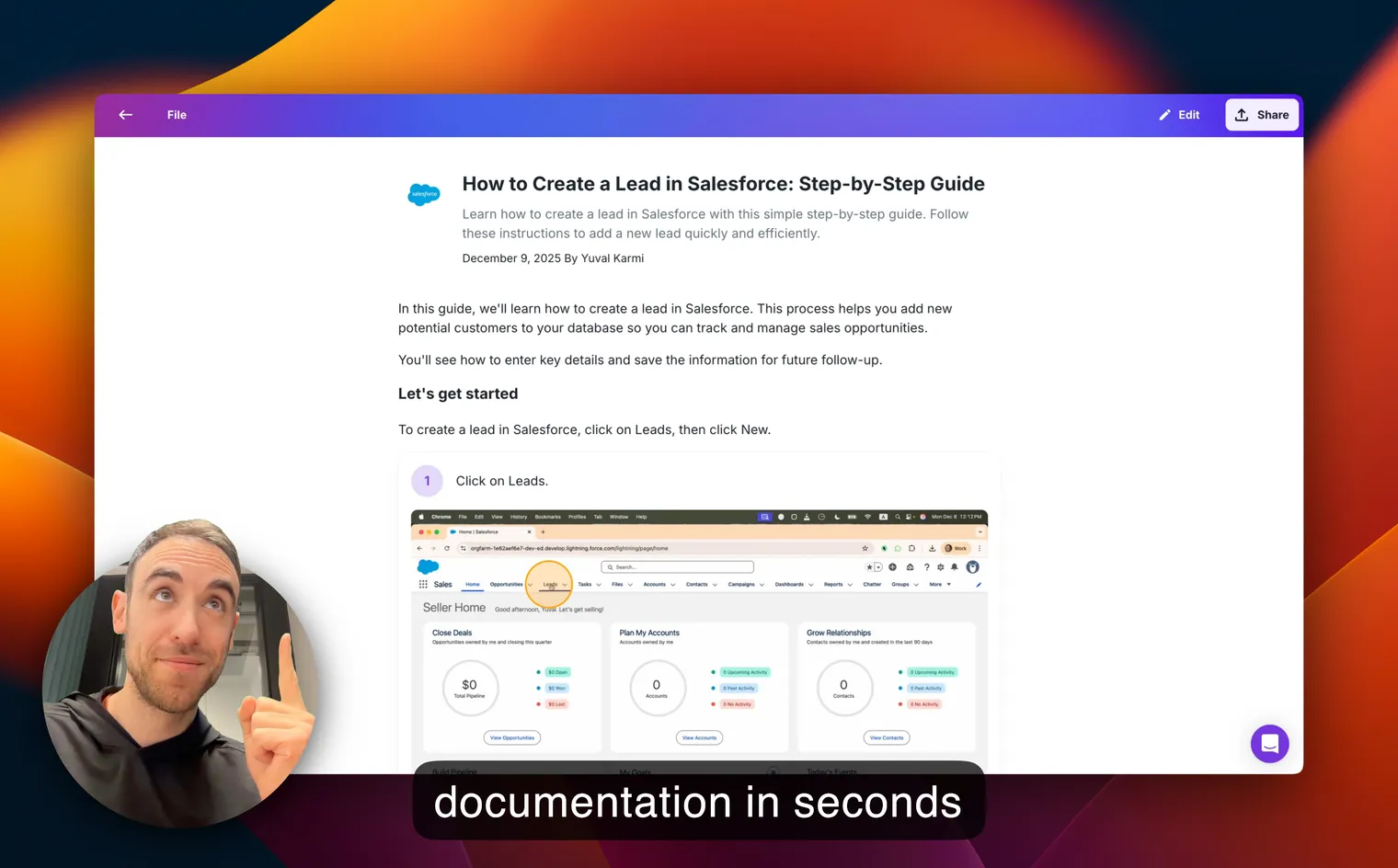
This is exactly what we built Glitter AI for. You hit record, perform the task as you normally would, and you get a fully written SOP with screenshots - no manual writing needed. The tribal knowledge gets converted to documentation as a byproduct of the work, not as a separate project.
Step 3: Assign an Owner to Every SOP
An SOP without an owner rots. The owner is responsible for keeping it current - reviewing it annually, updating it when systems change, and re-recording it when the procedure shifts.
Build the owner list into your SOP catalog. When someone leaves the company, every SOP they own needs to be reassigned before their last day.
Step 4: Schedule the Annual Review
Half of all SOPs are out of date the day they’re written. The other half get out of date within twelve months. Build an annual review cycle into the catalog. Block calendar time. Make the owner sign off.
For an end-to-end approach to building the program, see our complete guide to HR standard operating procedures.
Teach your co-workers or customers how to get stuff done – in seconds.
The Tribal Knowledge Problem, Solved
The reason HR ends up with so many one-person silos isn’t laziness. It’s that documenting a complex procedure used to mean stopping the procedure to write a document - and HR doesn’t have time for that.
The procedures stay in people’s heads because that’s the path of least resistance. Until you change the path of least resistance, you’ll keep ending up with the same gaps.
The shift that’s working for HR teams in 2026 is recording the procedure once, getting documentation as output, and storing it where the team can find it. Year-end W-2 export gets recorded once. The HRIS data hygiene check gets recorded once. The FMLA designation process gets recorded once. The next person who needs to run the procedure follows the recording.
That’s the future state of HR documentation. It isn’t perfect SOPs written from scratch. It’s institutional memory captured at the moment of execution.
If you’re building or auditing your HR SOP catalog, use the function-by-function map above as your checklist. Triage by risk and frequency. Capture procedures during execution, not from memory. Assign owners. Review annually.
Your team will thank you. So will your auditors.
Frequently Asked Questions
What is an SOP for HR department?
An SOP for HR department is a written procedure that documents how a specific HR task is performed, who is responsible, and what records are created. Essential HR SOPs span talent acquisition, payroll, benefits, employee relations, performance management, learning and development, operations, and compliance.
How many SOPs should an HR department have?
A typical HR department needs 40 to 60 SOPs across all functions. The exact number depends on company size, geographic footprint, and regulatory complexity. Multi-state employers and federal contractors need additional state and federal compliance SOPs on top of the core catalog.
Which HR procedures are highest priority to document first?
Document high-frequency-high-risk procedures first: payroll runs, terminations, I-9 verification, FMLA administration, and disciplinary actions. These run often or carry significant compliance and legal risk. Year-end procedures like W-2 export and EEO-1 filing should follow because they run annually and are usually held by one person.
Who owns SOPs in an HR department?
Every SOP should have a single named owner responsible for keeping it current. Common ownership patterns: recruiters own talent acquisition SOPs, comp specialists own payroll and benefits SOPs, HR business partners own employee relations and performance management SOPs, and HR ops owns records and HRIS SOPs.
What is the difference between an HR policy and an HR SOP?
An HR policy states what the company will and will not do. An HR SOP describes how a specific procedure is performed step by step. The policy says employees may take FMLA leave; the SOP describes how HR processes a leave request from intake to designation to tracking.
How long should HR records be retained?
Retention periods vary by record type. I-9s require three years after hire or one year after termination, whichever is later. FLSA payroll records require three years. ERISA benefits records require six years. EEOC applicant records require one year. Tax records require four years. Build retention rules into your records management SOP.
What HR tools support SOP execution?
Common HR systems include Workday, BambooHR, Rippling, ADP, and Gusto for HRIS and payroll. Lattice, 15Five, and Culture Amp support performance management. LMS platforms like Cornerstone and BambooHR Learning support training. Your SOPs should reference the specific systems and exact screens used at each step.
How often should HR SOPs be reviewed and updated?
Review every HR SOP at least annually. Review immediately when a system changes, a regulation changes, or the procedure owner changes. Compliance SOPs covering FMLA, ADA, OSHA, and state-specific rules require more frequent review because regulations shift often.
What are common gaps in HR SOP catalogs?
The most common gaps are year-end payroll close, performance improvement plans, investigation procedures, certification tracking, state-specific compliance overlays, and the annual HR audit itself. These procedures tend to live in one person's head because they run infrequently or are perceived as too nuanced to document.
How do you document HR procedures that only one person knows?
Capture the procedure while the person performs it, not from memory. Screen-record the next execution and convert the recording into a written SOP with screenshots. This eliminates the documentation backlog problem and produces accurate, current procedures as a byproduct of normal work rather than a separate documentation project.