
Read summarized version with
I used to think SOPs were a “later” problem.
The kind of thing you’d get to when the company was bigger. When there was a “real” ops team. When someone finally had time. Then one of our best people left, took six weeks of accounts payable knowledge out the door with her, and I learned the cost of skipping SOPs the hard way. It’s paid in panic, not calendar invites.
This post is for the founders, small business owners, and ops leaders who already suspect SOPs matter but need ammunition. For themselves, their team, or a skeptical co-founder. Ten reasons why SOPs are important, with real examples and honest ROI. No fluff.
I’m Yuval, CEO of Glitter AI. We help teams document the work they actually do. Let’s get into it.
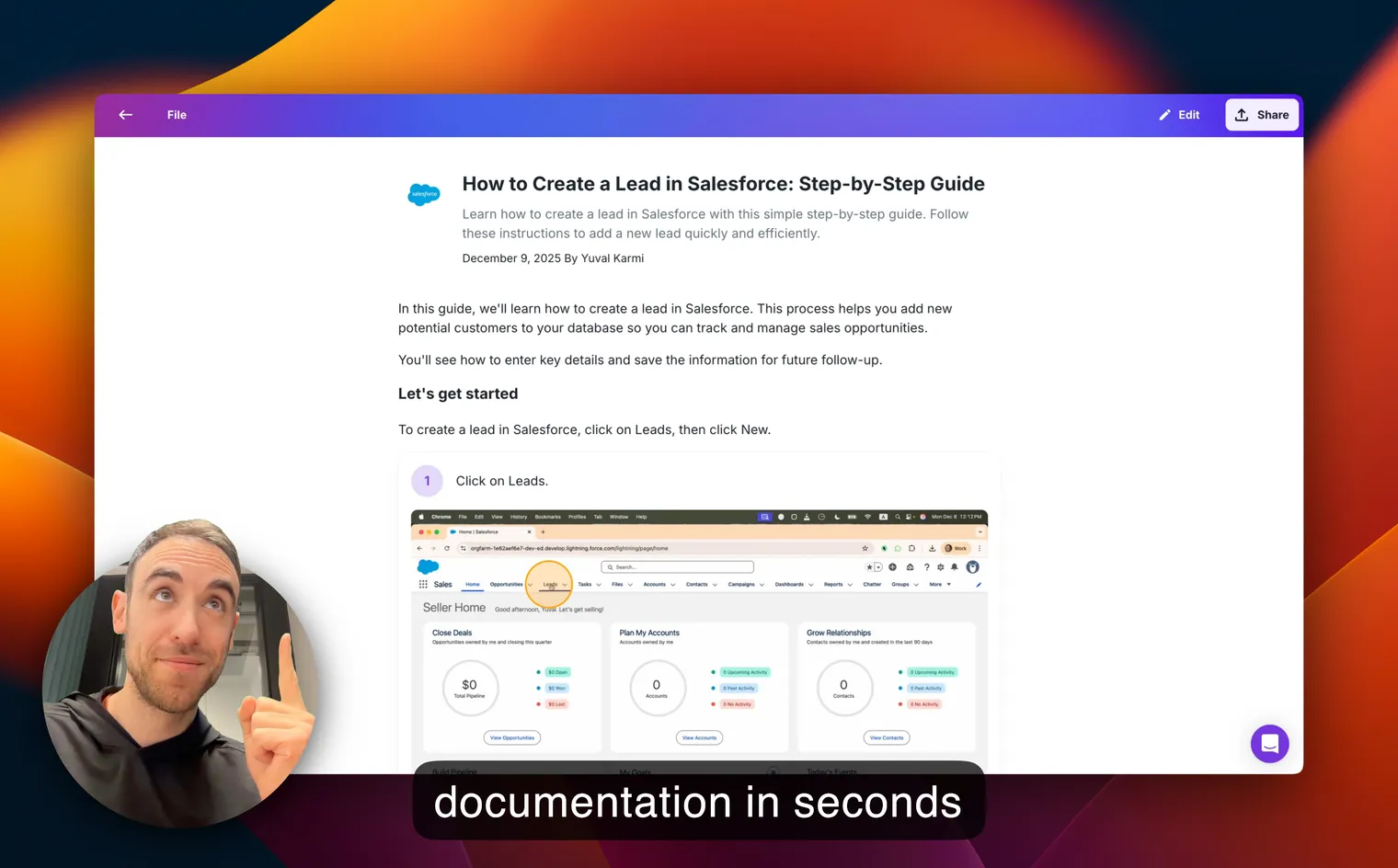
Teach your co-workers or customers how to get stuff done – in seconds.

What we mean by “SOP” (quick definition)
A standard operating procedure is a documented, repeatable way of doing a specific task. Written down so anyone qualified can execute it and land at the same outcome. That’s it. Not a dissertation. Not a 40-page binder no one reads. If even the acronym is new, our quick take on what it means in a business context clears it up in a minute.
If you want the deeper version, I wrote a full piece on what an SOP actually means in business and another on what SOP stands for. For this post, the working definition is enough: a written, repeatable process.
So why bother?
1. Tribal knowledge insurance: when your accountant quits, you don’t lose six weeks
Every business has tribal knowledge. The stuff that lives in someone’s head: the weird vendor portal login, the one customer who gets billed differently, the report that has to run on the 3rd of every month or finance loses its mind.
When that person leaves (quits, gets sick, retires) the knowledge walks out the door with them. The teams that handle this well capture the workflow as a series of recordings before the senior person walks out - turning what would’ve been a six-week scramble into a transition where the replacement is productive by week two.
ROI estimate: Replacing one knowledge-heavy employee without SOPs usually costs 3 - 6 weeks of reduced output across the team. At a loaded cost of around $8K/week for a small team picking up slack, that’s $24K - $48K per departure. SOPs cut it to 1 - 2 weeks.
Counter-objection: “But our people aren’t going anywhere.” Maybe not today. Average tenure at small businesses is under 4 years. Plan for the departure you don’t see coming.
2. Faster onboarding: cut new hire ramp from 6 weeks to 2
Onboarding without SOPs is really just shadowing. New hire follows a senior person around, takes notes, asks questions, slowly absorbs how things get done. Six weeks of two people doing one job.
With good SOPs, the new hire spends days one through three reading and following along. By week two they’re doing real work. By week three they’re contributing without supervision.
This is the single biggest ROI lever for small and mid-sized businesses. If you want the deeper playbook, I wrote one on streamlining business processes that gets into the mechanics.
ROI estimate: Cutting onboarding from 6 weeks to 2 at $80K loaded annual cost saves roughly $6,200 per new hire. And that’s just direct payroll, before counting the senior person’s time you reclaim.
Counter-objection: “Our work is too complex to document.” It isn’t. It’s specific, sure. But specific is exactly what SOPs are for.
3. Consistency across team members
Five people doing the same task five different ways isn’t a team. It’s five solo operators. SOPs are how you get one team.
Consistency matters most where the customer touches it: support replies, sales follow-ups, refund decisions, onboarding emails. Without an SOP, each person’s version drifts based on mood, context, and whatever they remember from their last manager. With one, the customer experience is predictable, which is the precondition for trust.
Counter-objection: “SOPs kill creativity.” Only if you write them badly. SOPs cover the 80% that should be the same. The other 20% is where judgment lives.
Teach your co-workers or customers how to get stuff done – in seconds.
4. Audit-ready for SOC 2, SOX, and ISO
If you sell to anyone larger than a 50-person company, an audit is coming. SOC 2, ISO 27001, HIPAA, SOX. They all share one bone-deep requirement: documented procedures.
Auditors don’t want to know you have a process. They want to see the document, the version history, who approved it, and proof that someone follows it. Companies that scramble to write SOPs three weeks before the audit pay 2 - 3x the consultant fees and still risk findings.
The companies that pass audits cleanly aren’t the ones with the prettiest infrastructure. They’re the ones with the cleanest paper trail.
ROI estimate: SOC 2 readiness consulting runs $15K - $40K for unprepared companies. Companies with existing SOPs usually cut that in half.
5. Scale without hiring more managers
Here’s the math nobody tells you. Every time a manager has to personally explain a process, you’ve capped your scale at the manager’s calendar.
SOPs are how a 5-person team turns into a 25-person team without adding three more middle managers. The senior person’s knowledge becomes a self-serve resource instead of a meeting bottleneck.
This is why a comprehensive SOP guide is one of the highest-leverage things a growing business can build. Every documented process is one fewer 1:1 someone has to schedule.
Counter-objection: “My senior person prefers explaining in person.” Of course they do. It’s social, it’s flattering, and it doesn’t require typing. It also doesn’t scale.
6. Catch process gaps before they become incidents
When you sit down to write an SOP, something interesting tends to happen. You realize half the steps don’t actually exist. There’s no defined approver. No rollback plan. The “manual check” everyone references doesn’t have a checklist.
Documentation is diagnostic. Writing a process down is what surfaces the gaps. I’ve watched teams uncover a missing approval workflow that had been quietly allowing $50K in unauthorized expenses, found only because someone tried to write the SOP for it.
I get into this further in the hidden cost of undocumented processes. Spoiler: the cost shows up as incidents, not invoices.
7. Easier delegation (especially for founders)
If you’re a founder, you’ve heard yourself say “it’s faster if I just do it myself.” Sure, for that one task. Across a year, it’s how you become the bottleneck on your own company.
SOPs are how you delegate without micromanaging. Instead of explaining the same thing five times, you write it once and point people at it. The first hour you spend writing the SOP saves you the next forty hours of repeated explanation.
Counter-objection: “I don’t have time to write SOPs.” True. You also don’t have time to keep doing every task forever. Pick one.
Teach your co-workers or customers how to get stuff done – in seconds.
8. Quality and customer experience consistency
Customers feel inconsistency before they can articulate it. The support reply that took 4 hours yesterday and 2 days today. The sales rep who confirms pricing one way and the other rep who confirms it differently. Contradictory advice from two account managers.
SOPs are the connective tissue that makes a multi-person company feel like one company to the customer. Companies with strong process documentation tend to rate noticeably higher on CSAT. Not because SOPs are magic, but because consistency reads as professionalism.
9. Reduce cognitive load on your best people
Your best people aren’t expensive because they execute tasks. They’re expensive because they make judgment calls. Every minute they spend re-deriving “how do we do this again” is a minute they’re not making the calls only they can make.
SOPs push the routine onto the document, freeing your senior people to do the work that actually needs them. This is the difference between a senior engineer who builds and one who answers Slack questions all day.
A real example: a multi-unit franchise operator built 15 guides on payroll alone. Their bookkeeper used to spend hours every other Friday answering the same questions from store managers. Now the guide answers them. The bookkeeper got Fridays back.
10. M&A and exit-ready
If you ever plan to sell your business, raise institutional capital, or bring in a partner, SOPs are due diligence gold.
Acquirers look at two things: revenue, and how transferable the operation is. A business that runs on three people’s heads is worth less than one that runs on documented processes. The same EBITDA earns a meaningfully higher multiple when the operations are written down.
I’ve watched founders leave money on the table at exit because the buyer discounted the offer for “key person risk.” SOPs are how you avoid that conversation.
ROI estimate: Strong process documentation can move a small-business multiple by 0.5 - 1x EBITDA. On a $2M EBITDA business, that’s $1M - $2M of enterprise value.
Teach your co-workers or customers how to get stuff done – in seconds.
The real bottleneck on SOPs isn’t motivation - it’s time-to-write
Here’s what I’ve learned running Glitter AI: nobody disagrees that SOPs matter. The objection is never philosophical. It’s always logistical. “I don’t have time to write all this down.”
That’s the actual problem. The traditional way of writing SOPs (open a Google Doc, type out steps, take screenshots, paste them in, annotate, format, repeat) takes about 45 minutes per process. Multiply by 50 processes and you’ve got a month of work nobody’s going to do.
That’s why we built Glitter the way we did. You record yourself doing the task once, and an AI turns it into a written, screenshotted, annotated SOP. The 45 minutes drops to under 5. That’s the difference between “we’ll get to it” and “we have 50 SOPs documented by next Friday.” If you want to see how it works, the SOP generator is free to try.
I’m not saying tools solve everything. Culture matters. Ownership matters. But if the bottleneck is time-to-write, fix the time-to-write.
What to do this week
If you’re convinced and want to act, here’s the smallest useful step:
- Pick one risky process. The one where you’d be in trouble if the person who owns it left tomorrow.
- Document it this week. Not perfectly. Just well enough that someone else could execute it.
- Have someone else follow it. This is the test. Gaps surface fast.
- Iterate, then move to the next one.
You don’t need 100 SOPs by Friday. You need one. Then another. Then the next.
The teams I’ve watched succeed at this aren’t more disciplined than yours. They just started with one and didn’t stop.
Frequently Asked Questions
Why are SOPs important for small businesses?
SOPs are important for small businesses because they protect against tribal knowledge loss when employees leave, cut new hire onboarding time, and create consistency in customer experience. For most small businesses, the biggest immediate ROI comes from faster onboarding and reduced key-person risk.
What are the main benefits of standard operating procedures?
The main benefits of standard operating procedures include faster onboarding, consistent quality, audit readiness, easier delegation, and reduced reliance on a few key people. They also surface process gaps and increase the resale value of the business.
Do SOPs really save time?
Yes. SOPs save time by replacing repeated explanations with a self-serve document. The hour spent writing one SOP typically saves dozens of hours over its lifetime in repeated questions, training, and rework.
Why do SOPs matter for compliance?
SOPs matter for compliance because frameworks like SOC 2, ISO 27001, HIPAA, and SOX require documented procedures as evidence. Auditors look for written processes, version history, and proof that the SOP is actually followed.
How do SOPs help founders delegate?
SOPs help founders delegate by replacing repeated verbal explanations with a written reference. Once a process is documented, the founder can hand off the task without explaining it from scratch each time, which is the only way founder time scales.
Are SOPs only for big companies?
No. SOPs are arguably more important for small businesses because each person owns more knowledge and the impact of one departure is greater. A 10-person company without SOPs has more single points of failure than a 1,000-person one.
What is the biggest objection to writing SOPs?
The biggest objection is time. Most leaders agree SOPs matter but don't have time to write them in long-form documents. Modern tools that auto-generate SOPs from screen recordings have largely solved this problem.
How many SOPs does a small business need?
Most small businesses need between 30 and 100 SOPs covering their core operating processes. Start with the highest-risk, highest-frequency tasks first, then expand. You do not need them all on day one.
Do SOPs increase business valuation?
Yes. SOPs increase business valuation by reducing key-person risk, which is one of the top concerns for acquirers of small and mid-sized businesses. Strong documentation can move EBITDA multiples meaningfully higher at exit.
What is the fastest way to start writing SOPs?
The fastest way is to record yourself doing one task, then convert the recording into a written guide using an AI tool like Glitter. This drops the time per SOP from around 45 minutes to under 5 minutes, which is the difference between getting started and never starting.