
Read summarized version with
If you’ve ever watched your AP department come to a standstill because one person called in sick, you already know the problem.
Sage Paperless is powerful AP automation software. It handles scanning, indexing, coding, routing, approvals, matching, and payment processing. It takes mountains of paper and turns them into a digital workflow. But here’s what nobody mentions when you buy it: Sage Paperless training – actually getting your team to use it properly – is harder than installing it.
I’m Yuval, founder of Glitter AI. Through building a tool that helps teams create training guides from screen recordings, I’ve talked to dozens of Sage Paperless teams who all describe the same problem – whether they’re in construction, contracting, or other industries. Someone spends months learning every corner of Sage Paperless. They become the person. Then they leave, and suddenly nobody knows how to code an invoice or route it for approval.
Teach your co-workers or customers how to get stuff done – in seconds.

The Sage Paperless Training Problem Nobody Talks About
Here’s what makes accounts payable different from most other departments.
In AP, every step matters. One wrong account code, one missed approval, one invoice that doesn’t get matched to its purchase order – and you’re looking at a mess that takes hours to untangle. Vendors don’t get paid. Month-end close gets delayed. Auditors start asking uncomfortable questions.
Now put Sage Paperless on top of that. The software is designed to automate all of this, but automation only works when people know how to use it correctly. Scanning settings need to be dialed in. Indexing has to match your chart of accounts. Approval routing rules need to reflect your actual approval hierarchy. And exception handling? That requires judgment calls that only come from experience.
All of that knowledge tends to live in one person’s head. Maybe two, if you’re lucky.
This is undocumented expertise at its most dangerous – not because the knowledge itself is complicated, but because the consequences of losing it are immediate. When your Sage Paperless expert leaves, invoices don’t just slow down. They stop.
The steep price of leaving processes undocumented hits AP teams especially hard. Late payments damage vendor relationships. Duplicate payments waste money. Missed early payment discounts add up fast. And the new person you hire? They’ll spend weeks figuring out things that should have been written down from day one.
Why Standard AP Automation Training Approaches Fail
Most teams try to train on Sage Paperless the same way they train on everything else. It doesn’t work.
The Shadowing Approach
You pair the new AP clerk with the experienced one. They sit together for a week, watching invoices get processed. The trouble is that AP automation involves dozens of screens, menus, and decision points. Nobody can absorb all of that by watching. By Wednesday, Monday’s lessons are already gone.
And you’ve just cut your experienced person’s productivity in half for an entire week.
The Written Manual Approach
Someone creates a Word document with screenshots. It takes them two weeks. By the time it’s done, Sage has pushed an update and half the screenshots are wrong. The document sits in a shared drive folder that nobody remembers the path to.
I’ve written about this failure mode before – training material that sits unread in a folder isn’t really training at all.
The “Just Call Support” Approach
Sage has support resources for AP automation training, the same generic material you’ll find for adjacent products like Sage 100. But they teach you how Sage Paperless works in general. They can’t teach your team how your company uses it. Your specific vendor list, your account codes, your approval thresholds, your exception handling rules – none of that exists in any vendor documentation.
Your team doesn’t need to learn Sage Paperless in the abstract. They need to learn your Sage Paperless.
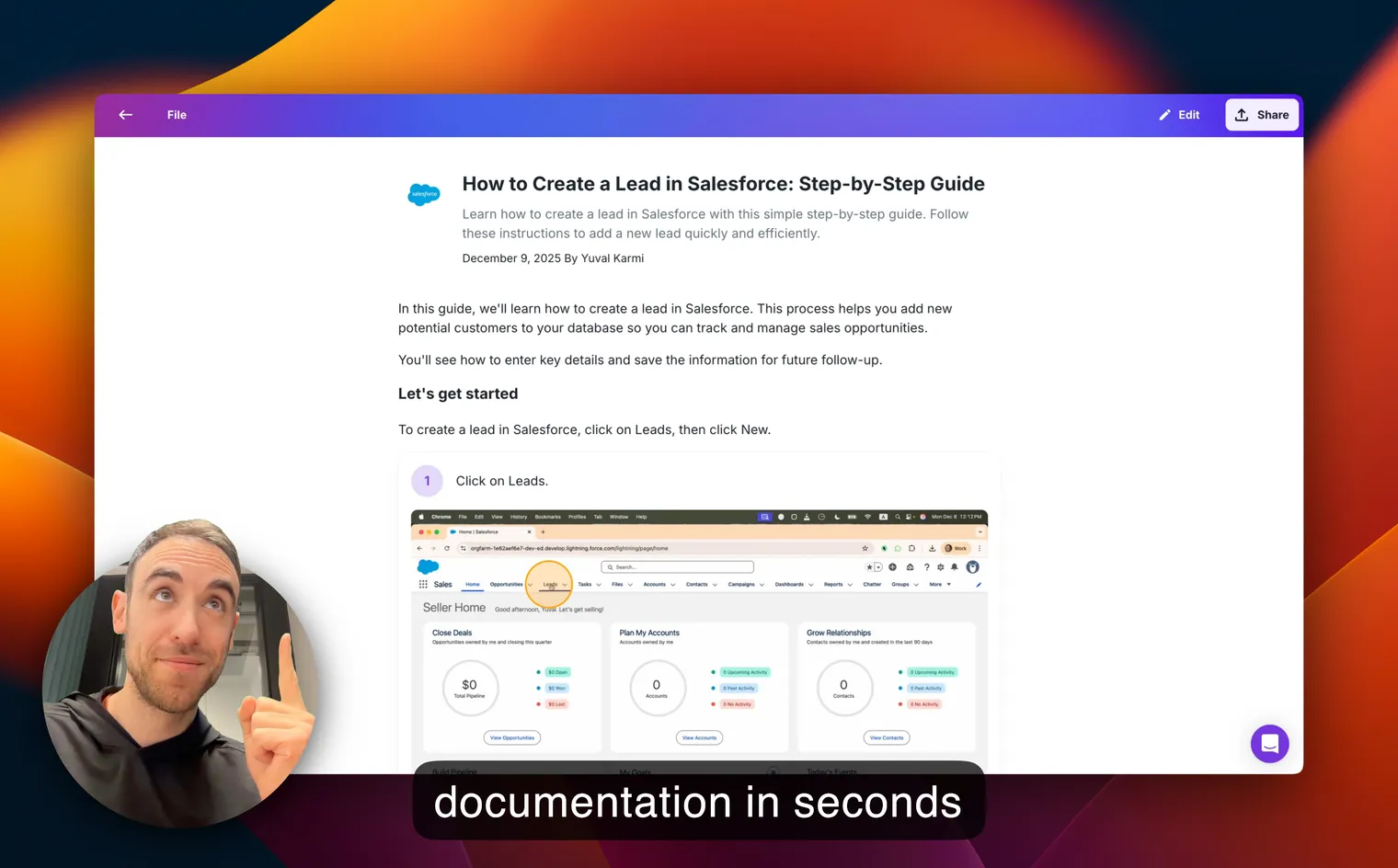
Record your screen, talk through the steps, and Glitter creates the guide automatically
How Glitter Solves Sage Paperless Training
The approach is almost stupidly simple. That’s kind of the point.
Instead of writing documentation or scheduling Sage Paperless training sessions, you just do the work. Open Sage Paperless, start a Glitter recording, and process an invoice while talking through what you’re doing. Explain why you’re selecting that account code. Mention the gotcha with that particular vendor. Point out what to watch for during three-way matching.
When you stop recording, Glitter generates a complete training guide with:
- Video of your entire walkthrough
- Annotated screenshots of each key step
- Written instructions pulled from what you said and did
- Voiceover so people can watch and listen
One recording captures everything. Every learning style covered. No writing required.
The best part? You were going to process that invoice anyway. The training guide is just a byproduct of doing your actual job.
The 8 Sage Paperless Workflows You Need to Document
Not everything needs a guide on day one. Start with the workflows that keep your AP operation running and the ones that cause the most confusion when someone new takes over. Here’s my recommended priority order.
1. Scanning and Indexing Invoices
This is where it all starts. Walk through the full process of getting a paper or emailed invoice into Sage Paperless. Show your scanner settings, how you handle batch scanning, how the OCR picks up vendor names and amounts, and how you verify the indexed data is correct.
Cover the common problems: blurry scans, invoices with unusual layouts, multi-page invoices that need to be grouped together. These edge cases are exactly what trips up new people.
Pro tip: Record yourself handling a problematic scan, not just a clean one. The messy examples teach more than the perfect ones.
2. Coding AP Transactions
Coding is where most AP mistakes happen. Show how you assign GL account codes, cost centers, job numbers, and tax codes in Sage Paperless. Explain your chart of accounts structure and the thinking behind it. Walk through how the system pulls default codes from vendor settings and when you need to override them.
If your organization uses job costing or project-based accounting – common in Sage Paperless construction setups – this guide is especially critical. One wrong job code and your project profitability reports become useless.
3. Routing Invoices for Approval
Sage Paperless supports multi-level approval routing based on GL account, vendor, job, invoice amount, and other criteria. Document your specific routing rules. Show what happens when an invoice hits each approval level. Demonstrate how approvers review and approve from the office or the field.
This is also a good spot to explain your escalation process. What happens when an approver is out of office? Who’s the backup? How long before an invoice gets flagged as stuck?
4. Three-Way PO Matching
Purchase order matching is one of the most powerful features in Sage Paperless, and probably the most confusing for new users. Record yourself matching an invoice to its PO and receiving document. Show what a clean match looks like. Then show what happens when quantities don’t match, when prices differ, or when a PO covers multiple invoices.
The exceptions are where the real training value lives. Anyone can handle a perfect match. Your team needs to know what to do when things don’t line up.
5. Handling Exceptions and Discrepancies
Every AP team has them. Invoices without POs. Duplicate invoices. Invoices where the amount doesn’t match the approved quote. Short shipments. Credit memos that need to offset existing invoices.
Record how you handle each type of exception in Sage Paperless. This is the workflow most likely to be locked away as knowledge nobody has written down – the kind of thing your experienced AP clerk just knows how to handle but has never explained to anyone else.
6. Running AP Aging Reports
Your AP aging report drives payment decisions. Show how to generate it in Sage Paperless, how to filter and sort it, and most importantly, how to read it. Walk through how you use the aging report to prioritize payments, identify overdue invoices, and spot potential issues before they turn into real problems.
This ties directly into month-end close, so document it early. A good reference here is our walkthrough for documenting accounting procedures which covers the broader context of standardizing financial processes.
7. Vendor Management
Setting up a new vendor correctly in Sage Paperless prevents headaches down the road. Document how you create new vendor records, set default payment terms, assign default GL codes, and configure any vendor-specific routing rules. Show how to update vendor information when banking details change – this is a common source of payment errors and even fraud risk.
8. Payment Processing
The final step. Walk through how you use Sage Paperless to select invoices for payment, generate payment batches, and process them. Show how the Payment Manager module gives check signers that final review before payments go out. Cover your process for handling partial payments, priority payments, and payment holds.
If your company follows the purchasing SOP guide approach to standardize procurement, link your payment processing guide to those upstream processes so new team members can see the full cycle.
Document every workflow so AP processing doesn't depend on one person
Building a Sage Paperless Training Program That Actually Works
Once you’ve recorded the core workflows, structure how your team works through them.
Week 1: Getting Oriented
Start with scanning, indexing, and basic coding. These are the entry point tasks that every AP clerk needs to get right. Let the new person process simple invoices from your most common vendors – the ones where coding is straightforward and PO matching is clean.
Week 2: Core Processing
Move into approval routing, PO matching, and vendor management. The new hire should be processing routine invoices on their own by the end of this week, with someone available to answer questions on the unusual ones.
Week 3: Exceptions and Reporting
This is where experience starts to build. Cover exception handling, AP aging reports, and payment processing. These tasks require judgment, so pair the guides with some supervised practice on real scenarios.
Week 4: Full Cycle
Have the new hire run through a complete AP cycle – from scanning to payment – with minimal supervision. They should be referencing the guides, not asking colleagues. By the end of this week, they should be able to handle the daily workload on their own.
This is how you ramp up new hires more quickly with recorded guides – structured, self-paced, with recorded guides doing the heavy lifting.
Why Video + Screenshots + Written Steps Work Better for Sage Paperless
Let me be specific about why multi-format AP automation training matters for software like Sage Paperless.
Video shows the flow. AP processing in Sage Paperless involves moving through multiple screens in a specific sequence. Video captures that rhythm – how quickly you move through routine steps, where you pause to check something, the overall path through the software.
Screenshots show the details. When your AP clerk is coding an invoice and needs to verify they’re looking at the right field, they don’t want to scrub through a video. They want to glance at an annotated screenshot and confirm they’re in the right place.
Written steps capture the logic. Why you chose that cost center. What the approval threshold is for that GL account. When to escalate versus when to handle it yourself. Written instructions are searchable and scannable – exactly what you need when you’re stuck on step 7 of a 15-step process.
Voiceover captures the nuance. The “double-check this because vendors sometimes send duplicates” warnings. The “I know this looks wrong but it’s actually correct because…” explanations. That verbal context carries meaning that written text often strips away.
When all four come from a single recording, they stay perfectly in sync. That consistency is what makes the training actually stick.
Tips for Recording Better Sage Paperless Training Guides
Talk Naturally
Don’t script it. Talk the way you’d explain something to a new hire sitting next to you. “Okay, so this vendor always sends their invoices without a PO number, so here’s what I do…” That conversational tone makes guides more engaging and way easier to follow.
Cover the Why, Not Just the What
“Click here, then click here” isn’t training. “I’m selecting this cost center because all office supply invoices go to 6500, except when they’re for a specific job site” – that’s training. The reasoning behind decisions is what separates a useful guide from a screenshot slideshow.
One Workflow Per Guide
Don’t try to cram everything into one recording. “How to code and route a standard invoice” is a guide. “Everything you need to know about Sage Paperless” is a semester-long course nobody will finish. Keep each guide focused on one task. Shorter guides are easier to record, easier to update, and easier to find when you need them.
Record Real Work, Not Demos
Use actual invoices (redact sensitive information if needed). Real invoices have the quirks and edge cases that demo data doesn’t. Your team will face these same quirks on day one, so they should see them in training.
Video, screenshots, written steps, and voiceover -- all generated automatically
From Single Guide to Complete Knowledge Base
As someone who built Glitter, I’ve watched our best teams document 5+ different operational workflows. The ones who stick around aren’t creating one guide – they’re building an entire knowledge base.
Your Sage Paperless training guides are just the beginning. Once you’ve documented invoice processing and payment workflows, you’ll naturally want to capture the processes that feed into AP and the ones that depend on it. How you handle purchase requisitions. How you prepare for audit. How you manage month-end close. How you onboard new vendors.
Each guide takes minutes to record and saves hours of future training. More importantly, it removes the single point of failure that every AP department dreads – the one person who knows how everything works.
Start with the workflow that gets the most questions. Record it today. Share it with your team tomorrow. One guide per week, and in two months you’ll have a complete Sage Paperless training library – whether you’re in construction, distribution, or any other industry – that protects your operation no matter who comes or goes.
Frequently Asked Questions
How long does Sage Paperless training take for a new AP clerk?
Most teams need 3-4 weeks to get a new AP clerk comfortable with core Sage Paperless tasks like scanning invoices, coding transactions, and processing payments. With documented training guides that combine video, screenshots, and written steps, you can cut that timeline down significantly because new hires can learn at their own pace and revisit guides whenever they need a refresher. The exact timeline depends on the complexity of your AP workflows and how many custom routing rules you use.
What Sage Paperless workflows should I document first?
Start with scanning and indexing invoices, then coding AP transactions, since these are the tasks your team does every day. Next, document your approval routing rules and PO matching process. Save exception handling, AP aging reports, and payment processing for after the daily workflows are covered. Prioritize whatever generates the most questions from your current team -- that's where tribal knowledge risk is highest.
Can I use Sage's built-in training resources instead of creating my own?
Sage provides documentation for how Sage Paperless works in general, but it can't cover your specific setup. Your chart of accounts, approval routing rules, vendor-specific coding conventions, and exception handling procedures are unique to your company. Vendor documentation can supplement your training but should never replace internal guides that show exactly how your organization uses the software.
How do I train remote AP staff on Sage Paperless?
Screen-recorded training guides work really well for remote AP teams because they can be accessed from anywhere, anytime. Record yourself walking through each Sage Paperless workflow with narration explaining what you're doing and why. Tools like Glitter automatically generate video, screenshots, and written steps from a single recording. Remote employees can work through the guides on their own without needing to schedule live training sessions across time zones or offices.
What's the biggest Sage Paperless training mistake AP teams make?
The biggest mistake is relying on one person to train everyone through live walkthroughs with no documentation. When that person leaves, all the institutional knowledge of how your AP automation works goes with them. The second biggest mistake is creating text-only documentation without screenshots or video. Sage Paperless is a visual, multi-screen application, and text instructions alone can't really convey the navigation and decision points involved.
How often should I update my Sage Paperless training guides?
Update your guides whenever Sage releases interface changes, whenever your internal processes change (new GL accounts, different approval thresholds, new vendors with special requirements), and do a general review quarterly. If you're using Glitter, re-recording a workflow takes just a few minutes, which makes regular updates practical rather than something everyone dreads.
How do I document exception handling in Sage Paperless?
Record yourself handling each type of exception your team commonly runs into: invoices without purchase orders, duplicate invoices, price discrepancies, short shipments, and credit memo processing. Walk through the decision-making process out loud so the guide captures not just what you click but why. Exception handling is the workflow most likely to be pure tribal knowledge, so documenting it should be a high priority.
What's the best way to train someone on PO matching in Sage Paperless?
Record a walkthrough showing both a clean three-way match and several common mismatch scenarios. Show what happens when quantities differ, when prices don't align, and when a single PO spans multiple invoices. The exceptions teach more than the happy path. Use real examples where possible so your team sees the kinds of discrepancies they'll actually encounter.
How many training guides does a typical AP team need for Sage Paperless?
Most mid-size AP teams need somewhere between 8 and 15 core guides to cover essential Sage Paperless workflows. This typically includes guides for scanning and indexing, coding, approval routing, PO matching, exception handling, AP aging reports, vendor management, and payment processing. Some teams add guides for month-end close procedures, audit preparation, and 1099 processing. Start with the 5-8 workflows your team uses daily and expand from there.
Can Glitter create Sage Paperless training guides for both the cloud and on-premises versions?
Yes. Glitter works by recording your screen and generating guides from whatever you're doing, regardless of whether you're using the cloud-based or on-premises version of Sage Paperless. The recording captures your specific interface, workflows, and data, so the generated guide reflects exactly how your team uses the software in your environment.