
Read summarized version with
If you’ve ever tried to figure out how to train your team on Salesforce, you know the pain already. Salesforce training is one of those things that sounds straightforward until you actually try it. Salesforce is one of the most powerful CRMs out there, but it’s also one of the most frustrating to learn. The interface is dense. Every org customizes it differently. And the person who set it all up three years ago? They left six months ago and took all the context with them.
I’m Yuval, and I built Glitter AI. Before that, I ran a startup called Simpo where I used Salesforce daily with my sales team. I saw firsthand how hard it is to train new reps on your specific Salesforce setup. Salesforce tends to be the worst offender when it comes to tribal knowledge, because no two Salesforce orgs look the same.
Your Salesforce instance isn’t Salesforce. It’s your company’s Salesforce, with custom fields your old admin created, automations nobody fully understands, and workarounds that exist because someone hit a wall three years ago and found a way around it. That’s what makes training so hard.
Teach your co-workers or customers how to get stuff done – in seconds.

The Tribal Knowledge Problem (And Why Salesforce Makes It Worse)
Every company has knowledge that lives only in people’s heads – the unwritten processes that only certain people know. Salesforce takes this problem and makes it significantly worse.
Here’s why. Most software has a standard interface that every company sees. Salesforce doesn’t work that way. Your org has custom objects, custom fields, custom page layouts, validation rules, approval processes, and workflow automations that are unique to your business. When your CRM admin or your senior sales ops person leaves, they’re not just taking general Salesforce knowledge with them. They’re taking the knowledge of how your specific instance works.
I’ve talked to sales ops managers who inherited a Salesforce org they didn’t build. They describe it like moving into a house where the previous owner did all the electrical work themselves. Everything works… until it doesn’t. And when something breaks, you have no clue why, because there’s nothing explaining the wiring.
The Real Cost of CRM Knowledge Loss
Think about what happens when your best sales ops coordinator quits:
- Nobody knows why certain leads get routed to specific reps
- The custom report that leadership reviews every Monday? Nobody knows how to update it
- The approval workflow for discounts over 20%? Someone disabled it by accident and nobody can figure out how to fix it
- New reps have no idea which fields are required vs. optional vs. “technically optional but your manager will be upset if you skip them”
The true toll of leaving processes undocumented is staggering in CRM environments. It’s not just lost productivity. It’s lost deals, bad data, and a sales team that stops trusting the tool entirely.
Why Traditional Salesforce Training Fails
Let me be honest about the approaches I’ve seen teams try, and why they fall short when it comes to teaching people how to use Salesforce CRM effectively.
Trailhead Is Great, But It’s Not Your Org
Salesforce’s Trailhead is excellent Salesforce training for beginners learning the platform generically. But your new sales rep doesn’t need to know how Salesforce works in theory. They need to know how to use Salesforce to create an opportunity in your org, with your custom fields, your sales stages, and your required data points.
Trailhead can’t teach that. Only someone inside your company can.
Written SOPs Die on the Vine
You can write a 30-page Salesforce training document. Some teams do. It takes weeks. And by the time you finish, three things have changed: a custom field got renamed, a page layout was updated, and someone added a new validation rule. Your screenshots no longer match reality.
Written documentation for Salesforce has a half-life of about two months. After that, new users start seeing screens that don’t match the docs, and they lose confidence in the whole document. “If step 4 is wrong, why would I trust step 12?”
Shadow Training Creates Inconsistency
Without formal Salesforce training materials, teams fall back on shadow training – new reps sit with experienced reps and learn by watching. This creates two problems. First, every experienced rep teaches it a little differently. Second, the experienced reps are losing selling time to train the new person. Nobody’s happy about it.
A Better Approach: Record It, Don’t Write It
Here’s what I’ve seen work best. The most effective Salesforce training combines video, screenshots, and written steps – all generated from a single screen recording.
With Glitter, you open Salesforce, hit record, and walk through the process while talking through what you’re doing. “I’m clicking on the Opportunities tab. Now I’m hitting New. This first field is Account Name – make sure you search for the existing account, don’t create a new one, because duplicates mess up our reporting.” It’s natural. Conversational. Like showing a colleague.
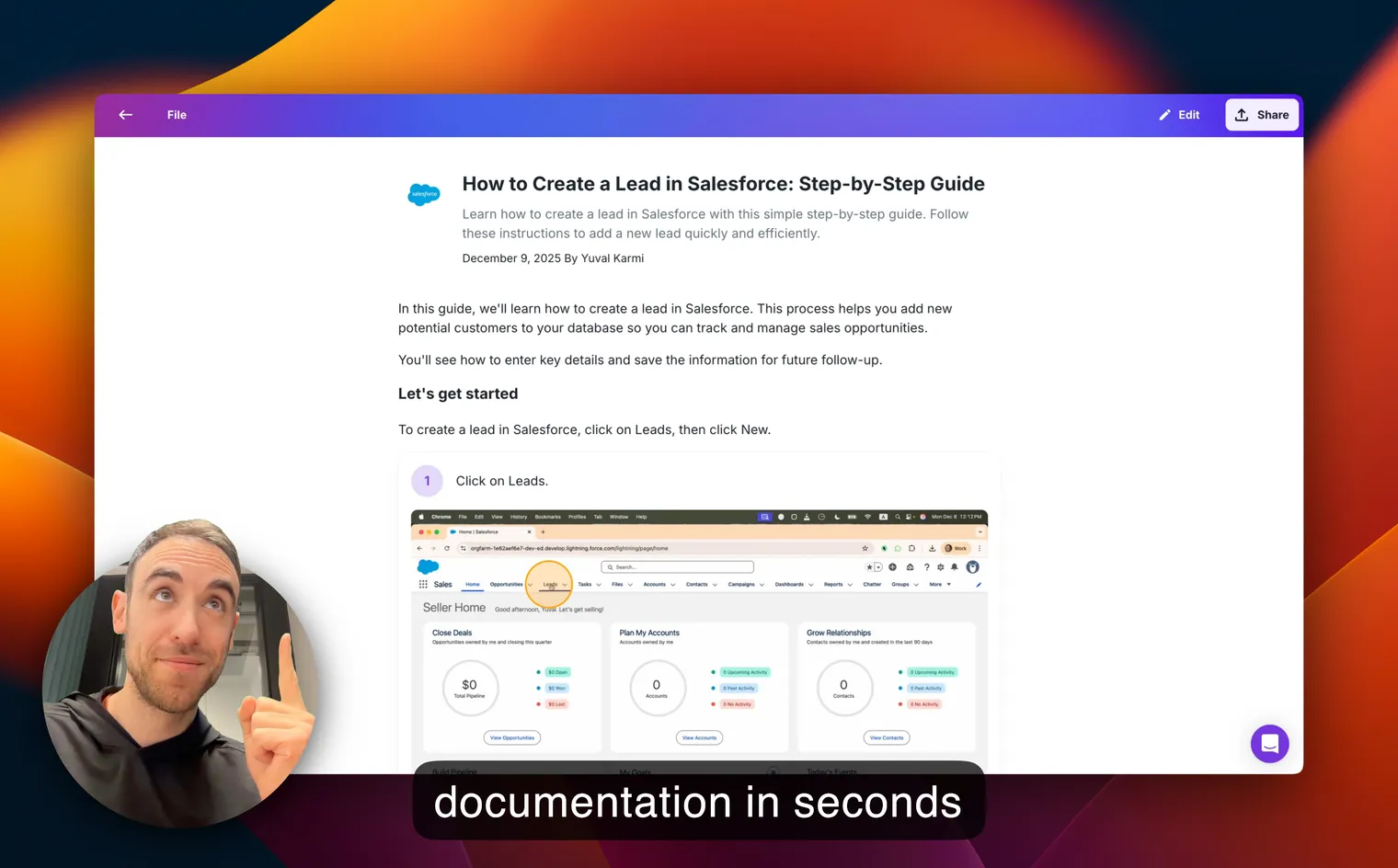
When you stop recording, Glitter generates a complete training guide: the full video, annotated screenshots of each step, and written instructions. All from that one recording.
No formatting. No screenshot tools. No document editors. You just did the thing and explained it, and now you have a guide any new team member can follow.
As someone who built Glitter, I’ve seen our best teams use it to document 5+ different operational workflows. The ones who stick around aren’t creating one guide – they’re building an entire knowledge base that spans every system, from eBay seller operations to a Clover POS register.
The Salesforce Training Workflows You Need to Document
Don’t try to document your entire Salesforce org at once. Start with the workflows that cause the most confusion and have the highest impact when done wrong. Here’s my priority list.
1. Lead Conversion
This is where new reps struggle the most. Converting a lead in Salesforce means creating an account, a contact, and an opportunity all at once. But your org probably has specific rules: which fields need to be filled before conversion, how to handle duplicate accounts, what to do when a lead belongs to an account that already exists.
Record your best sales ops person walking through a lead conversion. Have them show both the happy path and the common pitfalls. “See this warning about a potential duplicate? Here’s how you check if it’s a real duplicate or just a similar name.”
2. Creating and Managing Opportunities
Opportunities are the lifeblood of your CRM. Every company defines its sales stages differently, though. Different custom fields, different expectations for what data should be captured at each stage.
Document the full lifecycle: creating a new opportunity, moving it through stages, adding products or line items, updating the close date, and closing it (won or lost). Pay special attention to the fields your sales managers actually look at during pipeline reviews – those are the ones reps need to get right.
3. Processing Purchase Orders
If your team processes purchase orders through Salesforce, this workflow is critical. It often involves custom objects, approval processes, and integrations with other systems. It’s exactly the kind of workflow where screenshot-driven step guides outperform written docs, because you’re jumping between multiple screens and objects.
Record the end-to-end flow: receiving a PO, entering it into Salesforce, linking it to the right opportunity and account, routing it for approval, and confirming it’s been processed. Show where to find status updates and how to handle exceptions.
4. Running Reports and Dashboards
Most sales teams use a fraction of Salesforce’s reporting capabilities because nobody showed them what else is possible. Your new reps need to know which existing reports to check, how to filter them for their territory or accounts, and how to build simple reports on their own.
This is a great workflow to document even if you’re not a writer. Just open the Reports tab, start recording, and walk through pulling the reports your team uses daily. Show how to apply filters, change date ranges, and export to Excel.
5. Managing Contacts and Accounts
This sounds basic, but account and contact hygiene is where CRM data goes to die. Your team needs clear guidance on: when to create a new account vs. add a contact to an existing one, which fields are mandatory, how to handle merges, and how to associate contacts with the right opportunities.
Bad data in Salesforce isn’t just messy – it breaks reporting, ruins email campaigns, and makes the entire CRM less trustworthy. Document the right way to do this early, and your data quality will thank you later.
6. Using Custom Objects
If your org has custom objects (and most do), these are the trickiest things to train on. Custom objects don’t appear in any generic Salesforce training material. They’re unique to your company. Maybe you have a custom “Projects” object, or a “Vendor” object, or something built specifically for your industry.
These custom objects are often the most important parts of your Salesforce implementation. They exist because standard Salesforce couldn’t do what you needed. And they’re almost never documented.
Start documenting workflows today
7. Handling Approval Workflows
Approval processes in Salesforce – for discounts, contract terms, pricing exceptions – are powerful but opaque. New users don’t know they exist until they get blocked by one. “Why can’t I change this field?” Because it requires VP approval first, and nobody told you.
Record a walkthrough of every approval process in your org. Show what triggers them, who approves, how long it typically takes, and what the submitter should do while waiting. This saves a huge number of confused Slack messages.
8. Campaign Management
If your marketing team uses Salesforce campaigns, they need guides for creating campaigns, adding members, tracking responses, and reporting on ROI. Campaign management in Salesforce is powerful but unintuitive. The relationship between campaigns, campaign members, leads, contacts, and opportunities is genuinely confusing the first time you see it.
Structuring Your Salesforce Training Program
Creating guides is half the battle. Organizing them so people can actually find what they need is the other half.
Organize by Role
Your sales reps, sales ops team, marketing team, and managers all use Salesforce differently. Don’t give everyone the same training. Build role-specific paths:
- Sales reps: Lead conversion, opportunity management, activity logging, running their pipeline reports
- Sales ops / admins: Data hygiene, report building, workflow management, user administration (this is where Salesforce admin training guides really matter)
- Account managers: Account and contact management, renewal tracking, purchase order processing
- Marketing: Campaign creation, lead source tracking, campaign reporting
When training matches the role, people engage with it. When you dump everything on everyone, nobody reads any of it. This lines up with proven approaches to training staff that consistently show role-based training outperforms generic programs.
Layer Your Training
Start with the basics and build up:
Week 1: Navigation, core workflows – this is Salesforce training for beginners in practice (create an opportunity, log an activity, run a basic report)
Week 2: Advanced workflows (lead conversion, custom objects, approval processes)
Week 3: Reporting, dashboards, and data management
Month 2: Edge cases, integrations, advanced customization
This layered approach lets new hires become productive within days while still building deeper skills over time.
Keep Guides Discoverable
The best training guides in the world are useless if nobody can find them. Build a central knowledge base where guides are organized, searchable, and accessible. The teams that successfully shorten ramp time using recorded guides always have a system for organizing and surfacing the right guide at the right time.
Why Multiformat Training Wins
I want to make the case for why combining video, screenshots, and written steps isn’t a nice-to-have – it’s a necessity for Salesforce training specifically.
Salesforce is a visually complex application. Page layouts can have dozens of fields. Navigation menus have multiple levels. Related lists, detail pages, and Chatter feeds all compete for screen space. Trying to describe where to click using words alone is an exercise in frustration.
When you record a Salesforce walkthrough with Glitter, your team gets:
- The video showing the complete flow, including where the cursor moves, which tabs get clicked, and your verbal explanation of why
- Annotated screenshots capturing each key step with highlights on exactly where to click or type
- Written steps providing a scannable reference they can follow while working in Salesforce themselves
Different people on your team will reach for different formats. Your visual learners will watch the video. Your systematic folks will follow the written steps. Most will do both – watch the video first to get the flow, then reference the written steps when doing it themselves.
And when Salesforce updates its interface (which happens regularly), you just re-record the affected workflow. Five minutes. One recording. All three formats updated. Compare that to the hours of manual work it takes to update a traditional written training package.
Getting Started This Week
You don’t need a grand documentation plan. Here’s how to start:
Today: Identify the one Salesforce workflow your team asks about most. It’s probably opportunity creation or lead conversion. Record yourself walking through it. Talk naturally – explain the “why” behind each step, not just the “what.”
This week: Share the guide with your team. Ask them what’s missing. Record two more workflows based on their feedback.
This month: Build out 5-8 core guides covering the workflows that matter most. Organize them by role.
Next month: You’ll have a Salesforce knowledge base that survives employee turnover, makes onboarding faster, and stops your senior reps from being interrupted every time someone has a CRM question.
The teams I’ve seen transform their Salesforce training didn’t start with a committee or a project plan. They started with one ops manager who was tired of explaining the same process for the tenth time. They recorded it once. And then they never had to explain it again.
Frequently Asked Questions
How long does it take to create a Salesforce training guide with Glitter?
Most Salesforce workflows take 5-15 minutes to record, depending on complexity. Glitter generates the complete guide -- video, annotated screenshots, and written steps -- automatically from that single recording. Compare that to the hours or days it takes to create traditional documentation manually.
Do I need Salesforce admin training to create training guides?
No. You just need to be comfortable with the workflow you're recording. In fact, some of the best guides come from people who recently learned how to use Salesforce, because they remember what was confusing and naturally explain those parts more clearly. Salesforce admin training is useful for documenting configuration and setup workflows, but any team member can create guides for their daily tasks.
What Salesforce workflows should I document first?
Start with the workflows that generate the most questions from your team: opportunity creation and management, lead conversion, running reports, and any custom object workflows unique to your org. These are the daily tasks where mistakes are costly and where new hires struggle most.
How do I keep Salesforce training guides updated after platform releases?
Salesforce releases updates three times a year. With Glitter, you simply re-record any affected workflows after a release. One new recording regenerates the entire guide with updated video, screenshots, and written steps. This takes minutes instead of hours.
Can I create training guides for our custom Salesforce objects?
Yes, and custom objects are actually the most important things to document. They don't appear in any generic Salesforce training material because they're unique to your org. Recording walkthroughs of your custom objects captures knowledge that literally cannot be learned anywhere else.
How should I organize Salesforce training guides for different roles?
Organize by role, not by Salesforce feature. Sales reps need different guides than sales ops, who need different guides than account managers. Create role-based paths so each person only sees workflows relevant to their job. This prevents overwhelm and improves adoption.
What if my team is resistant to using Salesforce -- will Salesforce training guides help?
Low Salesforce adoption is almost always a training problem, not a motivation problem. When people learn how to use Salesforce CRM confidently, they actually use it. Visual training guides reduce the frustration and confusion that drive resistance. Reps who can follow a clear guide are far more likely to enter data consistently.
How do I train remote team members on Salesforce?
Recorded training guides solve remote training completely. Instead of scheduling screen-share sessions across time zones, create the guide once and share it. Team members can watch, pause, rewind, and reference the written steps at their own pace, on their own schedule.
Should I document Salesforce approval processes?
Absolutely. Approval workflows are one of the most common sources of confusion in Salesforce. New users get blocked by approvals they didn't know existed. Document what triggers each approval, who approves it, and what the submitter should do while waiting.
How many Salesforce training guides does a typical team need?
Most sales teams need 10-20 core guides covering daily operations across opportunity management, lead conversion, reporting, contact and account management, custom objects, approval processes, and role-specific workflows. Start with 3-5 covering your highest-impact processes and build from there.