
Read summarized version with
The first time someone on my team said “we need an SOP for that,” I nodded along confidently. Then I googled what SOP meant.
I’m Yuval, CEO of Glitter AI. Before this, I ran Simpo for about 5 years. Plenty of small business meetings I’ve been in, someone drops “SOP” like the whole room signed off on a definition. Half of us are usually guessing. So if you’re a founder, ops manager, or office manager who heard the term and quietly wondered whether you actually need one, this post is for you.
Quick answer: SOP stands for Standard Operating Procedure. It’s a written, step-by-step description of how your business does a specific repeatable task. That’s the whole thing. No certification. No fancy software to get started.
The longer answer is where most SMBs get tangled - when you need them, what they look like, how they’re different from a “policy.” Let’s untangle it.
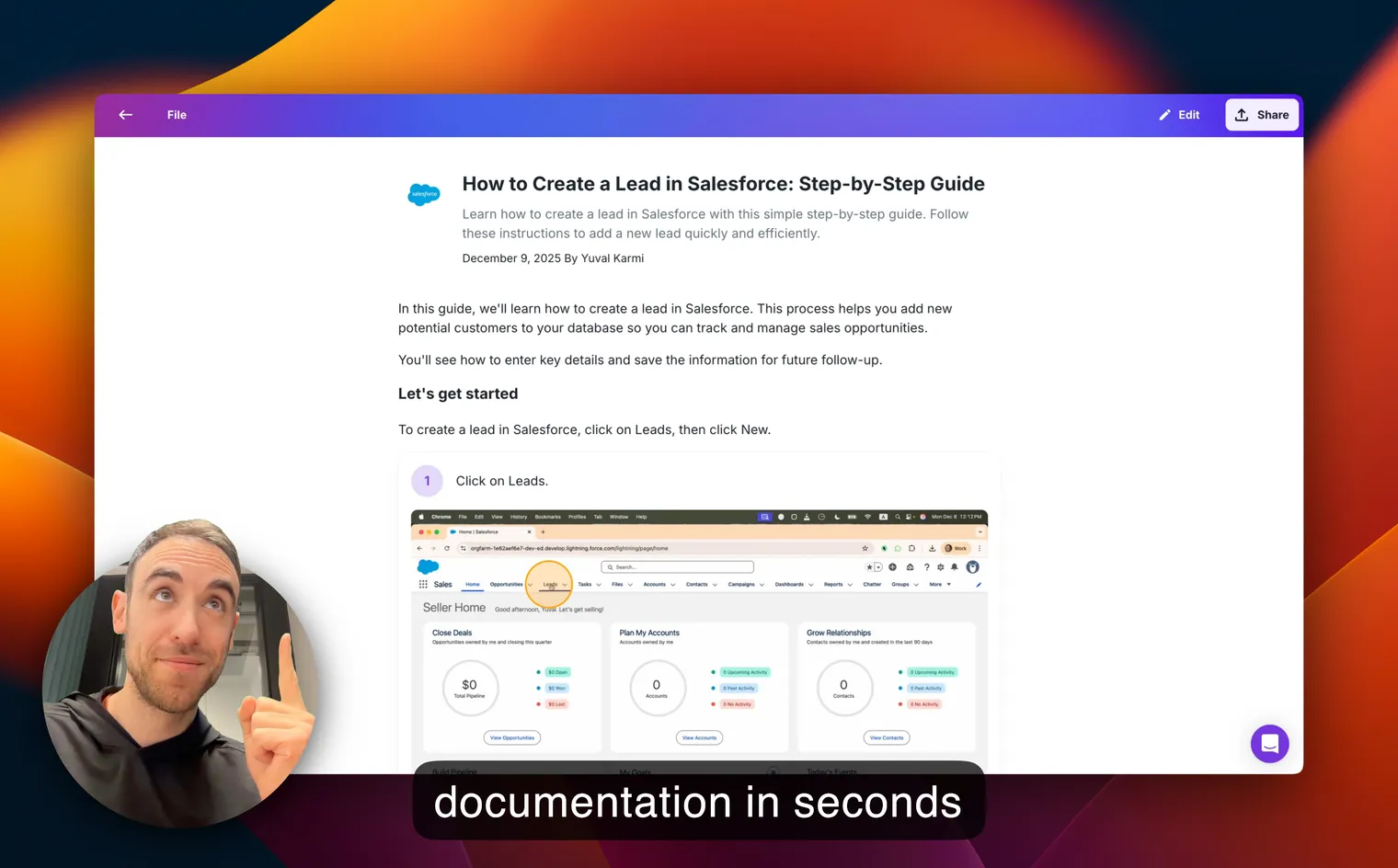
Teach your co-workers or customers how to get stuff done – in seconds.

What SOP means in business (the actual definition)
In a business context, an SOP is a documented, repeatable procedure that anyone on your team can follow to complete a specific task the same way every time.
The keyword there is specific. An SOP isn’t a vague principle like “treat customers well.” It’s the literal click-by-click, step-by-step recipe for something like “How to issue a refund in Stripe when a customer requests one within 30 days.”
A good SOP usually includes:
- The task it covers (one task, not five)
- Who it applies to (which role)
- The trigger (when this gets done)
- The steps (numbered, in order)
- The tools used (links and screenshots help)
- The expected outcome (how you know it’s done right)
If you want the textbook version, here’s the Standard Operating Procedure glossary entry with the formal definition.
Where the term came from
Most people assume “SOP” came from corporate America. It actually came from the military - “standing operating procedure” - which is why you’ll occasionally still see the older phrasing. We have a standing operating procedure glossary entry that walks through the etymology if you’re curious. The military used SOPs so a new recruit could replace a veteran without the mission falling apart. That’s pretty much exactly what SMBs need them for too.
SOP vs. policy vs. procedure vs. work instruction
This is where SMBs get confused. And honestly, the terms get used interchangeably out in the wild. Here’s the cleanest way I’ve found to think about it:
- Policy - What we do and why. “We offer refunds within 30 days of purchase.”
- Procedure - The general flow of how we do it. “Refunds go through customer support, who confirm eligibility, then process the refund and notify the customer.”
- SOP - The exact steps for one specific task. “How to process a refund in Stripe: open the dashboard, find the charge, click Refund…”
- Work instruction - The micro-detail for one part of an SOP. “How to format the refund note in our customer comms tool.”
Policies sit at the top. Procedures are the middle. SOPs are the working layer your team actually opens at 9:47am on a Tuesday. Work instructions are the smallest pieces, the granular bits.
I wrote about policy vs procedure separately, and there’s a companion piece on how SOPs differ from work instructions if you want to go deeper. For most SMBs, the practical takeaway is this: don’t worry about the labels. Worry about whether your team can find the steps when they need them.
When does a small business actually need SOPs?
Not at 3 employees. Definitely by 25. Somewhere in between is where it gets interesting.
Here’s the rough heuristic I give friends:
1 - 5 employees: don’t bother with formal SOPs
You’re all in the same room (or Slack channel). Tribal knowledge works fine. Writing SOPs at this stage is mostly procrastination dressed up as productivity.
One exception: anything involving money, security, or compliance. Even at 2 people, write down how you handle customer payment data and how you offboard someone who quits. Those two will bite you.
6 - 15 employees: start with the painful repeats
This is when you’ll feel the first sting. You hire your fifth ops person and realize the previous four all process invoices in slightly different ways. Or someone asks “how do we do X?” and gets three different answers from three different people.
Pick the 5 - 10 things that happen weekly and have caused at least one mistake. Write SOPs for those. That’s it. Don’t try to document everything at once.
15 - 50 employees: SOPs become survival
Once you cross ~20 people, your business runs on processes nobody designed on purpose. The veteran who’s been there from year one is now the bottleneck for half the company, because the steps for everything live in their head (or, worse, in one email reply they sent back in 2023).
This is where Glitter’s ICP lives. The ops person at a 10 - 50 person SMB juggling 3 - 5 SaaS tools - Stripe, HubSpot, QuickBooks, Slack, plus whatever the founder bought last week - and trying to make new hires productive in under two weeks.
50+ employees: SOPs become non-negotiable
You’re now hiring people who will never meet the person whose job they’re inheriting. Without SOPs, every offboarding turns into a small house fire.
Teach your co-workers or customers how to get stuff done – in seconds.
Common SMB SOPs (real examples)
To make this concrete, here are the SOPs I see at almost every 10 - 50 person company. If you don’t have written versions, you have spoken ones. They’re just stuck in someone’s head.
Finance & ops
- Invoice processing - How AP receives, codes, approves, and pays a vendor invoice
- Monthly close - The 30-step ritual your bookkeeper does in the first week of each month
- Expense reports - How an employee submits expenses and how finance reimburses them
- New vendor setup - Tax forms, bank info, contract storage
People & HR
- Employee onboarding - Day 1 laptop, accounts, intro meetings; week 1 training; 30-day check-in
- Offboarding - Revoking access, returning hardware, final paycheck, knowledge transfer
- PTO requests - Where it gets logged, who approves it, how it shows on the calendar
Customer-facing
- Customer refund - The Stripe-or-similar refund flow, plus the email template
- Support ticket triage - Tags, priority, who owns what
- Bug report escalation - When customer success loops in engineering vs. handles it themselves
Sales & marketing
- New lead handoff - From marketing to sales, with the data fields that need filling
- Quote and proposal generation - Who builds it, who approves it, where it lives
- Win/loss logging - What gets recorded when a deal closes (or doesn’t)
For each of these, the win isn’t a 12-page document. It’s 8 - 15 numbered steps with screenshots that let a new hire finish the task without interrupting anyone. Our full guide to standard operating procedures goes deeper on what each section should contain.
How SOPs actually save time
The honest pitch isn’t “SOPs make your business 10x more efficient.” Most won’t get opened daily. The real value is more boring, and more useful:
1. They free senior people from being a help desk. Your veteran ops person stops getting Slack-pinged every 20 minutes about how to run the monthly close.
2. They cut new-hire ramp time roughly in half. Instead of shadowing for two weeks, a new hire can self-serve the standard tasks and only escalate the edge cases.
3. They make hiring decisions clearer. When the role is documented, you hire for the role instead of hoping someone matches your veteran’s exact brain.
4. They survive churn. When the person who’s done payroll for 4 years quits, the next person opens the SOP instead of staring blankly at QuickBooks.
5. They make audits, ISO/SOC2/whatever, dramatically less painful. Auditors love documented procedures. Trying to manufacture them retroactively is brutal.
The thing nobody really says out loud: you probably already have SOPs. They’re just trapped in your head, your veteran’s email signature, or that one Notion page from 2024 nobody can find. Writing them down is mostly an act of extraction, not invention.
Who actually writes SOPs?
Whoever actually does the task. Not the manager. Not an outside consultant. Not ChatGPT in a vacuum.
The person doing the work is the only one who knows the click-by-click reality, including the weird workarounds (“yeah, after you click Save, you have to refresh the page or it doesn’t actually save”). A manager writing the SOP tends to produce a fantasy version of the process. The doer produces the real one.
The blocker is almost always that the doer hates writing. They’d rather do the task ten more times than describe it in prose. That’s pretty much the exact problem we built Glitter’s SOP generator for - they go through the task once, screen-record it, and the SOP gets generated automatically with screenshots, steps, and clean formatting. The doer reviews and edits instead of staring at a blank page.
If you’re not using a tool for this, the next best workflow looks like:
- The doer does the task while screen-recording
- They narrate as they go (Loom-style)
- Someone else turns the recording into a written doc
- The doer reviews for accuracy
Anything that puts the burden of writing-from-scratch on the doer is going to fail.
Teach your co-workers or customers how to get stuff done – in seconds.
Where to keep SOPs
Boring answer that’s mostly correct: wherever your team already lives. Notion, Confluence, Google Drive, Coda, SharePoint - pick whichever. The “best” SOP repository is the one your team actually opens.
Two things to avoid:
- Don’t put them in a system your team doesn’t already use. A pristine Notion workspace nobody opens beats no SOPs at all, but it loses to “the same shared drive everybody already uses.”
- Don’t keep them only in PDF. PDFs go stale and nobody updates them. SOPs should be living documents.
Common mistakes to avoid
- Writing SOPs for tasks done once a year. Diminishing returns. Save them for things done weekly or things that carry high stakes.
- Making them 20 pages long. If the doc is longer than the actual task, nobody reads it. Aim for the shortest version that lets a competent person finish the work.
- Documenting the ideal instead of the real. Your SOP should describe what your team actually does, workarounds and all. Otherwise it’s fiction.
- Writing them all at once. The “Q3 SOP project” never finishes. Write one a week, forever.
- Forgetting to update them. A wrong SOP is worse than no SOP. Put a “last updated” date at the top and assign an owner.
The TL;DR
SOP in business means Standard Operating Procedure - a written, step-by-step way to do a specific repeatable task. SMBs don’t need them at 3 employees. By 25, they’re survival gear. The best SOPs are short, written by the person doing the task, kept where the team already works, and updated regularly. You probably already have a dozen SOPs floating around in your head. The work is getting them out.
Frequently Asked Questions
What does SOP mean in business?
SOP stands for Standard Operating Procedure. In business, it means a written, step-by-step description of how to complete a specific repeatable task the same way every time, regardless of who is doing it.
What is the difference between an SOP and a policy?
A policy describes what your business does and why (for example, "we offer 30-day refunds"). An SOP describes the exact steps to carry that policy out (for example, "how to issue a refund in Stripe"). Policies set direction; SOPs are the working instructions.
When does a small business need SOPs?
You generally don't need formal SOPs at 3 to 5 employees because tribal knowledge works. By 15 to 25 people, SOPs become essential because no one person can hold all the institutional knowledge anymore. Start with high-frequency or high-stakes tasks first.
What are examples of common business SOPs?
Typical SMB SOPs include invoice processing, monthly financial close, employee onboarding, employee offboarding, customer refunds, support ticket triage, expense reports, and new vendor setup. Anything done weekly or that has caused mistakes in the past is a good candidate.
Who should write SOPs in a company?
The person who actually performs the task should write the SOP, not their manager or an outside consultant. The doer is the only one who knows the real click-by-click steps, including any workarounds. Managers can review and edit, but they should not be the primary author.
How long should an SOP be?
An SOP should be the shortest possible document that lets a competent person complete the task. For most SMB tasks, that is 8 to 15 numbered steps with a few screenshots, usually one to three pages. If it is longer than the task itself, nobody will read it.
What is the difference between an SOP and a work instruction?
An SOP covers a complete task end-to-end, like "process a customer refund." A work instruction is a smaller, more granular sub-step of an SOP, like "how to format the refund note in our customer comms tool." SOPs are the working layer; work instructions are the micro-detail.
Where should SOPs be stored?
Keep SOPs wherever your team already works - Notion, Confluence, Google Drive, SharePoint, or your existing wiki. The best SOP repository is the one your team actually opens. Avoid PDFs because they go stale and discourage updates.
How often should SOPs be updated?
Review each SOP at least every 6 to 12 months, and immediately whenever the underlying tool, system, or process changes. Assign each SOP an owner and add a "last updated" date at the top. An outdated SOP is worse than no SOP.
Do I need software to create SOPs?
No, you can write SOPs in any document tool you already use. Software helps when you have many SOPs to create and maintain, especially tools that auto-generate steps from screen recordings so the person doing the task does not have to write from a blank page.