
Read summarized version with
At my first startup, we had an SOP for our refund process that was three years old and completely wrong.
The thing is, nobody noticed because nobody read it. The actual process had evolved through tribal knowledge, passed down person to person like some kind of company folklore. When our customer success lead went on maternity leave, chaos ensued. Three different people handled refunds three different ways. Customers got confused. Money got lost in accounting limbo.
That experience taught me what an SOP actually is. More importantly, it showed me what happens when you don’t have good ones.
I’m Yuval Karmi, founder of Glitter AI. I’ve spent years building startups and learning (often the hard way) why writing down how your processes work matters. Here’s everything you need to know about SOPs.
Teach your co-workers or customers how to get stuff done – in seconds.

What Is an SOP?
SOP stands for Standard Operating Procedure. It’s a document that outlines step-by-step instructions for completing a specific task or process in your organization, and the meaning of an SOP in a business setting goes a bit deeper than the acronym suggests.
Think of it as a recipe for how work gets done. Just like a recipe tells you exactly how much flour to use and how long to bake, an SOP tells your team what steps to follow, in what order, and what the expected outcome should be.
Here’s a simple example, and you’ll find plenty more in these SOP examples for small business. An SOP for processing a customer refund might include:
- Verify the customer’s order number and purchase date
- Check if the refund request falls within the 30-day policy
- Log into the payment system
- Navigate to Transactions → Refunds
- Enter the order number and refund amount
- Add notes explaining the refund reason
- Click “Process Refund”
- Email the customer a confirmation
Without this SOP, much like a support team operating without a help desk SOP, different team members might skip steps, use different systems, or forget to notify the customer. With it, everyone follows the same process every time.
Why the SOP Meaning in Business Matters
Here’s what I’ve learned after running two startups: knowledge lives in people’s heads until you document it.
When that knowledge walks out the door because someone quits, goes on vacation, or just gets busy, you’re in trouble.
SOPs solve this by getting critical processes out of people’s heads and into a format everyone can access and follow.
The Real Benefits of SOPs
Consistency. When everyone follows the same steps, you get predictable results, which is one of the bigger reasons why SOPs matter for a growing business. Your customer in Chicago gets the same experience as your customer in Miami.
Efficiency. New hires don’t have to interrupt colleagues constantly. They can reference the SOP and get up to speed faster. I’ve seen companies cut onboarding time in half just by having good documentation.
Reduced errors. Checklists work. Surgeons use them. Pilots use them. Your team should too. SOPs cut down on those “I forgot that step” mistakes that end up costing time and money.
Scalability. You can’t scale a business that depends on one person knowing everything. SOPs let you delegate with confidence because the process is documented.
Compliance. In regulated industries, SOPs aren’t optional. They’re required. But even if you’re not in healthcare or finance, having documented procedures protects you legally.
Capture processes before they walk out the door. Create SOPs automatically with AI.
Types of SOPs
Not all SOPs look the same. The format you choose really depends on what you’re documenting.
Step-by-Step SOPs
This is the most common type. A numbered list of actions in sequential order. Works best for linear processes where you do step 1, then step 2, then step 3.
Example use cases:
- Software onboarding procedures
- Equipment setup instructions
- Data entry processes
Hierarchical SOPs
These break complex processes into main steps and sub-steps. They work well for procedures that have branching paths or detailed sub-procedures.
Example:
- Receive customer complaint
- Log in support system
- Create ticket
- Assign priority level
- Investigate issue
- Review customer history
- Check product logs
- Identify root cause
Flowchart SOPs
Visual diagrams showing decision points and different paths. These are ideal when the process depends on conditions or choices, such as an escalation procedure that branches based on severity.
Example use cases:
- Troubleshooting guides (if X, then do Y; if not, do Z)
- Approval workflows
- Escalation procedures
Checklist SOPs
Simple yes/no verification lists. Great for quality control and compliance checks.
Example use cases:
- Pre-launch checklists
- Safety inspections
- End-of-day closing procedures
For more on the differences between these formats, check out my post on SOPs vs work instructions.
When Do You Need an SOP?
Not everything needs an SOP. Here’s my general rule:
Create an SOP when:
- A task is performed regularly (daily, weekly, monthly)
- Multiple people perform the same task
- Consistency matters for the outcome
- Mistakes would be costly or dangerous
- You need to train new people on the process
- Compliance or legal requirements exist
Skip the SOP when:
- The task is truly one-time
- Only one expert will ever do it
- The process changes so often that documentation would always be outdated
- It’s genuinely trivial (you probably don’t need an SOP for making coffee)
In my experience, most businesses under-document rather than over-document. If you’re unsure, just write it down.
SOP Examples by Industry
SOPs exist everywhere, from a social media SOP to a factory floor. Here are some examples to show how they work across different contexts:
Manufacturing SOPs
- Machine startup and shutdown procedures
- Quality inspection checklists
- Safety protocols for equipment operation
- Maintenance schedules
Check out my detailed guide on work instruction examples for more.
HR SOPs
- New employee onboarding
- Performance review processes
- Time-off request procedures
- Offboarding checklists
I cover these in depth in my employee training and onboarding guide.
Finance SOPs
- Invoice processing
- Expense reimbursement
- Month-end closing procedures
- Audit preparation
See my SOP guide for specific examples.
IT SOPs
- User account provisioning
- Software deployment
- Incident response
- Backup and recovery procedures
Customer Service SOPs
- Handling complaints
- Processing refunds
- Escalation procedures
- Quality assurance
Teach your co-workers or customers how to get stuff done – in seconds.
How to Create an Effective SOP
I’ve written hundreds of SOPs over the years. Here’s what I’ve learned about making ones that people actually use:
1. Start with the Expert
Find the person who knows the process best. Watch them do it. Ask questions. Document what they actually do, not what they think they do or what the old documentation says.
2. Write for the Newbie
Assume the reader has never done this task before. What context do they need? What might confuse them? Where might they get stuck?
I always ask myself: “If I handed this to someone on their first day, could they follow it?”
3. Be Specific
Vague instructions create inconsistent results.
- Bad: “Update the system”
- Good: “Log into Salesforce, navigate to Contacts, find the customer record, click Edit, update the Status field to ‘Closed Won’”
4. Use Visuals
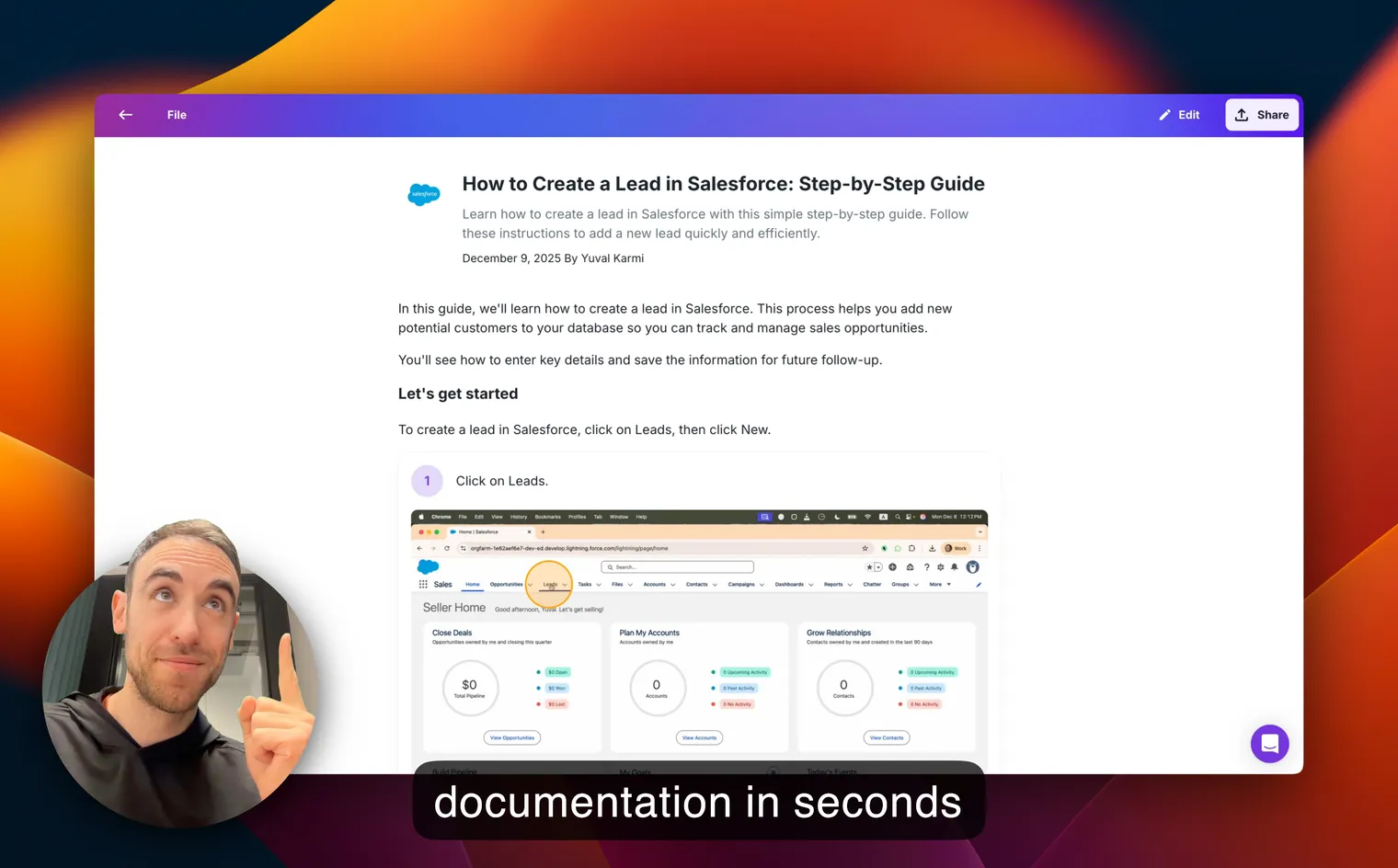
Screenshots and diagrams make a huge difference in comprehension. A picture showing exactly where to click beats a paragraph of description any day.
This is actually why I built Glitter AI. I wanted to make it easy to capture screenshots automatically while documenting a process.
5. Include the Why
Don’t just tell people what to do. Tell them why. When someone understands the purpose, they can make better decisions when situations don’t match the documentation exactly.
6. Test It
Have someone unfamiliar with the process try to follow your SOP. Watch where they struggle. Those struggle points reveal gaps in your documentation.
7. Keep It Updated
SOPs are living documents. Build in regular reviews. When processes change, update the documentation right away, not “later” (which always means never).
For a complete walkthrough, see my full guide to building SOPs.
Common SOP Mistakes to Avoid
I’ve made all of these mistakes. Learn from my pain:
Writing SOPs nobody can find. If people can’t locate the documentation, it might as well not exist. Use a centralized system with good search.
Making them too long. A 50-page SOP won’t get read. Break complex processes into multiple focused documents.
Using jargon without explanation. New team members won’t know your internal acronyms. Define terms or link to a glossary.
Documenting the ideal, not the real. Write down what actually happens, not what should happen in a perfect world. You can improve processes later.
Never updating. Outdated SOPs are worse than no SOPs. They actively mislead people.
Creating without ownership. Every SOP needs an owner who’s responsible for keeping it current.
SOP Software and Tools
You can write SOPs in Word docs or Google Docs. Many companies do, and that’s fine. But as you scale, you’ll probably want something purpose-built.
Options range from simple wiki tools to full process documentation platforms. I compare several in my guide to tools for documenting your workflows.
Key features to look for:
- Easy editing and updating
- Version control
- Search functionality
- Access controls
- Integration with your existing tools
And if you want to create SOPs without the manual work of writing and taking screenshots, tools like Glitter AI can capture your screen automatically as you walk through a process, turning your actions into documentation.
Frequently Asked Questions
Frequently Asked Questions
What does SOP stand for?
SOP stands for Standard Operating Procedure. It's a document that provides step-by-step instructions for completing a specific task or process within an organization. SOPs ensure consistency, reduce errors, and make it easier to train new team members.
What is the difference between an SOP and a policy?
A policy states what should be done and why (the rules), while an SOP explains exactly how to do it (the steps). For example, a policy might say 'All customer refunds must be processed within 48 hours.' The SOP would detail the specific steps to process that refund in your systems.
How long should an SOP be?
An SOP should be as long as necessary but as short as possible. Most effective SOPs are 1-3 pages. If your SOP is longer than 5 pages, consider breaking it into multiple documents. The goal is to be complete without overwhelming the reader.
Who should write SOPs?
The person who knows the process best should contribute to the SOP, but they don't have to write it alone. Often, having a documentation specialist or manager interview the subject matter expert works well. The expert provides the knowledge; someone else structures it clearly.
How often should SOPs be reviewed?
At minimum, review SOPs annually. Better yet, review them whenever processes change. Many companies assign an owner to each SOP who's responsible for keeping it current. Set calendar reminders for quarterly or semi-annual reviews of critical procedures.
What's the difference between an SOP and work instructions?
SOPs typically cover broader procedures and may include multiple tasks, while work instructions focus on a single, specific task in detail. An SOP might cover 'Customer Onboarding' while work instructions would detail 'How to Create a Customer Account in Salesforce.' See our full comparison in the SOP vs work instructions guide.
Can I use AI to create SOPs?
Yes. AI tools can help create SOPs by capturing your screen as you perform tasks, transcribing your explanations, and formatting everything into a structured document. This is much faster than manual documentation. Tools like Glitter AI specialize in this approach.
What industries require SOPs?
While SOPs benefit any business, they're legally required in healthcare, pharmaceuticals, food production, aviation, and financial services due to regulatory compliance. Manufacturing, IT, and customer service industries also rely heavily on SOPs for quality and consistency.
The Bottom Line
An SOP is simply a documented way of doing things. It’s the difference between “ask Sarah, she knows how” and “here’s exactly how we do this.”
Good SOPs make your business more consistent, more efficient, and less dependent on any single person’s knowledge. They’re not glamorous, but they’re essential.
The hardest part isn’t writing SOPs. It’s maintaining them. Whatever system you use, build in regular reviews and make updating easy.
If you want to make SOP creation faster, check out Glitter AI. I built it to capture processes automatically so you can create documentation in minutes instead of hours.
But whether you use specialized tools or just Google Docs, the important thing is to start documenting. Your future self (and your team) will thank you.
Document any process in minutes with AI. Start for free.