
Read summarized version with
What is Deviation Management?
Deviation management is the formal process regulated manufacturers use to identify, document, investigate, and resolve any departure from approved procedures, specifications, or standards. In GMP environments such as pharmaceutical, biotech, and medical device production, a deviation is any unintended move away from the validated state. Think a missed batch record step, an out-of-specification environmental reading, or an equipment parameter that drifts past its limits.
Fixing the immediate problem is only part of it. You also have to assess the impact on product quality and patient safety, work out why it happened, and stop it from happening again. Done well, deviation management keeps the quality control system honest: every excursion gets captured, classified by risk, and closed with documented evidence instead of being left to memory or some informal workaround.
Regulators expect that rigor. FDA 21 CFR 211.192 requires a thorough, written investigation of any unexplained discrepancy or batch failure, and weak or delayed deviation closure remains one of the most-cited findings in GMP inspections - failure to investigate discrepancies under 21 CFR 211.192 has appeared in the FDA’s top five 483 observation categories every year for at least a decade.
Key Characteristics of Deviation Management
- Risk-based classification: Every deviation is graded minor, major, or critical based on its impact on product quality, patient safety, and Critical Quality Attributes. That grade decides how deep the investigation goes and how fast it has to move.
- Structured investigation: Major and critical deviations call for root cause analysis using tools like 5 Whys or fishbone diagrams, backed by scientific evidence rather than guesswork.
- Containment first: Affected material gets quarantined right away while the team assesses the impact on other batches that share equipment, materials, or methods.
- Documented closure: A deviation can’t close until corrective actions are done, verified effective, and recorded in the manufacturing SOP and quality system.
- Trending: Looking at deviation data in aggregate surfaces recurring or systemic issues that a single event would never reveal on its own.
Deviation Management Examples
Example 1: Equipment failure mid-batch
Picture an operator running a routine tablet batch when the press quietly loses compression force control. Tablets start coming off the line outside the validated hardness and weight spec, and she catches it on a spot check. That’s an unplanned deviation, and it’s likely a major one. She quarantines the batch, and now the investigation can’t just stop at “fix the press.” Anyone who ran a lot on that same equipment recently is in scope too, because the same fault could have touched their material without anyone noticing.
Example 2: Cold-chain excursion
Now imagine a refrigeration unit holding a biologic drug product. A compressor fault lets it drift above the validated 2-8°C window over a weekend, and you only find out Monday from the data logger. You can’t just shrug and ship it. Before any of those lots get released, your team has to go back and assess stability and potency for every single batch that was sitting in that unit while it was warm. One quiet hardware failure can put weeks of product in question.
Planned vs Unplanned Deviations
A planned deviation is a pre-approved, justified, intentional departure that’s documented and authorized before execution, with risk assessed up front. A temporary process change or a validation trial is a typical case. An unplanned deviation is the unexpected kind that happens without prior approval: equipment failure, operator error, contamination. Unplanned deviations are the ones that get severity-classified and investigated after the fact.
| Aspect | Planned Deviation | Unplanned Deviation |
|---|---|---|
| Timing | Approved before the event | Discovered after it occurs |
| Risk assessment | Done in advance | Done during investigation |
| Typical trigger | Process change, trial, equipment substitution | Equipment failure, error, excursion |
How Glitter AI Helps with Deviation Management
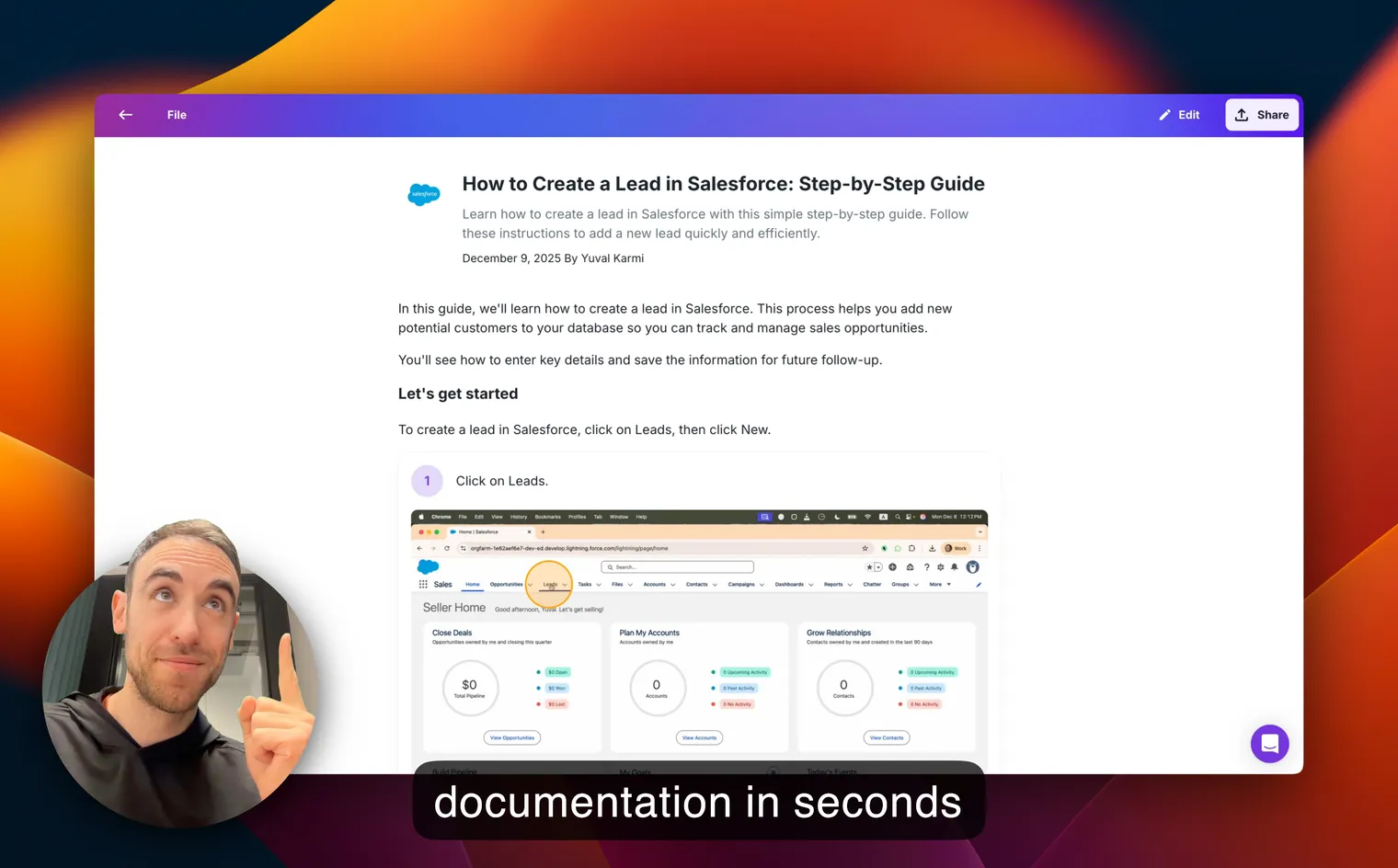
Here’s the thing about deviation procedures: the ones that actually keep you out of trouble are the ones people can follow under pressure, at 2am, on a shift where the expert is off. Glitter AI makes those easy to capture. Just record your screen while you walk through a deviation intake, an investigation, or a closure, and Glitter turns it into a clean step-by-step guide with screenshots. Your quality staff get to see exactly how to log the event, classify the severity, and route it to the right reviewer, instead of guessing or asking around.
Where this really pays off is when the auditor shows up. Instead of scrambling to explain how things “usually” get done, you’ve got your deviation handling documented the way it’s genuinely run across shifts and sites, with the corrective action and CAPA process it feeds into spelled out right there. Pair it with a solid process audit habit and two good things happen: new quality investigators get up to speed in days instead of months, and inspectors see a current, defensible paper trail rather than tribal memory.
Teach your co-workers or customers how to get stuff done – in seconds.

Frequently Asked Questions
What is deviation management in GMP manufacturing?
Deviation management is the quality-system process for identifying, documenting, investigating, and resolving any departure from approved procedures or specifications in regulated manufacturing, with the goal of protecting product quality and patient safety.
What is a deviation in pharmaceutical manufacturing?
A deviation is any unintended departure from an approved procedure, specification, or validated state, such as a missed batch record step, an out-of-specification reading, or an equipment parameter exceeding its limits.
What is the difference between a deviation and a CAPA?
A deviation is the triggering event, while CAPA (Corrective and Preventive Action) is the downstream remediation. The deviation is investigated for root cause, and a CAPA is opened when the cause indicates a systemic or recurring risk.
What is the difference between planned and unplanned deviations?
A planned deviation is pre-approved and documented before it happens, with risk assessed in advance. An unplanned deviation occurs unexpectedly without prior approval and must be classified and investigated after the fact.
What are the types of deviation classification?
Deviations are typically classified as minor (no foreseeable quality or safety impact), major (could affect product quality or violate GMP), or critical (direct impact on patient health or safety, may trigger a recall).
Does every deviation require a CAPA?
No. Minor, one-off deviations may close with a simple corrective action. A formal CAPA is invoked when the root cause points to a systemic issue, recurring risk, or serious quality or safety impact.
What is the deviation management process?
The lifecycle is detection and containment, documentation, risk-based classification, investigation, root cause analysis, corrective action or CAPA, effectiveness check and closure, and ongoing trending.
What regulations govern deviation management?
FDA 21 CFR 211.192 and cGMP (21 CFR Parts 210/211) govern pharmaceutical deviations, ICH Q10 and Q9 embed it in the quality system, and medical devices follow 21 CFR Part 820 and ISO 13485.
What is root cause analysis in a deviation investigation?
Root cause analysis is the structured determination of the true underlying cause of a deviation using tools like 5 Whys or fishbone diagrams, supported by scientific evidence rather than assumptions.
How long do you have to close a deviation?
Closure timelines depend on severity and company SOPs, but investigations should begin promptly and minor deviations typically close within a defined window while major and critical ones require deeper, time-bound investigation before closure.