
Read summarized version with
The most expensive document at any plant I’ve worked with is the one that doesn’t exist. There’s a machine that only one person knows how to changeover. There’s a “we always do it this way” step that lives in a 30-year veteran’s head and nowhere else. Then that person takes a vacation, or retires, and the line slows to a crawl while everyone reverse-engineers what they used to do in their sleep.
I’m Yuval, founder and CEO of Glitter AI. I’ve spent years helping manufacturing and operations teams turn the procedures locked in one person’s head into documentation the whole floor can follow. A good SOP for manufacturing is the cheapest insurance you’ll ever buy against that scenario, and somehow it’s still the thing most plants put off until an audit forces them.
So let me walk through it properly. What a manufacturing SOP actually is. Why they matter more on a production floor than almost anywhere else. What good ones look like, and a step-by-step way to build them without it turning into a six-month documentation project. Much of that process starts with interviewing the operator who actually runs the line, not writing from a manager’s mental model of it.
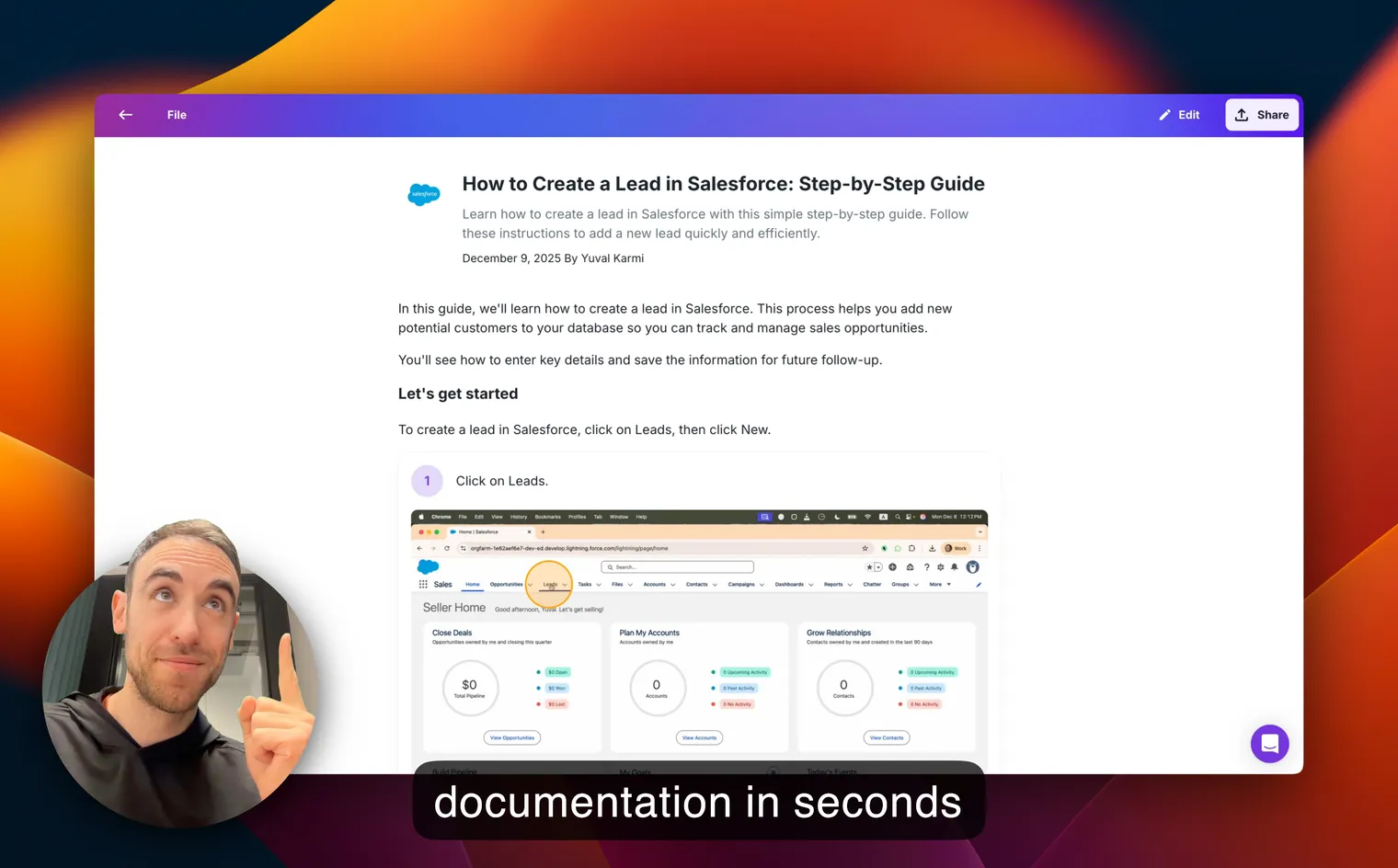
Teach your co-workers or customers how to get stuff done – in seconds.

What an SOP for manufacturing actually is
A standard operating procedure is a documented, repeatable method for doing a specific task the same way every time, by anyone who’s trained on it. In manufacturing, that “every time, by anyone” part is the whole point. A line that depends on who’s running it isn’t a process, it’s a gamble.
It helps to be precise about the layers here, because people use these terms loosely:
- A standard operating procedure describes what to do and why, at the level of a task or process.
- A work instruction goes deeper, the literal click-by-click or turn-by-turn detail of a single step. (If you want to go further on that distinction, here’s our guide on how to create work instructions.)
- A production-floor standard procedure is just an SOP scoped to a production environment: machine setup, changeovers, inspection, material handling, safety, maintenance.
“Run the press” is not an SOP. “Verify die part number against the work order, confirm material lot, set tonnage to spec ±X, run five-piece first-article check, get QC sign-off before full run” is. The difference is whether a new hire can follow it without tapping someone on the shoulder.
Why SOPs matter more in manufacturing than almost anywhere else
In a lot of industries a fuzzy process just means a slower week. On a production floor it means scrap, rework, a safety incident, or a failed customer audit. The stakes are physical, and they show up fast. That’s exactly why SOPs earn their keep here.
Consistency is the product
Customers don’t buy your process, but they feel it. Variation between shifts, between operators, between the day everything went smoothly and the day the experienced person was out - that variation is the defect rate. According to the American Society for Quality, the cost of quality - scrap, rework, inspection, and failure - runs 15 to 20 percent of annual sales for a typical manufacturer. An SOP collapses “however this particular person does it” into one agreed best way, which is the foundation of any real QC procedure program.
Tribal knowledge is a single point of failure
Every plant has a few people who are load-bearing. They know the trick to get the old line started on a cold morning, the feel of when a tool is going dull, the workaround nobody wrote down. That knowledge is incredibly valuable and incredibly fragile. Deloitte and the Manufacturing Institute estimate that 2.8 million of the 3.8 million manufacturing jobs that need to be filled by 2033 will come from retirements - meaning most of the knowledge gap isn’t from growth, it’s from people walking out the door. An SOP is how you move it from one head into the system, before turnover, retirement, or a bad week forces the issue.
Training time is a hidden line cost
Without SOPs, training is just shadowing. A new operator trails a senior one around for weeks, picking things up unevenly, and the senior operator’s own output drops the whole time they’re teaching. Good SOPs turn that into something a new hire can self-serve. They get to competence faster, and you stop paying for the same lesson over and over. (We dug into this specifically in our piece on SOP training.)
Audits and compliance stop being fire drills
ISO 9001, IATF 16949, FDA, customer quality audits - they all ask the same fundamental question: do you do what you say you do, and can you prove it? The ISO Survey puts the total at more than 1.3 million ISO 9001-certified organizations across more than 170 countries, and every one of them had to demonstrate controlled, documented procedures to earn that certificate. An auditor pulling a procedure and watching an operator follow it should be a non-event. Without SOPs, every audit becomes a scramble to document what you’ve been doing all along.
Continuous improvement needs a baseline
You can’t improve a process you haven’t defined. Lean manufacturing runs entirely on standardized work, you set the standard, you measure against it, you improve the standard, you re-baseline. Skip the SOP and your kaizen events are just opinions arguing with each other.
Teach your co-workers or customers how to get stuff done – in seconds.
What good manufacturing SOPs look like: examples
It’s easier to recognize a good SOP than to define one in the abstract. Here are the types most plants need, and what makes each one actually work.
Machine setup and changeover
This is the highest-leverage SOP in most plants, because changeover is where time and consistency go to die. A strong one covers work order verification, tooling and fixture selection, parameter settings with tolerances, the first-article check, and the QC sign-off gate before a full run. Bonus points if it’s built around SMED principles, so the SOP itself is structured to minimize internal setup time.
Quality inspection
What to measure, with what instrument, how often, what the acceptance criteria are, and exactly what to do when a part fails (quarantine, tag, notify, who has disposition authority). The failure path is the part people skip and the part auditors care about most.
Preventive maintenance
Frequency, the specific checks, lockout/tagout steps, what “good” looks like for each item, and how to record it. A PM SOP that doesn’t make the record trivially easy to complete is a PM SOP that quietly stops getting followed.
Safety and lockout/tagout
Non-negotiable, and the place where a fuzzy step isn’t a quality risk, it’s a person. These need to be unambiguous, visual, and impossible to “interpret” your way around.
Material handling and traceability
Lot control, FIFO, labeling, and how material moves and gets recorded between stations. This is the SOP that determines whether a recall is “we pulled three lots” or “we pulled three months.”
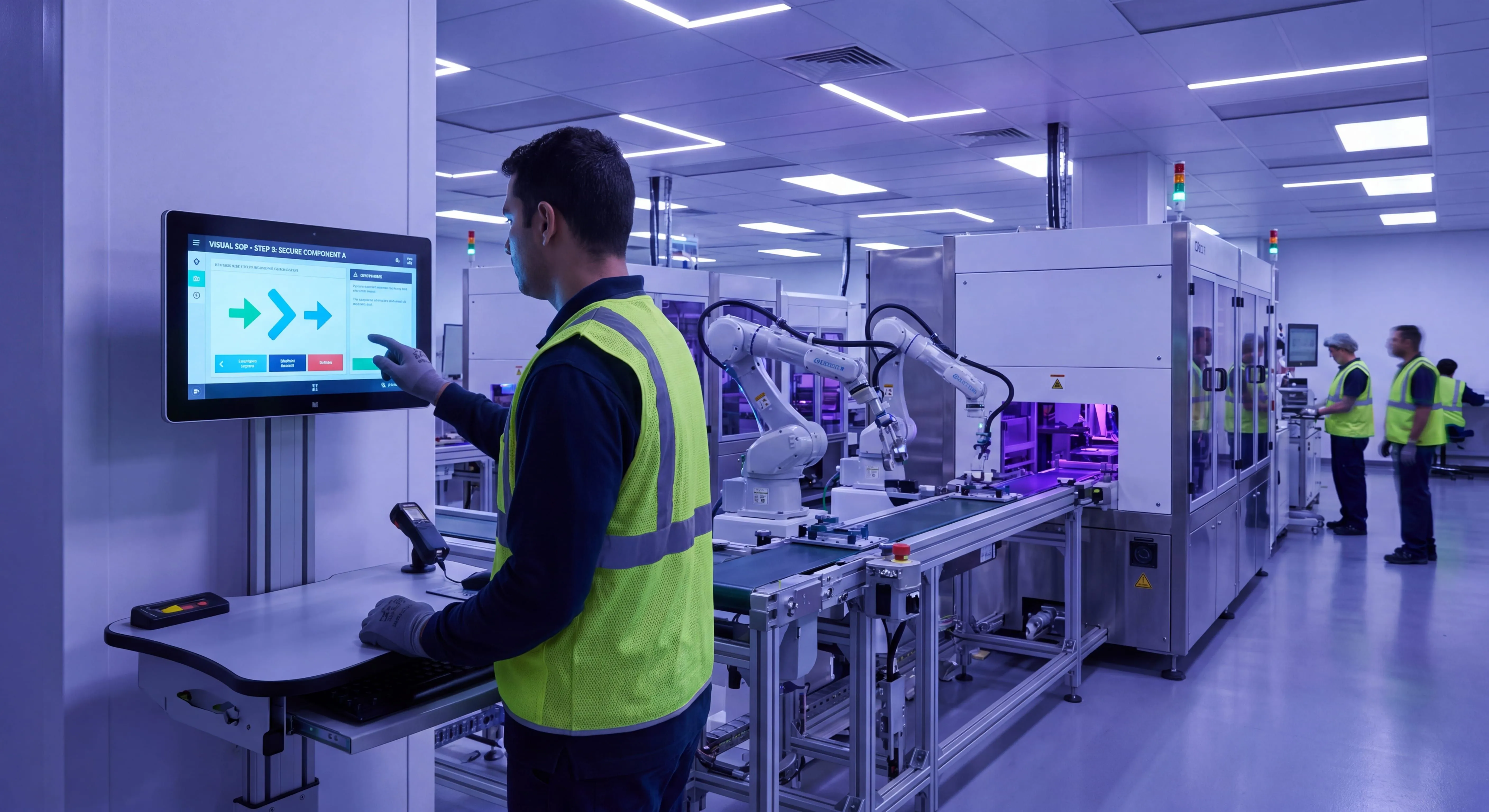
The common thread across all of these is that the best manufacturing SOPs are visual. A wall of paragraph text doesn’t survive contact with a noisy floor and an operator wearing gloves. A picture of the correct setting next to a picture of the wrong one does.
How to build a manufacturing SOP, step by step
Here’s the process I’d actually use. It’s far less painful than the binder-of-Word-docs approach most plants dread.
1. Pick the right process first
Don’t try to document the whole plant. Start where the pain is: the process with the most scrap, the longest changeover, the highest training burden, or the one that depends entirely on one person. One genuinely useful SOP beats fifty that nobody reads.
2. Capture it from the person who actually does it
The single biggest mistake is having a manager write the SOP from memory of how it’s supposed to work. Document the real process by watching your best operator do it. The gap between the official method and the actual method is usually where all the institutional knowledge, and the defects, live.
3. Write for the floor, not the auditor
Use short, numbered, action-first steps. One action per step. State tolerances and acceptance criteria explicitly with numbers, never “set it about right.” Call out hazards and gotchas visually and up front, not buried in a paragraph. Assume the reader is competent but new, not stupid and not a veteran.
4. Make it visual
Every step that has a “right way” and a “wrong way” should show both. Screenshots of the HMI. Photos of the correct fixture orientation. A marked-up image of where the gauge contacts the part. This is the difference between an SOP that gets followed and one that gets ignored after week one. Capturing all that manually with a camera and a doc editor is exactly the friction that kills SOP projects, and it’s the part we built Glitter AI to remove.
5. Validate it with someone who didn’t write it
Hand the draft to an operator who doesn’t normally run that process and have them follow it literally, doing only what’s written. Every place they hesitate, ask a question, or do the wrong thing is a defect in the SOP, not in them. Fix it there.
6. Control it and keep it alive
Give it a number, an owner, a revision, and a review date. An SOP that drifts out of date is worse than no SOP, because people stop trusting any of them. Tie reviews to a cadence and to triggers: a process change, a recurring defect, new equipment. The goal isn’t a perfect document. It’s a living one.
Downloads
Want a starting structure instead of a blank page? Download this free SOP template and adapt it to your line:
Download the SOP Template
A free Word template with the structure, headers, and sections a strong manufacturing SOP needs. Fill it in and ship it.
Download SOP Template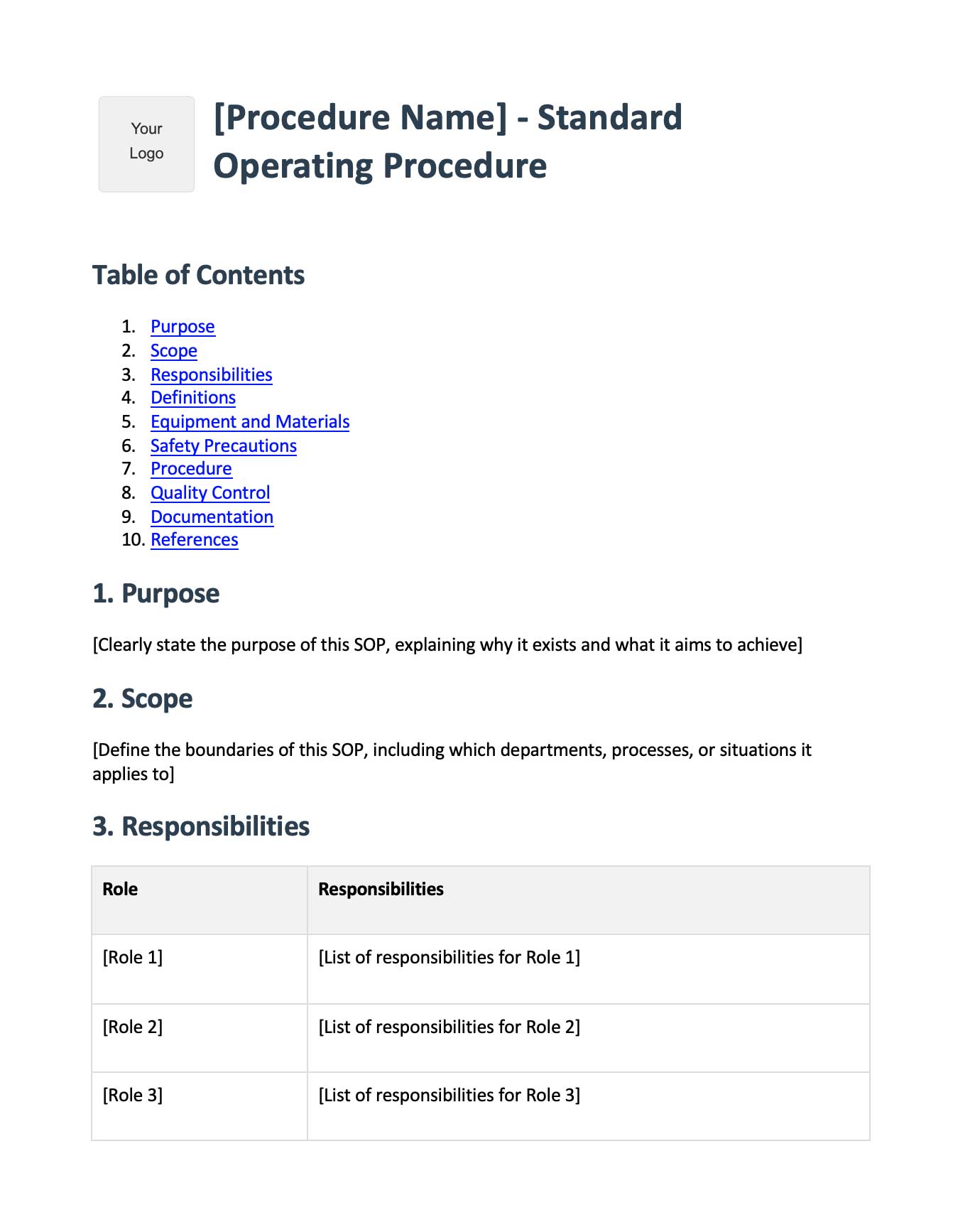
The honest takeaway
A manufacturing SOP isn’t a compliance chore, it’s how a plant stops being hostage to who happens to be on shift. The plants that run smoothly aren’t the ones with the most heroes. They’re the ones where the heroes wrote it down, made it visual, and made it easy enough that following it is the path of least resistance.
Start with one painful process. Capture it from the person who really does it. Make it visual. Validate it with fresh eyes. Then do the next one. That’s the whole game.
Frequently Asked Questions
What is an SOP for manufacturing?
An SOP for manufacturing is a documented, repeatable procedure for performing a specific production task the same way every time, by anyone trained on it. It typically covers machine setup, changeovers, quality inspection, maintenance, safety, and material handling, including the steps, tolerances, and what to do when something fails.
Why are SOPs important in manufacturing?
SOPs reduce variation, scrap, and rework by making sure every operator runs a process the same way. They also move tribal knowledge out of one person's head, cut training time, keep you audit-ready for standards like ISO 9001, and give you the baseline needed for any continuous improvement effort.
What is the difference between an SOP and a work instruction?
An SOP describes what to do and why at the level of a task or process, while a work instruction goes deeper into the click-by-click or turn-by-turn detail of a single step. An SOP often references multiple work instructions. In practice, the SOP is the method and the work instruction is the granular how-to.
What should a manufacturing SOP include?
A strong manufacturing SOP includes a title and unique number, scope and purpose, required tools and materials, step-by-step numbered actions with explicit tolerances, safety call-outs, acceptance criteria, the failure path (what to do when something is out of spec), records to complete, and an owner with a revision and review date.
How do you write a manufacturing SOP?
Pick a high-pain process first, then document the real method by watching your best operator perform it rather than writing it from memory. Use short numbered action steps with explicit numbers and tolerances, make it visual with photos of right versus wrong, validate it with someone who didn't write it, and put it under revision control with a review cadence.
What are examples of SOPs in manufacturing?
Common examples include machine setup and changeover, quality inspection, preventive maintenance, lockout/tagout and safety procedures, and material handling and lot traceability. Changeover and inspection SOPs usually deliver the most value because that is where time loss and defects concentrate.
How often should manufacturing SOPs be reviewed?
Set a recurring review cadence (often annually) and also trigger reviews on events: a process or equipment change, a recurring defect, a near-miss, or a customer complaint. An SOP that quietly drifts out of date is worse than none, because operators stop trusting all of them.
Why should manufacturing SOPs be visual?
A wall of text does not survive a noisy floor and an operator wearing gloves. Photos and screenshots showing the correct setting next to the wrong one let people verify at a glance, which dramatically improves whether the SOP is actually followed and reduces interpretation errors.
How do SOPs support ISO 9001 and audit compliance?
Audits ask whether you do what you say you do and can prove it. Controlled SOPs with owners, revisions, and records turn an audit into a non-event: an auditor can pull the procedure, watch an operator follow it, and see the matching records, rather than triggering a scramble to document existing practice.
What is the most common mistake when creating manufacturing SOPs?
Writing the SOP from how a manager thinks the process works instead of how the best operator actually does it. The gap between the official method and the real method is where institutional knowledge and most defects live, so capturing the real process is essential.