
Read summarized version with
The scariest sentence I have ever heard from a small finance team was four words long: “Only Donna knows that.”
Donna was the bookkeeper. She knew how the bills got entered, how the deposits got matched, which customers got chased on day 30 versus day 45, and the exact order of clicks to close the month. None of it was written down anywhere. It lived in her head, and in the muscle memory of her right hand on the mouse.
Then Donna went on leave for six weeks. The books did not go on leave.
I’m Yuval, CEO of Glitter AI. Most of my week is spent talking to bookkeepers and finance ops people who run their entire operation inside QuickBooks and have almost none of it written down. This post is about fixing that. Specifically, how to turn your QuickBooks workflow into real documentation your team can actually follow when Donna is out, when you hire someone new, or when tax season hits and everyone is moving fast.
Teach your co-workers or customers how to get stuff done – in seconds.

What “QuickBooks Workflow” Actually Means
When people say “our QuickBooks workflow,” they almost never mean QuickBooks itself. They mean the string of human decisions and clicks wrapped around it.
QuickBooks is the tool. The workflow is everything you do with it: which screen you start on, what you check before you hit save, how an invoice becomes a payment, what you do when the numbers don’t line up. The software is the easy part. The workflow is where the knowledge actually lives, and it happens to be the part nobody writes down.
A QuickBooks workflow usually breaks into three workhorse processes:
- Accounts payable - bills in, coded, approved, paid
- Accounts receivable - invoices out, payments in, collections
- Bank reconciliation - books matched to the bank statement
Document those three well and you’ve covered most of what a bookkeeper does in QuickBooks in any given week. Everything else is a variation on the same theme.
Why Undocumented QuickBooks Workflows Are a Real Risk
Let me be honest about the stakes here, because “you should document your process” is the kind of advice everyone nods at and nobody acts on.
Here’s what undocumented QuickBooks workflows actually cost you:
- Single point of failure. If one person leaves, gets sick, or quits during close, your books stall. That’s not hypothetical. That’s the Donna story, and I hear some version of it almost every month.
- Inconsistent books. Two people entering bills two different ways means your chart of accounts slowly turns to mush. Reports get a little less trustworthy every quarter.
- Painful onboarding. Every new hire learns by sitting next to someone for two weeks, asking the same questions the last hire asked. It’s expensive, and it doesn’t scale.
- Audit and tax exposure. When your accountant or an auditor asks “how do you handle this,” “Donna just knows” is not an answer that holds up.
Statista reports that about 64% of small business owners use accounting software - which means the people most likely to be running everything through QuickBooks are also the least likely to have a second person who knows the system. That’s the exact setup where a single undocumented workflow becomes a business risk.
A documented workflow is the difference between a process that survives turnover and one that walks out the door. If you want the broader case for this, our breakdown of what undocumented processes really cost you breaks down the math.
How to Document a QuickBooks Workflow (Step by Step)
Here’s the method I’d hand to any finance team. It works whether you’re on QuickBooks Online or Desktop, and you don’t have to become a technical writer to pull it off.
Step 1: Pick One Workflow, Not All of Them
Most documentation projects die because someone tries to document everything at once. Don’t. Pick the one workflow that would hurt the most if the person who owns it vanished tomorrow. For most teams that’s accounts payable or month-end reconciliation.
Start there. Ship one good SOP before you touch the next one.
Step 2: Capture the Process While You Do It, Not From Memory
This is the part everyone gets wrong. They sit down to “write the SOP” weeks after the last time they actually did the task, and they leave out the three small judgment calls that actually matter, because those calls feel obvious to the person who makes them every day.
The fix: document the workflow while you’re doing it for real. Do the actual bill run. Do the actual reconciliation. Capture every screen as you go. This is also where the judgment calls that never make it into writing actually get caught, since they only surface while the bookkeeper is working the process live.
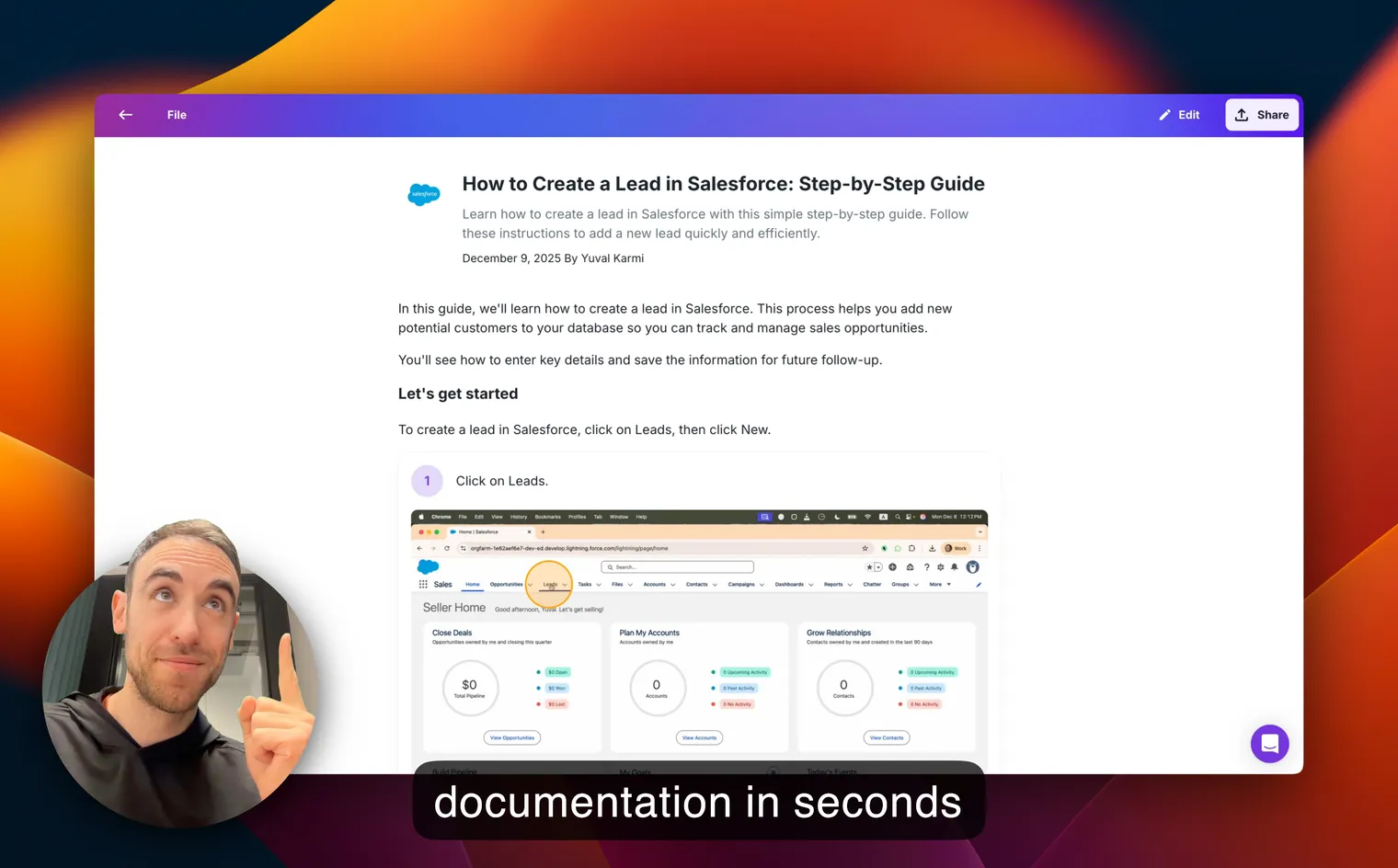
This is pretty much why I built Glitter the way I did. You run the process in QuickBooks once, the way you normally would, and Glitter captures each click as a screenshot with the step written next to it. No stopping to take screenshots, paste them into a doc, crop them, annotate them. You just do your job and a step-by-step guide comes out the other side. For a finance workflow with thirty clicks across six screens, that’s the difference between a one-hour documentation task and a five-minute one. Screen capture is the natural fit here. See the screen recording glossary entry for why visual capture beats writing from memory. If the recording still leaves questions, walking the bookkeeper through a short follow-up interview usually closes the gap faster than a second recording session.
Step 3: Add the Decisions, Not Just the Clicks
A pile of screenshots is not an SOP. The clicks are the skeleton. The judgment is the muscle that makes it move.
Once you’ve captured the screens, go back through and add the why at each decision point:
- “Code utilities to 6200, not 6000 - 6000 is for office supplies only.”
- “If the vendor isn’t in QuickBooks yet, stop and follow the vendor setup SOP first.”
- “Don’t approve anything over $5,000 - route it to the controller.”
These are the exact things that live only in Donna’s head. They’re also the whole reason the documentation is worth doing in the first place. Capturing them is what turns a screenshot tour into a repeatable finance procedure someone can actually run without you in the room.
Step 4: Structure It So Someone Can Follow It Cold
Every QuickBooks workflow SOP should answer four questions at the top before the steps even start:
- When does this run? (e.g. “Bills are processed every Tuesday and Friday”)
- Who owns it? (the role, not just the person)
- What do you need before you start? (access, documents, approvals)
- How do you know it’s done correctly? (the check at the end)
Then the numbered steps with screenshots. Then a short “what to do when it goes wrong” section, because finance work is mostly fine right up until it isn’t.
Step 5: Put It Where People Will Actually Look
A perfect SOP in a folder nobody opens is worthless. Link it from wherever the work starts. If your team lives in a shared drive, that’s where it goes. If you run a finance wiki, put it there. The test is simple: when a new hire asks “how do I do the bill run,” the answer should be a link, not a meeting.
Teach your co-workers or customers how to get stuff done – in seconds.
Documenting the Three Core QuickBooks Workflows
Let’s get specific. Here’s what each of the big three looks like once you document it properly.
Accounts Payable in QuickBooks
The AP workflow is the one that most often hides expensive mistakes, duplicate payments especially. Your documented workflow should walk through receiving the bill, entering it against the right vendor and account, the three-way match where it applies, the approval step, and the payment run. According to APQC benchmarking, the median cost to process a single AP invoice is about $5.83, but the bottom quartile - teams without consistent documented workflows - pay more than $10 per invoice. At scale, that gap is meaningful.
The judgment calls worth capturing: coding rules, approval thresholds, and what happens when an invoice doesn’t match a PO. For the full process logic, the end-to-end AP workflow walkthrough and the three-way match definition pair well with your QuickBooks-specific steps.
Accounts Receivable in QuickBooks
The AR workflow is invoice creation, sending, payment recording, and collections cadence. The part teams forget to document is the collections logic: who gets a reminder at 30 days, who gets a call at 45, what gets escalated and to whom.
Capture the cash application step carefully too. Misapplied payments are one of the top reasons AR aging reports lie to you. The accounts receivable process post covers the end-to-end flow your QuickBooks SOP should mirror.
Bank Reconciliation in QuickBooks
This is the workflow with the most muscle memory and the least documentation, which is a bad combination. The documented version should cover pulling the statement, matching transactions in QuickBooks, telling timing differences apart from actual discrepancies, and what to do when it doesn’t tie out.
The “doesn’t tie out” branch is the whole point. That’s where the duplicated payment gets caught. The bank reconciliation process guide is the deeper reference; your QuickBooks SOP is the screen-by-screen version of it.
If you want the wider weekly and monthly rhythm these three sit inside, the bookkeeping process guide maps the whole calendar, and a clean reconciliation is also what makes the month-end close survivable.
QuickBooks Workflow Documentation Best Practices
A few things I’ve picked up watching finance teams do this well, and watching others do it badly:
- Document the real process, not the ideal one. If the official process is “always get approval first” but in practice small recurring bills skip it, write down what actually happens and flag the exception. Aspirational SOPs get ignored.
- One workflow per document. Don’t write a “QuickBooks Manual.” Write “Weekly AP Bill Run” and “Monthly Bank Reconciliation” as separate, focused guides.
- Show the screen. Finance software is visual. A sentence that says “go to the banking tab” is worth less than a screenshot of the banking tab with the next click circled. This is the single biggest reason screenshot-based capture beats writing from memory.
- Date it and own it. Every SOP needs a last-updated date and a named owner. QuickBooks changes its UI, and a screenshot from two versions ago quietly erodes trust in the whole document.
- Review on a cadence. Re-walk each finance SOP at least quarterly, and again after any QuickBooks UI change or process change. The traceable change history you build by keeping docs current is also what makes audits boring, which is exactly the goal.
The teams that get this right treat documentation as part of doing the work, not a separate project. The first time you document the bill run costs you five extra minutes. Every time after that, it saves the next person an hour.
Turning Tribal Knowledge Into a System
Here’s the real shift. Documenting your QuickBooks workflow isn’t really about the document. It’s about moving knowledge out of one person’s head and into a system the team owns.
Once Donna’s process is written down, she stops being a risk and starts being someone who can take a vacation. The new hire onboards in days instead of weeks. Your accountant gets a straight answer. And you, whoever owns the finance function, stop lying awake wondering what happens if the one person who knows the books gets hit by a bus.
That’s the whole game. Not perfect documentation. Just enough that the work survives the person. If you want the founder-level version of this argument, I wrote about why I document everything. It applies to a two-person bookkeeping team exactly as much as it applies to a startup.
So pick your most dangerous undocumented QuickBooks workflow. Do it once, captured. You’ll have your first real SOP before lunch.
Teach your co-workers or customers how to get stuff done – in seconds.
Frequently Asked Questions
What is a QuickBooks workflow?
A QuickBooks workflow is the sequence of steps and decisions your team follows to complete an accounting task in QuickBooks, such as entering bills, sending invoices, or reconciling the bank. The software is the tool; the workflow is the repeatable process wrapped around it.
How do I document a QuickBooks workflow?
Pick one workflow, then capture each step with a screenshot while you actually perform the task in QuickBooks rather than writing it from memory. Add the decision logic at each step (coding rules, approval thresholds, exceptions), structure it with a clear owner and trigger, and store it where your team will look for it.
Which QuickBooks workflows should I document first?
Start with the workflow that would cause the most damage if the person who owns it disappeared tomorrow. For most teams that is accounts payable or month-end bank reconciliation. Document one well before moving to the next.
What should a QuickBooks SOP include?
A good QuickBooks SOP states when the process runs, who owns it, what you need before starting, and how you verify it was done correctly. Then it lists numbered steps with screenshots and a short troubleshooting section for when things go wrong.
Why is documenting QuickBooks processes important for small finance teams?
Small teams often have a single person who knows the entire process by memory, which makes turnover, sick leave, or vacation a real risk to the books. Documentation moves that knowledge into a system the whole team can follow and makes onboarding and audits far easier.
Should I document my QuickBooks workflow from memory or while doing it?
Always document it while doing the real task. Writing from memory weeks later almost always leaves out the small judgment calls that matter most, because they feel obvious to the person who makes them daily. Capturing the process live preserves those decisions.
How is documenting a QuickBooks workflow different from QuickBooks training?
QuickBooks training teaches general software skills, while workflow documentation captures your specific process, your coding rules, your approval thresholds, and your exceptions. Training shows how the software works; documentation shows how your team uses it.
How often should I update QuickBooks workflow documentation?
Review each finance SOP at least quarterly and immediately after any QuickBooks UI change or process change. Outdated screenshots erode trust in the whole document, so every SOP should carry a last-updated date and a named owner.
Can I use screenshots to document a QuickBooks process?
Yes, and you should. Finance software is highly visual, so a screenshot of the exact screen with the next click marked is far clearer than a written instruction. Tools like Glitter AI capture each click as a screenshot automatically while you work, which removes the manual screenshotting effort.
How does documenting QuickBooks workflows help during tax season?
Tax season is when everyone moves fast and mistakes are costly. Documented workflows keep the books consistent, let any team member cover the process if someone is out, and give your accountant clear answers about how each step is handled.