
Read summarized version with
A few years back I spent a week on the floor of a small manufacturer that was bleeding money on returns. Not because nobody cared about quality. They cared, a lot. They had inspectors, gauges, a “quality binder,” all of it.
So what was wrong? Every inspector checked parts a little differently. One measured three dimensions, the next measured five. The day shift would sign off on cosmetic flaws the night shift threw straight in the reject bin. Their quality control procedures existed on paper. On the floor, though, “quality” meant whatever the person holding the part decided it meant that day. That inconsistency has a price tag: quality costs typically consume between 15 and 20 percent of annual sales at manufacturers that haven’t gotten a handle on them, according to the American Society for Quality.
I’m Yuval, founder and CEO of Glitter AI. I’ve spent years helping operations and quality teams turn fuzzy, in-someone’s-head processes into documentation people actually follow. Quality control is probably where this matters most. An inconsistent QC process doesn’t just slow you down. It ships defects to customers and chips away at trust you spent years earning.
So let me walk you through how quality control procedures actually work in practice: the types, the steps, and the documentation that makes them stick across shifts and people.
Teach your co-workers or customers how to get stuff done – in seconds.


What Are Quality Control Procedures?
Quality control procedures are the documented, repeatable steps your team follows to check that a product, batch, or output meets defined specifications before it moves forward. They answer four questions every single time, no matter who’s doing the work:
- What are we checking (the characteristic or spec)?
- How do we check it (the method, tool, and sample size)?
- What counts as pass vs. fail (the acceptance criteria)?
- What happens when something fails (the disposition and escalation)?
One distinction people blur constantly is worth getting right. Quality control is the inspection and testing of actual output to catch defects. Quality assurance is the wider system of processes built to prevent defects in the first place. QC is “did this part pass?” QA is “is our process even capable of making good parts?” You need both, and good QC procedures are the part of QA that sits closest to the product.
Writing them down isn’t about bureaucracy. It’s about removing the one variable that wrecked my client above: human interpretation. When the procedure is explicit, the night shift and the day shift make the same call.
The Main Types of Quality Control Procedures
Not all QC happens at the same place or the same time. Most teams run some mix of these, and your documentation should make clear which is which.
Incoming inspection (receiving QC)
You check raw materials and components from suppliers before they ever enter production. Catching a bad lot of fasteners at the dock is cheap. Catching that same lot after it’s been welded into a finished assembly is anything but. Incoming inspection procedures usually reference a sampling plan and tie back to supplier quality records.
In-process inspection
You check work while it’s still being produced, at defined control points between operations. This is where you catch a drifting machine before it makes 5,000 bad units instead of 50. In regulated environments, in-process checks usually get captured in a batch record, so there’s a contemporaneous, signed history of what was verified and when.
Final inspection (outgoing QC)
The last gate before the product ships. This one is thorough: dimensional checks, functional tests, cosmetic review, labeling, and packaging verification, all against the customer or regulatory spec.
First article inspection
A full, detailed verification of the first part off a new setup, tool, or production run. You prove the process can make a conforming part before you let it loose at volume. Honestly, it’s about the cheapest insurance you’ll ever buy.
Statistical process control (SPC)
Instead of inspecting every unit, you sample at intervals and chart the results to spot process drift before it turns into defects. This is where QC connects to methodologies like Six Sigma and structured root cause analysis. The data tells you something is moving before the parts go out of spec.
Teach your co-workers or customers how to get stuff done – in seconds.
The Quality Control Process, Step by Step
Here’s the sequence a solid quality control procedure walks through. I’ll keep it concrete, since vague QC steps are exactly how you end up with my client’s “everyone checks differently” mess.
Step 1: Define the specification and acceptance criteria
Before anyone inspects anything, write down exactly what “good” means. Dimensions with tolerances. Functional thresholds. Cosmetic standards, ideally with reference photos or limit samples. “No scratches” is not a spec; “no scratch longer than 2mm visible at arm’s length” is. If you can’t state the acceptance criterion in a single sentence, your inspectors can’t apply it consistently.
Step 2: Determine the inspection method and sample size
Specify the tool (calipers, CMM, go/no-go gauge, test fixture), the measurement procedure, and how many units you check. Document the sampling plan explicitly, say, an AQL-based plan or a fixed sample per lot. “Spot check a few” is not a sampling plan.
Step 3: Perform the inspection
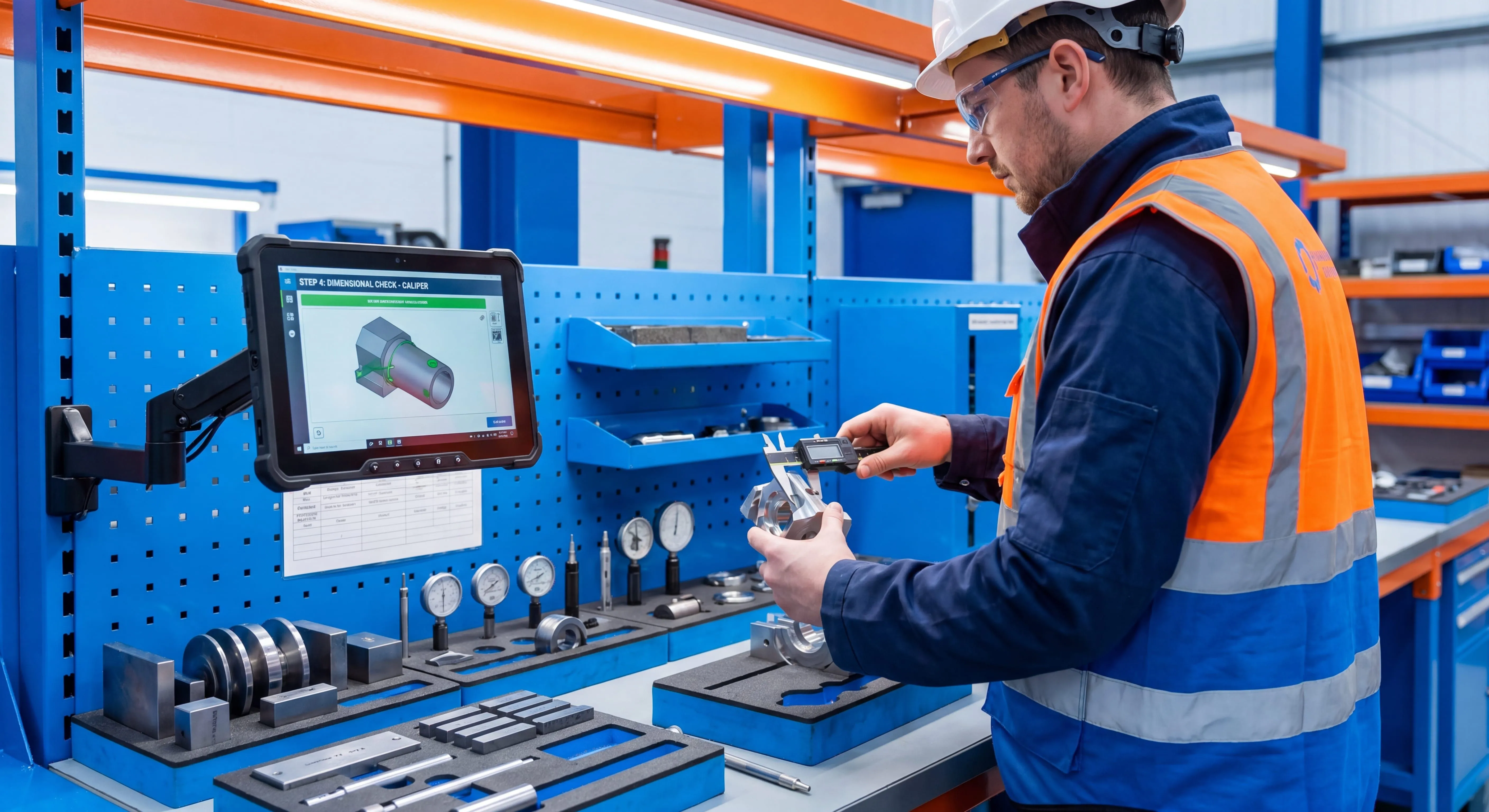
The inspector follows the documented method exactly. This is the step that gains the most from visual, screenshot-or-photo-driven work instructions instead of walls of text. Nobody reads dense procedures on a noisy floor. They look at a picture and copy it.
Step 4: Record the results
Capture measured values, not just pass/fail. “Pass” tells you nothing six months later when you’re knee-deep in a field failure investigation. Actual readings let you see trends and feed SPC. Records should be timestamped, attributable to a person, and stored somewhere they can’t be quietly edited. A tamper-resistant record of who recorded each reading and when matters as much as the measurement itself.
Step 5: Disposition nonconforming items
When something fails, the procedure has to spell out what happens next: quarantine, rework, scrap, use-as-is with approval, or return to supplier. Ambiguity at this step is exactly where defects “accidentally” escape. Nonconformities that recur or carry real risk should trigger formal deviation management so the event gets investigated rather than quietly set aside.
Step 6: Drive corrective and preventive action
A failed inspection isn’t the end of the procedure. It’s the trigger for the next one. Repeated or significant nonconformities feed into your corrective action / CAPA process: find the root cause, fix it, and put a control in place so it doesn’t come back. QC that only catches defects without closing that loop is just expensive sorting.
How to Document Quality Control Procedures That People Actually Follow
I’ve read hundreds of QC procedures by now. The ones that fail almost always fail for the same handful of reasons, and the fixes aren’t complicated.
Lead with the visual. A photo of a correctly seated connector beats three paragraphs describing it. Quality is visual; your procedures should be too. This is the single biggest reason I see procedures ignored. They get written like legal documents when they should look like a recipe with pictures.
Make pass/fail unambiguous. Every check needs an explicit acceptance criterion an inspector can apply without judgment. If two reasonable people could look at the same result and disagree, the procedure isn’t finished.
Keep one procedure per job, in the order it’s done. Don’t make an inspector cross-reference four documents to check a single part. Mirror the physical sequence of the work.
Version it and date it. QC procedures change when specs change. An out-of-date procedure is arguably worse than none at all, because people trust it. Track revisions and make the current version the only one anyone can reach. (We’ve written more about why documentation goes stale and how to prevent it.)
Tie it to the standard. If you’re working toward or maintaining ISO 9001, your QC procedures are a core piece of the evidence that your quality system actually runs the way your manual claims it does.
This is honestly the reason I built Glitter AI. Capturing an inspection procedure used to mean someone sitting down to write and screenshot every step, which meant it never got done, or got done once and never touched again. Glitter records the process as you actually perform it and turns it into a visual, step-by-step guide automatically. The procedure stops being a binder nobody opens and starts being something an inspector can follow on a tablet right at the station.
Teach your co-workers or customers how to get stuff done – in seconds.
Common Quality Control Mistakes (And How to Avoid Them)
A few patterns show up over and over:
- Inspecting quality in instead of building it in. If your only quality strategy is final inspection, you’re paying to make defects and then paying again to find them. According to the American Society for Quality, world-class manufacturers keep their total quality cost below 5 percent of revenue; companies relying on end-of-line sorting often run three to six times that. Push checks upstream with in-process and incoming inspection.
- Recording pass/fail instead of values. You lose every trend and every early warning. Record the actual measurement.
- No defined disposition for failures. When the procedure goes silent at “fail,” the floor improvises, and usually it improvises toward shipping it.
- Procedures that don’t match reality. If the documented method doesn’t match the equipment on the floor, inspectors invent their own. Walk the floor and verify before you publish. A periodic process audit catches this kind of drift.
- Quality knowledge living in one person’s head. When your best inspector retires, the standard walks out the door with them, unless it’s documented in a way the next person can actually use.
Putting It Together
Good quality control procedures aren’t about more paperwork. They’re about making sure the part your customer receives matches the part you promised. Every time, on every shift, no matter who’s holding the gauge.
Start with one process. Define what “good” means in a sentence. Document the inspection method visually. Record real values. Decide in advance what happens when something fails, then close the loop with corrective action when it does. Do that consistently, and your returns, scrap, and late-night “why did this ship?” conversations all start dropping together.
If you want a deeper foundation on the documentation side, our guide on manufacturing SOP best practices pairs well with this one.
Frequently Asked Questions
What are quality control procedures?
Quality control procedures are documented, repeatable steps a team follows to verify that a product or output meets defined specifications before it moves forward. They specify what to check, how to check it, what counts as pass or fail, and what happens when something fails.
What is the difference between quality control and quality assurance?
Quality control is the inspection and testing of actual output to catch defects. Quality assurance is the broader system of processes designed to prevent defects in the first place. QC asks 'did this part pass?' while QA asks 'is our process capable of making good parts?'
What are the main types of quality control procedures?
The most common types are incoming inspection (checking supplier materials), in-process inspection (checking work during production), final inspection (the last gate before shipment), first article inspection (verifying the first part of a new run), and statistical process control (sampling and charting to detect drift).
What are the steps in a quality control process?
A typical quality control process defines the specification and acceptance criteria, determines the inspection method and sample size, performs the inspection, records the results, dispositions any nonconforming items, and drives corrective and preventive action for recurring failures.
How do you document quality control procedures?
Lead with visuals like photos or screenshots, make pass/fail criteria unambiguous, keep one procedure per job in the order the work is done, version and date every procedure, and tie it back to the relevant quality standard such as ISO 9001.
What is a quality control inspection?
A quality control inspection is the act of measuring or examining a product against its specification using a defined method, tool, and sample size, then recording the result. Inspections can occur at receiving, in-process, or final stages depending on the procedure.
What should you record during a quality control inspection?
Record the actual measured values rather than just pass or fail, along with a timestamp, the inspector's identity, the procedure version used, and the disposition of any failures. Capturing real values lets you spot trends and feed statistical process control.
What happens when a part fails quality control?
The procedure should define the disposition: quarantine, rework, scrap, use-as-is with documented approval, or return to supplier. Significant or recurring failures should trigger deviation management and a corrective action (CAPA) investigation to find and eliminate the root cause.
Why do quality control procedures fail to get followed?
The most common reasons are procedures written as dense text instead of visual steps, ambiguous pass/fail criteria, documents that don't match the actual equipment on the floor, and outdated versions that no one maintains. Visual, current, station-level procedures get followed far more reliably.
How do quality control procedures support ISO 9001?
Documented and consistently followed QC procedures are core evidence that a quality management system operates as described. Auditors look for clear acceptance criteria, complete inspection records, defined nonconformance handling, and a working corrective action loop.