
Read summarized version with
Every finance team I talk to has the same quiet problem. The procurement process works, but only because one or two people carry it in their heads.
They know which vendor needs a PO before they’ll ship. They know that one approver who sits on requisitions for a week unless you Slack them. They know the exact way the ERP wants the GL code entered so the invoice doesn’t bounce in three-way match. None of it is written down. And the day that person is out sick, or quits, the whole thing grinds.
If you work in finance or procurement ops, you already feel this. A textbook definition of procurement isn’t what you’re after. You want to see the full procurement process laid out step by step, the way it actually runs day to day, including the vendor onboarding process that so often stalls payments, plus a way to make it survive turnover.
I’m Yuval, founder of Glitter AI. The tool I build turns a screen recording into a step-by-step guide, and through that work I’ve watched dozens of procurement and AP teams describe this exact headache. So let me walk you through the whole cycle, with a nod to the purchasing SOP that keeps it consistent. Then I’ll show you the part most guides skip: how to make the process stick.
Teach your co-workers or customers how to get stuff done – in seconds.

What is the procurement process?
The procurement process is the full sequence a business follows to buy the goods and services it needs, from the moment someone realizes they need something to the moment the supplier gets paid. People also call it the procurement cycle or, when it’s tied tightly to payment, the procure-to-pay process.
It’s not just “buying stuff.” A real procurement process has controls baked in - approvals, budget checks, vendor vetting, a paper trail - so the company doesn’t overspend, get defrauded, or pay for things it never received.
Here’s what most people miss. The steps are fairly universal, but your version has a hundred small specifics. Which system you raise the requisition in. Who approves what dollar amount. How a vendor gets onboarded. That specificity is what lives in someone’s head and never makes it into a document. We’ll fix that at the end.
The procurement process, step by step
Below is the full cycle. I’ve kept it to the seven steps that show up in almost every finance team, whether you’re running NetSuite, SAP, or a stack of spreadsheets and email.
Step 1: Identify the need
Everything starts when someone in the business realizes they need something. A laptop for a new hire. Raw materials for a production run. A SaaS renewal. A contractor for a project.
Sounds trivial. It’s actually where the most money leaks. A vague need (“we need more software”) turns into the wrong purchase. A good procurement process forces the requester to specify what, how much, when, and why before anything moves. The clearer the need, the cleaner everything downstream. According to the Hackett Group’s 2025 procurement research, top-performing procurement teams generate more than twice the cost savings as a percentage of spend compared to their peers - and the difference starts here, at the need-definition step.
Step 2: Create a purchase requisition
The need becomes a formal purchase requisition - an internal request to buy. This is the first real control point. The requisition captures the item, quantity, estimated cost, the budget or cost center it hits, and the business justification.
A requisition is internal. Nothing has been ordered yet. You’re asking the company for permission to spend, not telling a vendor to ship. Mixing these two up is one of the most common process mistakes I see, and it’s almost always a documentation gap rather than a people problem.
Step 3: Approval
The requisition routes for approval. This is where your approval matrix lives: maybe a manager signs off under $1,000, finance reviews $1,000 to $10,000, and anything bigger needs a VP.
Approval is where procurement processes go to die. Requisitions sit. Approvers don’t know it’s their turn. Someone escalates over Slack. If your approval rules and routing aren’t written down somewhere a new hire can actually read, this step turns into tribal knowledge, and tribal knowledge doesn’t scale. The Hackett Group finds that top-performing procurement teams complete the requisition-to-PO cycle 58% faster than peers - and documented approval routing is the single biggest driver of that gap.
Teach your co-workers or customers how to get stuff done – in seconds.
Step 4: Vendor selection and sourcing
Once the spend is approved, you pick who you’re buying from. For routine purchases that might be a pre-approved preferred vendor. For larger or new spend it could mean getting multiple quotes, an RFQ or RFP, evaluating on price, lead time, and reliability, then negotiating terms.
This is also where vendor onboarding happens for any new supplier: collecting their tax forms, banking details, and getting them set up in your system so they can actually be paid later. Skip or rush the vendor setup here and you’re the reason the payment stalls three weeks from now.
Step 5: Create and send the purchase order
Now the requisition becomes a purchase order (PO) - the official, legally binding document you send to the vendor that says “we are buying X, at this price, on these terms.” A clear PO process is the backbone of good procurement, which is why a documented purchasing SOP matters so much here.
The PO does a lot of quiet work. It locks in price and quantity. It gives the vendor authorization to fulfill. And, critically, it becomes the reference document everything else gets matched against later. A sloppy PO step means a painful matching step.
Step 6: Receive the goods or services
The vendor delivers. Someone on your side confirms what actually arrived against what the PO said: right items, right quantity, right condition. This generates a goods receipt (or a services-rendered confirmation).
This is the second financial control. It’s the company’s chance to catch short shipments, damaged goods, or a flat “we never ordered this” before any money moves. Receiving that just rubber-stamps whatever shows up defeats the entire purpose.
Step 7: Three-way match and payment
This is the financial heart of the process. Before AP pays the vendor’s invoice, they run a match across all three documents: the purchase order, the goods receipt, and the invoice all have to agree on item, quantity, and price.
- PO says 100 units at $5.
- Receipt confirms 100 units arrived.
- Invoice bills 100 units at $5.
Match. Pay. If the invoice says 120 units, or $6 each, it gets held and investigated instead of paid. Three-way match is the single biggest defense against overpayment and invoice fraud, and it’s the bridge between procurement and how your team pays its bills. According to World Commerce & Contracting, procurement contracts lose an average of 11% of their value after signature - largely through poor invoice controls, unauthorized changes, and missed obligations that a strict three-way match process is designed to catch. Once it clears, the invoice is approved, scheduled, and paid per the agreed terms.
That’s the full procurement cycle: need, requisition, approval, vendor, PO, receipt, match and pay.
Why the procurement process breaks (and it’s not the steps)
Here’s what I’ve learned from watching teams: almost nobody is confused about the steps. The seven above are not a mystery. Procurement breaks somewhere much more boring.
It breaks because the specifics live in one person’s head. The exact screens. Which field in the ERP. Which approver to chase. Which vendor refuses to ship without a PO number in the subject line. The general process is universal. Your implementation of it isn’t, and your implementation is the part nobody wrote down.
So teams usually write a procurement SOP - a long text document that’s stale within a quarter, that the new AP analyst skims once and never opens again. If you want to do that part well, this guide on building a procurement SOP is a solid starting point. But a static document still has the same fatal flaw: it can’t show someone the actual screens.
Document the procurement process once, so you never re-train
This is the part I actually care about, because it’s the part Glitter AI exists for.
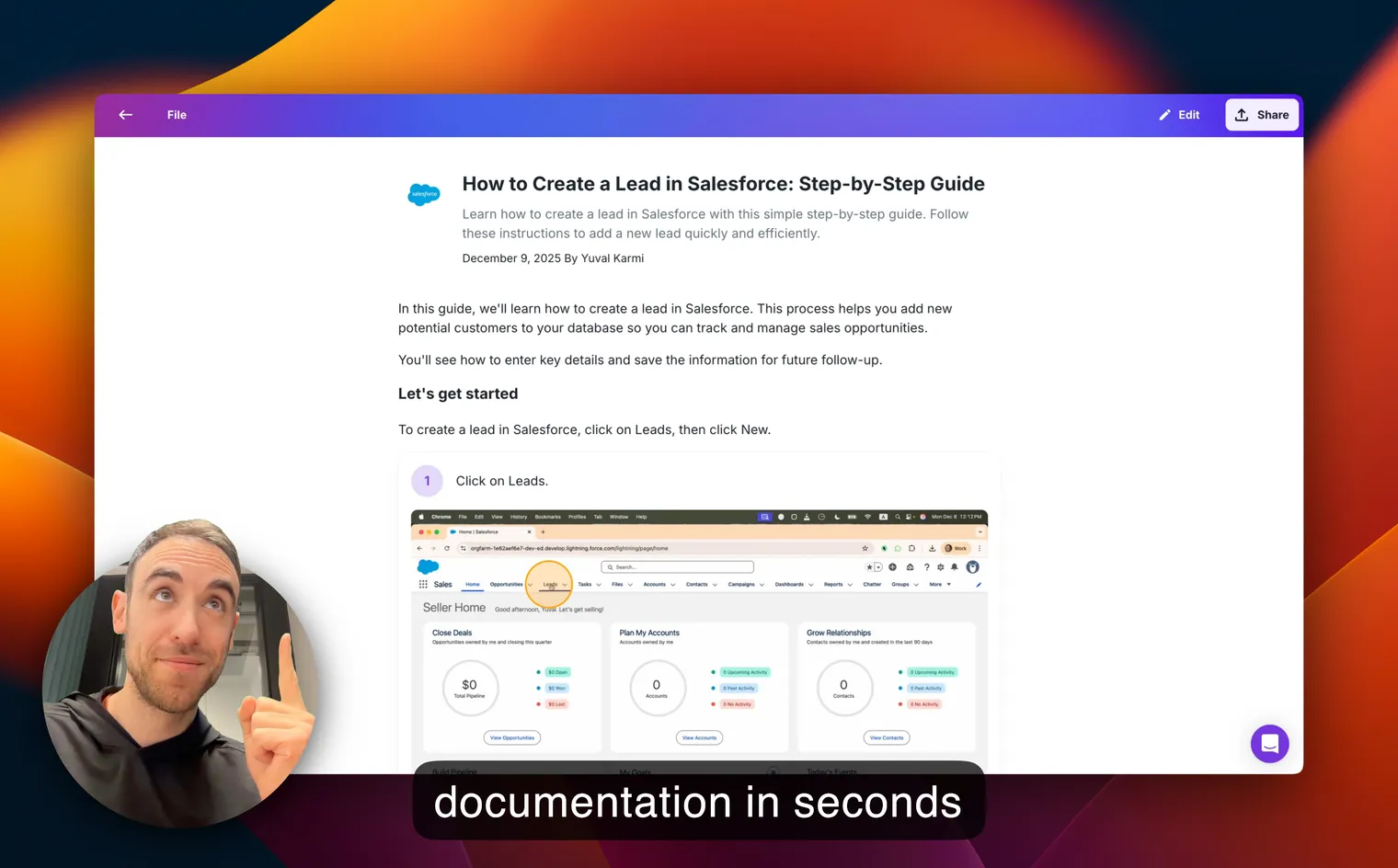
Instead of writing a 20-page procurement manual that goes stale, you run the process once with the screen recorder going. Raise a real requisition. Route a real approval. Cut a real PO. Run a real three-way match in your actual system. Glitter turns that single recording into a clean, step-by-step guide - every click, every screen, with screenshots and written instructions auto-generated.
Then a new person joins finance and you don’t sit with them for a week. You hand them the guide. When the steps change because you migrated ERPs, you re-record the part that changed instead of rewriting a document. Record once, never re-train. That’s the whole pitch, and for a process this repetitive and this turnover-sensitive, it matters more than it sounds.
The teams that get this right treat their procurement process the way good accounting SOP documentation works: capture the real workflow, keep it current, make it self-serve. The steps don’t change much. The people running them change constantly. Your documentation should be built for that reality.
Teach your co-workers or customers how to get stuff done – in seconds.
A quick checklist for a healthy procurement process
If you want to pressure-test your own cycle, here’s what a solid one has:
- A clear need definition so you’re not buying the wrong thing.
- A real requisition step that’s internal and separate from the PO.
- A documented approval matrix by dollar amount, not tribal knowledge.
- Proper vendor onboarding done before the PO, not during payment.
- A clean, specific PO that everything else gets matched to.
- Honest receiving that actually checks against the PO.
- A strict three-way match before any invoice gets paid.
- Self-serve documentation of all of it that a new hire can follow alone.
Get the first seven right and you have a controlled process. Get the eighth right and it survives your team changing, which it will.
I built Glitter AI because the gap between “we have a process” and “anyone on the team can run the process” is where companies quietly bleed time and money. Procurement is about the clearest example of that gap I’ve ever seen.
Frequently Asked Questions
What is the procurement process?
The procurement process is the full sequence a business follows to acquire goods and services, from identifying a need to paying the supplier. It typically includes need identification, requisition, approval, vendor selection, purchase order, receipt, and three-way match before payment.
What are the steps in the procurement process?
The core procurement process steps are: identify the need, create a purchase requisition, get approval, select a vendor, issue a purchase order, receive the goods or services, and run a three-way match before paying the invoice. Most organizations follow this same seven-step cycle regardless of industry.
What is the difference between a purchase requisition and a purchase order?
A purchase requisition is an internal request asking the company for permission to spend, while a purchase order is the external, legally binding document sent to the vendor authorizing the purchase. The requisition comes first and must be approved before a purchase order is issued.
What is the procure-to-pay process?
Procure-to-pay (P2P) is the procurement process viewed end to end with payment included, covering everything from raising a requisition through to settling the supplier invoice. It emphasizes the tight link between procurement activities and accounts payable.
What is a three-way match in procurement?
A three-way match is the control where the purchase order, the goods receipt, and the supplier invoice are compared and must agree on item, quantity, and price before payment is released. It is the primary defense against overpayment and invoice fraud.
Why does the procurement process break down?
Procurement rarely breaks because of the steps themselves, which are well understood. It breaks because the specific details, such as which system to use, who approves what, and how vendors are onboarded, live in one person's head and are never properly documented.
What is a procurement SOP?
A procurement SOP is a standard operating procedure that documents exactly how your organization runs each step of the procurement cycle, including systems, approval thresholds, and vendor setup. A good SOP makes the process self-serve so it survives staff turnover.
How long should the procurement process take?
Cycle time varies widely by purchase type, but most delays come from the approval step rather than the work itself. Documenting the approval matrix and routing clearly is usually the fastest way to shorten overall procurement cycle time.
Who is involved in the procurement process?
Typical participants include the requester who identifies the need, managers and finance who approve spend, the procurement team who source vendors and issue purchase orders, receiving who confirm delivery, and accounts payable who run the three-way match and pay.
How do you document the procurement process so new hires can follow it?
The most reliable approach is to perform the real workflow once with a screen recorder running and convert that recording into a step-by-step guide with screenshots. This captures your exact system and screens, stays easy to update, and lets new finance hires self-serve instead of being trained one-on-one.