
Read summarized version with
A few years ago, at my first startup, we paid the same vendor twice for the same shipment of laptops.
Not because anyone was careless. Because nobody actually owned the purchase order process. One person raised the need, someone else emailed the supplier, a third person approved an invoice they’d never seen a PO for, and finance paid it. Then it came around again the next month and we paid it again. Nobody connected the dots until the bank balance looked weird.
That’s the thing about the purchase order process. When it works, you don’t notice it. When it doesn’t, it’s a slow leak of money and trust, and nobody spots it until it’s already expensive.
I’m Yuval, founder of Glitter AI. I’ve run procurement chaos firsthand, and I’ve spent years helping teams document the processes that keep money from disappearing. Let me walk you through the full purchase order process, step by step, the way I wish someone had walked me through it back then.
Teach your co-workers or customers how to get stuff done – in seconds.


What Is the Purchase Order Process?
The purchase order process is the end-to-end workflow a company follows to request, approve, order, receive, and pay for goods or services. A purchase order (PO) is the formal document at the center of it: a buyer’s commitment to purchase specific items, at agreed quantities and prices, from a specific supplier.
If a purchasing SOP is the rulebook, the purchase order process is the actual game being played. (If you want the rulebook side of this, my purchasing SOP guide covers how to write the procedures themselves.)
A clean PO process buys you three things finance ops actually cares about:
- Control - nothing gets ordered without the right person signing off
- A paper trail - every dollar maps to a request, an approval, and a delivery
- Predictable cash - you know what you’ve committed to before the invoice shows up
The PO process is a core piece of the broader procurement process. Procurement is the whole strategy of sourcing and supplier management; the purchase order process is the transactional engine underneath it.
The 8 Steps of the Purchase Order Process
Here’s the full lifecycle. I’ll walk through each step the way it actually happens, including where it tends to break.
Step 1: Purchase Requisition
Everything starts with someone needing something. A purchase requisition is the internal request that says “we need to buy this” - before any money or supplier is involved.
A good requisition captures:
- What’s needed and why (item, quantity, business justification)
- Estimated cost and budget line
- Requested delivery date
- The requester and their department
This is the cheapest place in the whole process to catch a bad purchase. A requisition sitting in a queue costs nothing. A wrong PO already sent to a supplier costs real money to unwind. So make the requisition step do actual work. That’s where a budget owner should be asking the blunt question: do we even need this?
Step 2: Requisition Review and Approval
Before a requisition becomes a PO, someone with authority reviews it. Usually a department head or budget owner.
This is a checkpoint, not a rubber stamp. The reviewer confirms the need is real, the budget exists, and the spend lines up with priorities. Most organizations route approvals by dollar threshold, and they should: a $200 request and a $200,000 request have no business traveling the same path. Spelling out those thresholds clearly is one of the highest-payoff things you can put in your procurement SOP. APQC benchmarking puts the total cost to process a single purchase order at under $14 for top-quartile organizations and more than $54 for laggards - a gap that narrows quickly once approval routing is documented and followed consistently.
If a requisition gets rejected here, it goes back to the requester with a reason. If it’s approved, it moves into PO creation.
Step 3: Purchase Order Creation
Now the approved requisition becomes a formal purchase order. This is where the request turns into a commitment the supplier can act on.
A complete PO includes:
- A unique PO number (this number follows the order through its entire life)
- Supplier details and your billing/shipping addresses
- Line items: description, quantity, unit price, total
- Payment terms and delivery terms
- Any reference to a contract or quote
Teach your co-workers or customers how to get stuff done – in seconds.
That PO number matters more than people give it credit for. It’s the thread that ties the requisition, the goods receipt, and the invoice together. Without it, you’re back in my laptop story, paying invoices that float free with nothing to anchor them to.
Step 4: Purchase Order Approval
Depending on your controls, the PO itself may need a final approval before it’s released - especially for high-value orders or new suppliers.
Some teams approve at the requisition stage and treat PO creation as a clerical step. Others add a second gate right here, since the PO is the legally binding document. Either way the rule doesn’t change: the person committing company money shouldn’t be the only person who sees it before it’s committed. That’s the whole point of separation of duties.
Step 5: PO Dispatch to the Supplier
The approved PO gets sent to the supplier - via email, a procurement portal, or an EDI integration for larger operations.
The supplier reviews it and, ideally, sends back an order acknowledgment confirming they can fill it at the stated price and date. That acknowledgment is your early warning system. If the supplier comes back with “actually, that price changed” or “that’s a 6-week lead time,” you want to hear it now, not when the invoice lands.
Log the dispatch and the acknowledgment. This is the moment the PO becomes a live commitment, and it’s the start date for tracking whether the supplier delivers on time.
Step 6: Goods Receipt and Inspection
The goods (or services) arrive. Someone on the receiving side checks them against the PO.
This step answers one plain question: did we get what we ordered, in the quantity we ordered, in usable condition? The receiver records a goods receipt - quantity received, date, condition, and any discrepancies.
Skip or rush this step and short shipments and damaged goods get paid for in full. The receiving record is also one of the three documents you’ll need in the next step, so treat it as a real control rather than a box to tick.
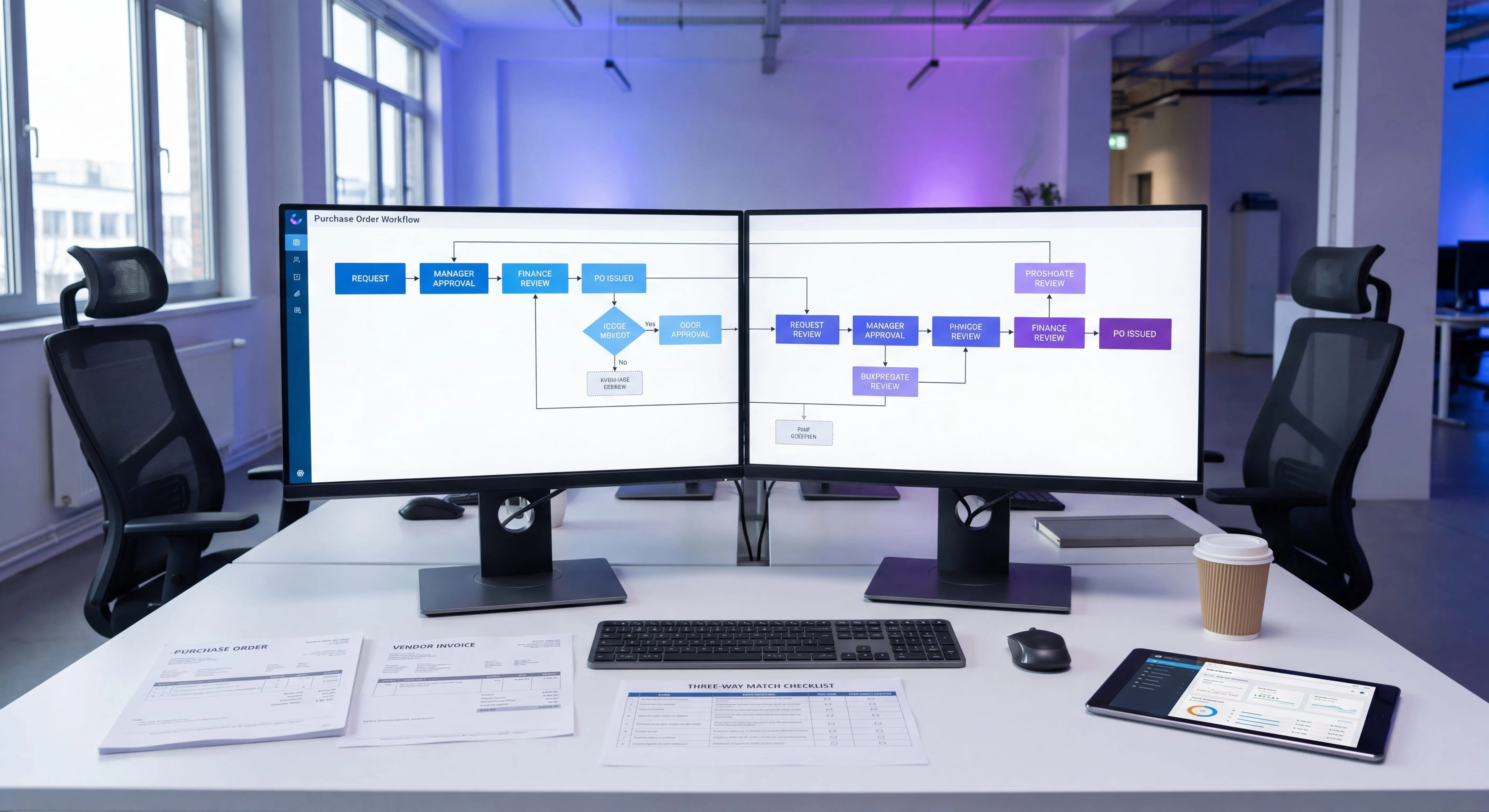
Step 7: Three-Way Match and Invoice Payment
This is where finance ops earns its keep. Before any invoice gets paid, you match three documents:
- The purchase order - what you agreed to buy
- The goods receipt - what you actually received
- The invoice - what the supplier is billing you
If all three agree on quantity and price, the invoice is cleared for payment. If they don’t, it goes to exception handling before a cent moves. This control is the three-way match, and it’s the single best defense against overbilling, duplicate payments, and the exact mistake my team made with those laptops.
Once the match clears, the invoice flows into your accounts payable process for scheduling and payment.
Step 8: Purchase Order Close
After payment is complete and there are no open discrepancies, the PO is closed.
Closing a PO isn’t just tidying up. An open PO is a live financial commitment sitting on your books. POs that never close distort your committed-spend reporting and turn month-end into a guessing game. Pick a clear close definition - fully received, fully invoiced, fully paid, no open issues - and actually enforce it.
Where the Purchase Order Process Breaks
After watching this process fail in a dozen ways, the failures are almost always the same handful:
- No requisition step. People order directly from suppliers and the PO gets created after the fact, defeating the entire control structure.
- Approval thresholds nobody knows. If the rules live in someone’s head, they get skipped under deadline pressure.
- Goods receipt treated as optional. Then there’s no second document to match the invoice against.
- POs that never close. Committed spend balloons on paper and nobody trusts the numbers.
- The process living in tribal knowledge. The one person who knows how it really works goes on vacation, and everything stalls.
That last one is the quiet killer. Most teams don’t actually have a process problem - they have a documentation problem. The steps exist. They just live in one person’s head. Per the Hackett Group’s 2025 research, procurement teams with properly documented and enforced controls lose around 60% less in savings to maverick buying and contract noncompliance than teams without them.
How to Actually Document Your Purchase Order Process
A process you can’t hand to a new hire isn’t really a process. If you want this to survive turnover and scale past you, it has to be written down in a form people will actually follow. Dense PDF manuals don’t get followed. Short, visual, step-by-step guides do.
This is the reason I built Glitter AI. Instead of writing a procurement manual nobody reads, you walk through the purchase order process once - clicking through your real ERP or procurement tool while you talk - and Glitter turns it into a clean, visual step-by-step guide on its own. Screenshots, written steps, all of it. When your approval thresholds change, you update the guide instead of rewriting a document.
If you want the foundations of writing procedures that stick, my guide to standard operating procedures is a good companion to this walkthrough.
Teach your co-workers or customers how to get stuff done – in seconds.
A Quick Checklist for a Healthy PO Process
If you only fix five things, fix these:
- Every purchase starts with a requisition. No exceptions, no “I’ll create the PO later.”
- Approval thresholds are written down and routed automatically. Not in someone’s head.
- Every PO has a unique number that follows it from creation to close.
- Goods receipt is mandatory before any invoice is matched.
- Three-way match before payment, always. This is non-negotiable for finance ops.
Get those five right and you’ve cut out most of the expensive mistakes I’ve watched teams make - including the one that cost my first company a duplicate laptop payment we didn’t catch for a month.
The purchase order process isn’t bureaucracy for its own sake. Done well, it’s the difference between knowing exactly what you’ve committed to spend and finding out the hard way.
Frequently Asked Questions
What is the purchase order process?
The purchase order process is the end-to-end workflow a company uses to request, approve, order, receive, and pay for goods or services. It typically runs from a purchase requisition through PO creation, approval, dispatch, goods receipt, three-way match, and PO close.
What are the steps in the purchase order process?
The core steps are: purchase requisition, requisition review and approval, purchase order creation, PO approval, dispatch to the supplier, goods receipt and inspection, three-way match and invoice payment, and finally purchase order close. Each step adds a control that prevents unauthorized or duplicate spending.
What is the difference between a purchase requisition and a purchase order?
A purchase requisition is an internal request to buy something, used to justify the need and secure budget approval before any supplier is involved. A purchase order is the external, legally binding document sent to a supplier committing the company to buy specific items at agreed prices.
What is a three-way match in the purchase order process?
A three-way match compares the purchase order, the goods receipt, and the supplier invoice before payment is approved. If all three agree on quantity and price, the invoice is paid. If they don't, the invoice goes to exception handling, which prevents overbilling and duplicate payments.
Why is the purchase order process important for finance operations?
It gives finance teams control over committed spend, a complete audit trail linking every dollar to a request and a delivery, and predictable cash flow. Without it, invoices float free with nothing to verify them against, which leads to duplicate and erroneous payments.
What is purchase order approval?
Purchase order approval is the checkpoint where someone with spending authority signs off before a PO is released to a supplier. Approvals are usually routed by dollar threshold so larger purchases require higher-level sign-off, enforcing separation of duties.
What does it mean to close a purchase order?
Closing a purchase order means the order has been fully received, fully invoiced, fully paid, and has no open discrepancies. Closing POs keeps committed-spend reporting accurate, since an open PO still represents a live financial commitment on the books.
How is the purchase order process different from procurement?
Procurement is the broader strategy of sourcing, supplier selection, and contract management. The purchase order process is the transactional engine inside procurement that handles individual orders from requisition through payment and close.
What is goods receipt in the PO process?
Goods receipt is the step where the receiving team verifies that delivered items match the purchase order in quantity and condition, then records what was actually received. This record becomes one of the three documents used in the three-way match before payment.
How can I document my company's purchase order process?
The most effective approach is a short, visual, step-by-step guide rather than a dense manual nobody reads. Tools like Glitter AI let you walk through your actual procurement system once and automatically generate a guide with screenshots and written steps that's easy to update when policies change.