
Read summarized version with
I once watched a plant run two “preventive maintenance programs” at the same time without realizing it. One was the official spreadsheet nobody opened. The other was the senior tech’s memory: which pump whined before it failed, which conveyor needed a belt every spring, which breaker panel ran hot in July. When he retired, exactly one of those programs left the building, and it wasn’t the spreadsheet.
That’s the real problem with most preventive maintenance programs. It isn’t that teams don’t know what to do. It’s that the program lives in people’s heads and a calendar nobody trusts, so it can’t survive a vacation, a turnover, or a busy week.
A real preventive maintenance program is a system. Every asset is known, ranked, scheduled, owned, and measured. When it works, breakdowns get boring and predictable instead of turning into a fire drill. The U.S. Department of Energy puts the average savings from switching to a preventive program at 12% to 18% over reactive-only approaches - and organizations that push further into condition-based monitoring add another 8% to 12% on top of that.
I’m Yuval, CEO of Glitter AI, and I spend a lot of time with maintenance and operations teams who want PM to be a system instead of a person. So here’s how to build a preventive maintenance program from scratch, in the order that actually works.
Teach your co-workers or customers how to get stuff done – in seconds.

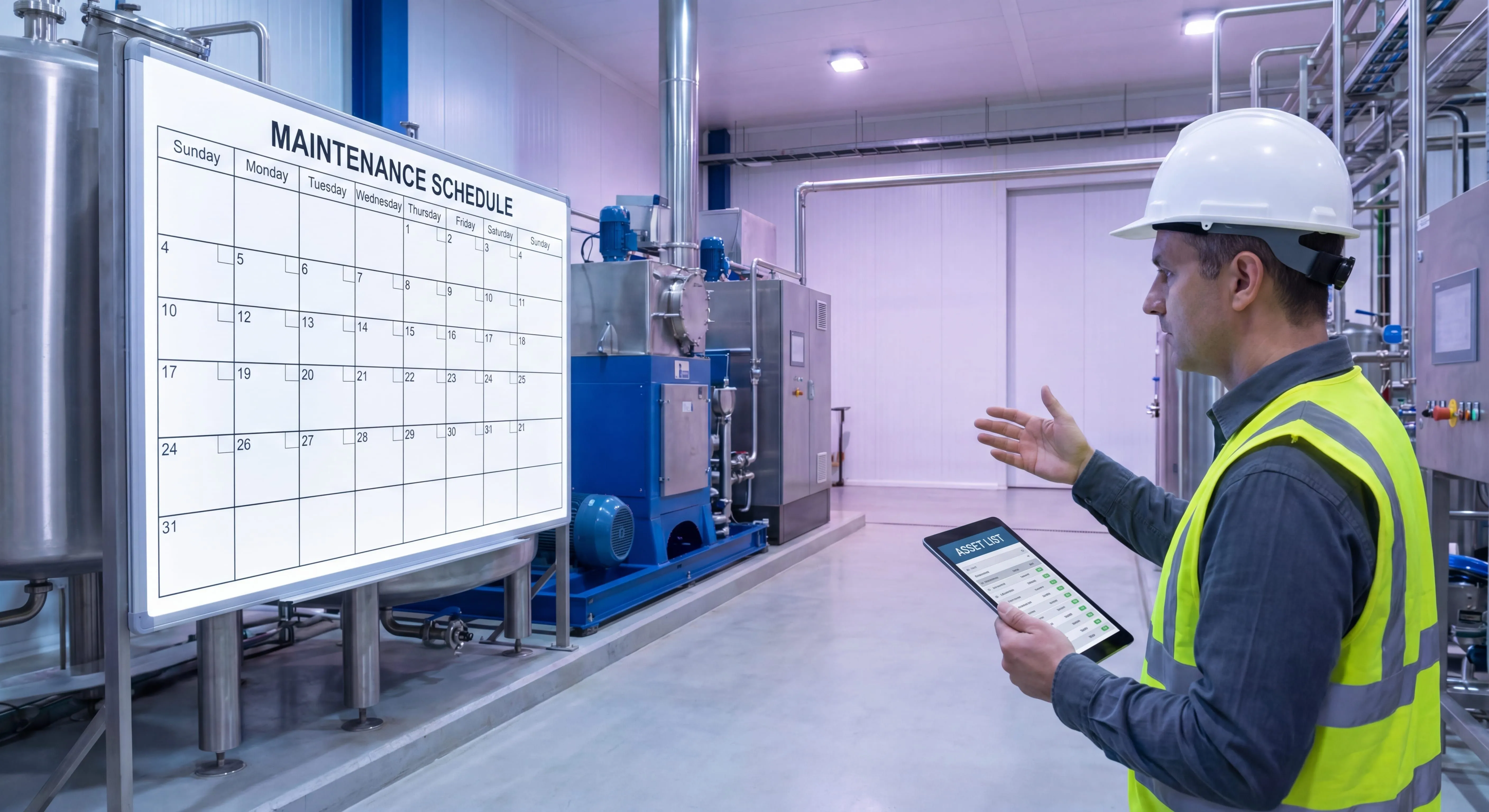
What a Preventive Maintenance Program Actually Is
A preventive maintenance program is the structured system that decides which assets get maintained, how critical each one is, what tasks are performed, on what schedule, by whom, and how you measure whether it’s working. It’s the level above a recurring list of maintenance tasks: the checklist is the task list, the program is the operating system that generates, assigns, tracks, and improves those tasks.
The difference matters more than it sounds. A checklist tells a technician what to do this morning. A program tells you why that task exists in the first place, whether it’s worth the labor, whether it actually got done, and whether it’s preventing failures or just burning hours.
It’s also the operational backbone of any computerized maintenance management system, and the day-to-day expression of total productive maintenance, where equipment care becomes part of how the whole team works rather than something one person does on a good week.
Here’s the principle I’d put on the wall: a preventive maintenance program isn’t real until every critical asset has a written task, a frequency, an owner, and a number you can check.
Step 1: Build the Asset Inventory
You can’t maintain what you haven’t listed. The first step of any preventive maintenance program is a complete asset inventory. Almost every program I’ve seen fail either skipped this or rushed it.
Walk the floor, not the spreadsheet. For every piece of equipment that can fail and cause a problem, capture:
- Asset ID and name (tag every asset physically so a technician in the field and a record in the system match).
- Location (building, line, room).
- Make, model, and serial number.
- Install date and expected service life.
- Manufacturer maintenance requirements (pull the actual O&M manuals; they tell you the intervals).
- Failure history (what’s broken before, and what it cost in downtime and parts).
Don’t try to make this perfect on the first pass. Get every critical asset in first, then enrich the records over time. A 70% inventory you actually use beats a 100% inventory you’re still building in six months.
Step 2: Rank Assets by Criticality
This is the step that separates a program that scales from one that drowns. You don’t maintain every asset with the same intensity. You maintain each one in proportion to what its failure costs you.
Score each asset on a simple, consistent scale. I like three factors, 1 to 5 each:
- Safety / compliance impact if it fails.
- Operational impact (does the line stop, or is there a workaround?).
- Cost to repair or replace, including downtime.
Multiply or add the scores and sort. The top tier (your “criticality 1” assets) gets the most rigorous, most frequent PM and the tightest tracking. The bottom tier might run to failure on purpose, because preventing a $50 failure with $400 of labor is a bad program, not a thorough one.
Write the criticality logic down so it’s defensible. When someone asks “why does that pump get weekly attention and this one doesn’t,” the answer should be a documented decision, not a vibe.
Teach your co-workers or customers how to get stuff done – in seconds.
Step 3: Define Maintenance Strategies and Schedules
Now you decide what gets done and how often, asset by asset, driven by the criticality scores you just built.
For each asset, pick a strategy:
- Time-based PM for assets that wear predictably (filters monthly, lubrication quarterly).
- Usage-based PM for assets that wear by cycles or runtime (every 5,000 hours, every 10,000 units).
- Condition-based PM for critical assets where you can monitor a signal (vibration, temperature, oil analysis) and act before failure.
- Run-to-failure for low-criticality, cheap, redundant assets where prevention costs more than the failure.
Then build the schedule. Pull tasks and intervals from the manufacturer manuals first, then adjust based on your own failure history and operating conditions. A pump in a clean, climate-controlled room and the same pump in a dusty 100°F environment do not get the same interval.
For every scheduled task, write a clear procedure. This is where most programs quietly leak knowledge: the schedule says “service compressor,” but only one person knows what “service” means. Turn each recurring task into a step-by-step standard operating procedure so any qualified technician can do it the same way. (If you’re standardizing PM procedures across a team, a shared procedures guide walks through the full process.)
A task isn’t part of the program until it has steps written down somewhere a second person can find them.
Step 4: Choose and Configure a CMMS
Once you have assets, criticality, schedules, and procedures, you need something that generates work orders automatically, routes them to the right person, and records what actually happened. That’s a maintenance management platform (Computerized Maintenance Management System).
You can technically start a small program in a spreadsheet, and plenty of teams do. But a spreadsheet can’t trigger a work order, won’t chase a missed task, and quietly rots the moment someone stops updating it. A CMMS turns the program from “a plan we have” into “a system that runs.”
When you configure it, get these right:
- Load the asset hierarchy (site → area → asset) so reporting rolls up cleanly.
- Enter PM schedules as recurring work orders, not reminders, so completion is enforced and logged.
- Attach the procedure to each work order so the steps travel with the task.
- Capture labor, parts, and downtime on every work order; this is the data your KPIs run on.
- Set up a backlog and priority view so deferred work is visible, not invisible.
Don’t over-configure on day one. Get critical assets and their PMs flowing, prove the loop works, then expand.
Step 5: Roll It Out Without Breaking Operations
A preventive maintenance program is a behavior change, and behavior change is where good plans go to die, which is why a phased equipment maintenance plan helps. So roll it out deliberately:
- Start with the top-criticality assets. Prove the loop (work order generated → assigned → done → logged) on the assets that matter most.
- Train technicians on the procedures, not just the schedule. The schedule tells them when; the procedure tells them how. Have them do it once with the written steps in hand.
- Make completion non-optional and visible. A PM that’s marked “done” without being done is worse than no program, because now you trust it.
- Expand in waves by criticality tier until the whole inventory is covered.
The fastest way I’ve seen teams kill PM knowledge loss is to record the procedure the first time an experienced tech performs it, then hand that recording to the next person instead of the tech. That’s exactly the gap Glitter closes: someone does the task once, and it becomes a step-by-step guide anyone can follow next time, so the program stops depending on who’s in the building.
Step 6: Measure the Program With KPIs
A program you can’t measure is a hope with a schedule. These are the maintenance KPIs that tell you whether the program is working:
- PM compliance - percentage of scheduled PMs completed on time. This is the heartbeat metric. Below ~90% and the rest of your numbers are noise.
- Planned vs. reactive ratio - share of maintenance hours spent on planned work vs. emergency repairs. A maturing program moves toward 80% planned. NIST research shows that facilities remaining heavily reactive experience 3.3 times more downtime than those running structured maintenance programs, so this ratio is the single clearest leading indicator of what your downtime numbers will look like six months from now.
- Mean Time Between Failures (MTBF) - rising MTBF on critical assets is the clearest proof PM is working.
- Mean Time To Repair (MTTR) - how fast you recover when something does fail.
- Maintenance backlog - total outstanding work, in hours. Trending up means you’re under-resourced or over-scheduled.
- Cost per asset - labor plus parts per asset over time, so you can spot the ones that should be replaced instead of maintained.
Review these monthly. When a critical asset keeps failing despite PM, that’s not a reason to do more PM; it’s a trigger for root cause analysis to fix the actual problem instead of scheduling around it. Aberdeen research puts unplanned downtime at $260,000 per hour for the average manufacturer, so every hour your KPIs are pointing at a problem you haven’t diagnosed yet is expensive time to waste.
Teach your co-workers or customers how to get stuff done – in seconds.
Keep the Program Alive
The last step has no end date. The program has to keep improving itself. Every failure on a PM’d asset is feedback of some kind. Either the interval was wrong, the procedure was wrong, or the task wasn’t really being done. Feed that back into the schedule and the procedures every quarter.
The programs that survive aren’t the ones with the most tasks. They’re the ones where the asset list is real, the criticality logic is written down, the procedures live outside one person’s head, and someone actually looks at the KPIs. Build those four things and your preventive maintenance program will outlast any single technician, including your best one.
Frequently Asked Questions
What is a preventive maintenance program?
A preventive maintenance program is the structured system that defines which assets get maintained, how critical each one is, what tasks run on what schedule, who owns them, and how performance is measured. It's the operating system above an individual maintenance checklist.
How do I build a preventive maintenance program from scratch?
Start with a complete asset inventory, rank assets by criticality, define maintenance strategies and schedules for each, configure a CMMS to generate and track work orders, roll it out by criticality tier, and measure it with KPIs like PM compliance and MTBF.
What is the difference between a preventive maintenance program and a preventive maintenance checklist?
A checklist is the task list a technician follows for a given asset or shift. A program is the larger system that decides which checklists exist, how often tasks run, who is accountable, and whether the maintenance is actually preventing failures.
What is asset criticality and why does it matter for PM?
Asset criticality is a score of how much a failure would cost in safety, operational, and financial terms. It matters because it tells you where to concentrate maintenance effort. High-criticality assets get rigorous PM while low-criticality ones may run to failure on purpose.
Do I need a CMMS for a preventive maintenance program?
You can start a small program in a spreadsheet, but a CMMS (Computerized Maintenance Management System) automatically generates work orders, routes them, enforces completion, and records the data your KPIs depend on. Most programs that scale move to a CMMS quickly.
What KPIs measure a preventive maintenance program?
The core KPIs are PM compliance (on-time completion rate), planned vs. reactive maintenance ratio, Mean Time Between Failures, Mean Time To Repair, maintenance backlog, and cost per asset. PM compliance is the heartbeat metric to watch first.
How often should preventive maintenance tasks be scheduled?
Start with the intervals in the manufacturer's manual, then adjust based on your own failure history and operating conditions. Identical equipment in harsher environments needs more frequent service, so schedules should be asset-specific, not one-size-fits-all.
What is a good PM compliance rate?
Most mature programs target 90% or higher on-time PM compliance. Below that threshold, failures driven by missed maintenance start to outweigh the program's benefits and your other maintenance metrics become unreliable.
How do I keep a preventive maintenance program from depending on one person?
Write every recurring task as a step-by-step procedure stored outside any individual's memory, attach it to the work order, and train technicians on the procedure rather than verbal hand-offs. Recording the task once and turning it into a reusable guide removes the single point of failure.
How do I improve an existing preventive maintenance program?
Review KPIs monthly, treat every failure on a maintained asset as feedback on the interval or procedure, run root cause analysis on repeat failures, and adjust schedules and procedures every quarter so the program keeps improving instead of going stale.