
Read summarized version with
The fastest way to lose a customer you already won is to onboard them badly.
They signed. They were excited. Then week one turns into a scavenger hunt - a login that doesn’t work, a “kickoff” that’s really a sales rep reading a slide deck, a product they’re now expected to figure out alone. By the time anyone on your team notices, the champion who bought you has gone quiet and the renewal is already shaky. That’s the customer onboarding process doing its damage silently, well before anyone calls it a problem.
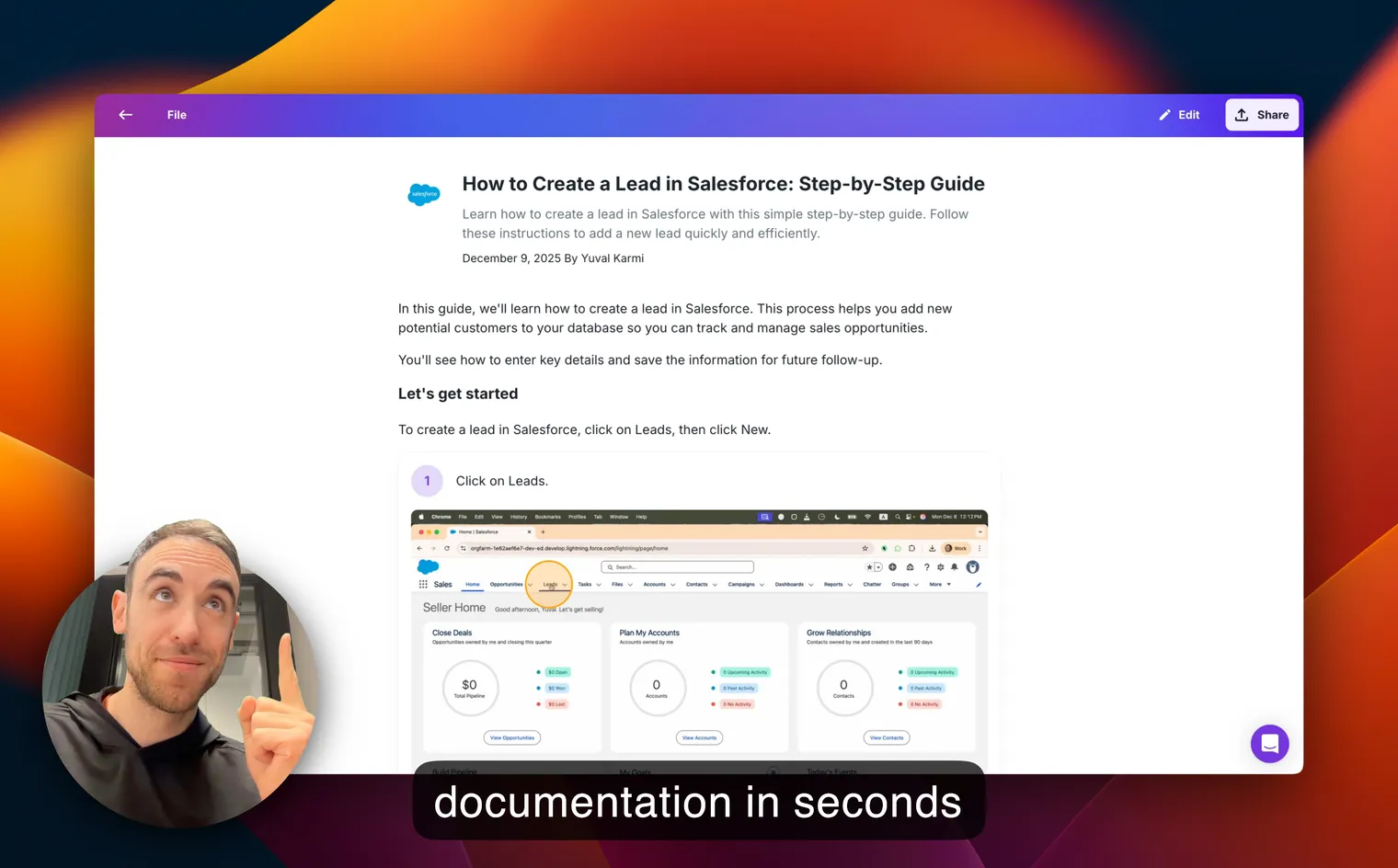
I’m Yuval, founder of Glitter AI. My tool turns a screen recording into a step-by-step guide, and building it has dropped me into a lot of conversations with customer success and support teams describing this exact gap. So here’s the customer onboarding process the way it actually runs - the stages, who owns them, and what “done” looks like at each one. Then I’ll get to the part most guides skip: how to make onboarding consistent so it doesn’t hinge on whichever CSM happens to pick up the account.
Teach your co-workers or customers how to get stuff done – in seconds.

What customer onboarding actually means
Customer onboarding is the process of getting a new customer from “I just bought this” to “I’m getting real value and I know how to keep getting it.” That’s the whole job. Everything else - the emails, the calls, the checklists - is in service of that outcome.
It’s worth being precise, because people blur three things together:
- The sale ends when the contract is signed. Onboarding starts the moment after.
- Onboarding is the guided runway: setup, first value, and enough confidence that the customer can operate without hand-holding.
- Adoption and success are what come after - the ongoing relationship where the customer expands usage and renews.
Here’s the distinction that trips people up: activation isn’t the same as onboarding. Activation is a single moment - the customer hits their first real win, their “aha.” Onboarding is the whole road that gets them there, and a little past it. End your onboarding at “account created” and you’ve confused setup with value. Your churn numbers will eventually tell on you.
The stakes are concrete. Research on customer retention has long held that acquiring a new customer costs far more than keeping an existing one - Harvard Business Review has cited figures in the range of five to 25 times more expensive. Onboarding is where you protect the more expensive investment you just made.
The customer onboarding process, stage by stage
A good onboarding workflow has clear stages with a defined “done” at each one. When teams struggle, it’s almost always because the stages blur into one long, vague “getting started” period with no checkpoints. Here’s how it should break down.
Stage 1: The handoff from sales
Onboarding starts before the customer sees you. The moment the deal closes, sales needs to hand success everything they know - why the customer bought, what problem they’re solving, who the actual users are, and any promises made during the sale.
This handoff is where most onboarding quietly breaks. The CSM walks into the kickoff blind, asks questions the customer already answered three times during the sales cycle, and immediately signals “we don’t talk to each other.” A short internal handoff doc, or a five-minute recorded sales-to-success sync, tends to fix it. What you want out of this stage is a success team that knows the account before the customer ever gets on a call.
Stage 2: The welcome and kickoff
Now the customer finally hears from you. That first touch should be fast - within a day of signing, not a week - and it should set expectations plainly: here’s what happens next, here’s what we need from you, here’s when you’ll see value.
The kickoff call is where you align on goals. Not features - goals. What does success look like for this customer in 30, 60, and 90 days? Write it down and mirror it back. A structured 30-60-90 day plan turns a vague “we’ll get you going” into a shared roadmap with checkpoints both sides can point to.
Teach your co-workers or customers how to get stuff done – in seconds.
Stage 3: Setup and configuration
This is the technical runway - accounts, integrations, data import, permissions, whatever it takes to make the product actually usable for their situation. It’s also the stage most likely to stall, because it depends on the customer doing things on their end and on your team explaining steps they’ve explained a hundred times.
The trap here is turning setup into a run of live screen-share calls that only your most senior people can run. It doesn’t scale, and it makes onboarding fragile - the day that person is out sick, three customers stall at once. This is exactly where documented, self-serve walkthroughs earn their keep, and I’ll come back to it below.
Setup is “done” when the customer can log in, their environment reflects their real use case, and they’re not blocked on anything from your side.
Stage 4: First value (the activation moment)
This is the whole point. First value is the moment the customer does the thing they bought your product to do and it works - the first report generated, the first workflow automated, the first guide published. Everything before this stage exists to get them here fast.
Define this moment explicitly. If you can’t name your product’s activation event in one sentence, your team can’t drive toward it, and onboarding becomes a vibe rather than a target. Time-to-first-value is one of the most honest onboarding metrics you have. Shorten it, and retention usually follows.
Stage 5: Adoption and habit
One win isn’t a habit. This stage is about turning that first success into repeated, independent use - getting more users in the account active, covering more of their use cases, and weaning the customer off your team’s direct help. What you’re after is a customer confident enough to operate on their own, who reaches for you only when they genuinely need to.
Stage 6: The transition to ongoing success
Onboarding ends with a clean handoff to the ongoing relationship - a defined “you’re onboarded” moment, a review of whether you hit the goals set at kickoff, and a clear owner for the account going forward. Don’t let onboarding trail off into silence. A customer who’s never told “you’re set” never quite feels set.
Where customer onboarding falls apart
Almost every broken onboarding process traces back to the same handful of causes. If you recognize your own team here, you’re in good company.
- It lives in someone’s head. The best CSM has a great onboarding flow - in their memory. Nobody else can replicate it, and when they leave, it leaves with them.
- Setup depends on live calls. Every new customer needs a person to walk them through the same steps. It doesn’t scale, and quality swings with whoever’s available.
- There’s no defined “done.” Without checkpoints, onboarding is a fuzzy period that ends whenever the customer stops asking questions - which is often the same moment they stop caring.
- First value comes too late. The customer spends three weeks in setup before they ever feel a win. By then the initial excitement is gone.
- Every customer gets a different experience. Consistency is the thing customers quietly judge you on, and inconsistent onboarding is the fastest way to look disorganized.
The common thread: the process isn’t written down anywhere a teammate or a customer can actually use it. Documenting your customer service processes broadly is the foundation here - I wrote a full guide on how to document customer service processes that pairs well with this.
Documenting the process so it survives the person who runs it
Here’s the part that actually moves the needle. Every stage above quietly assumes a level of consistency most teams can’t hit, and the reason is almost always the same: the process only lives in the heads of the people running it. So let’s fix that.
Turn every repeated setup step into a self-serve guide. The account-configuration walkthrough your CSM runs on every kickoff call is the highest-leverage thing to document first. Instead of a live screen-share, the customer gets a step-by-step guide they can follow at their own pace, at 11pm, without booking your team’s time. This is where Glitter fits: you record yourself doing the setup once - talking through it the way you normally would - and it turns that recording into a written guide with annotated screenshots plus the original video. You document it a single time, then hand it to every customer who follows.
Write an internal onboarding SOP so every CSM runs the same play. A customer-facing guide covers the “how.” An internal onboarding SOP covers the “who does what, when” - the sequence of stages, the owner of each, and the checkpoint that marks it done. If SOPs are new to your team, the standard operating procedure basics are a good starting point. This is what makes onboarding a repeatable process instead of a talented individual’s improvisation.
Build a small library, not one giant doc. Break onboarding into the discrete moments customers actually get stuck on - connecting an integration, importing data, inviting their team, generating that first result. Short, focused guides beat one intimidating manual every time. My roundup of customer service SOP templates shows the same modular structure applied across a support team.
And the payoff compounds. Documented onboarding scales without new headcount, keeps quality steady across every customer, survives turnover, and shortens time-to-first-value because customers stop waiting on your calendar. Do it once, do it well, and it keeps paying you back on every account that comes after.
Teach your co-workers or customers how to get stuff done – in seconds.
A simple way to start this week
You don’t need a customer success platform or a six-month project to fix onboarding. Start smaller.
- Write down your stages and their “done” criteria. Just the six above, adapted to your product. One page. This alone surfaces the gaps.
- Name your activation moment in one sentence. If the team can’t agree, that’s your first real finding.
- Record your top three setup steps as guides. The ones you explain on every single kickoff. Record yourself doing them once and hand the guides to the next customer instead of booking a call.
- Write a one-page internal onboarding SOP. Who owns each stage, what triggers the next, what marks it complete.
- Measure time-to-first-value. Even a rough number gives you something to improve against.
That’s a week of work that changes how every future customer experiences you. The teams that win at onboarding usually aren’t the ones with the biggest success org - they’re the ones who bothered to write the process down so it runs the same way every time, no matter who’s on the account.
Downloads
Want a running start? Grab the free onboarding SOP template and fill it in with your own stages and owners:
Download the Employee Onboarding Template
A free Word template you can adapt for your customer onboarding stages, owners, and checkpoints.
Download the Onboarding Template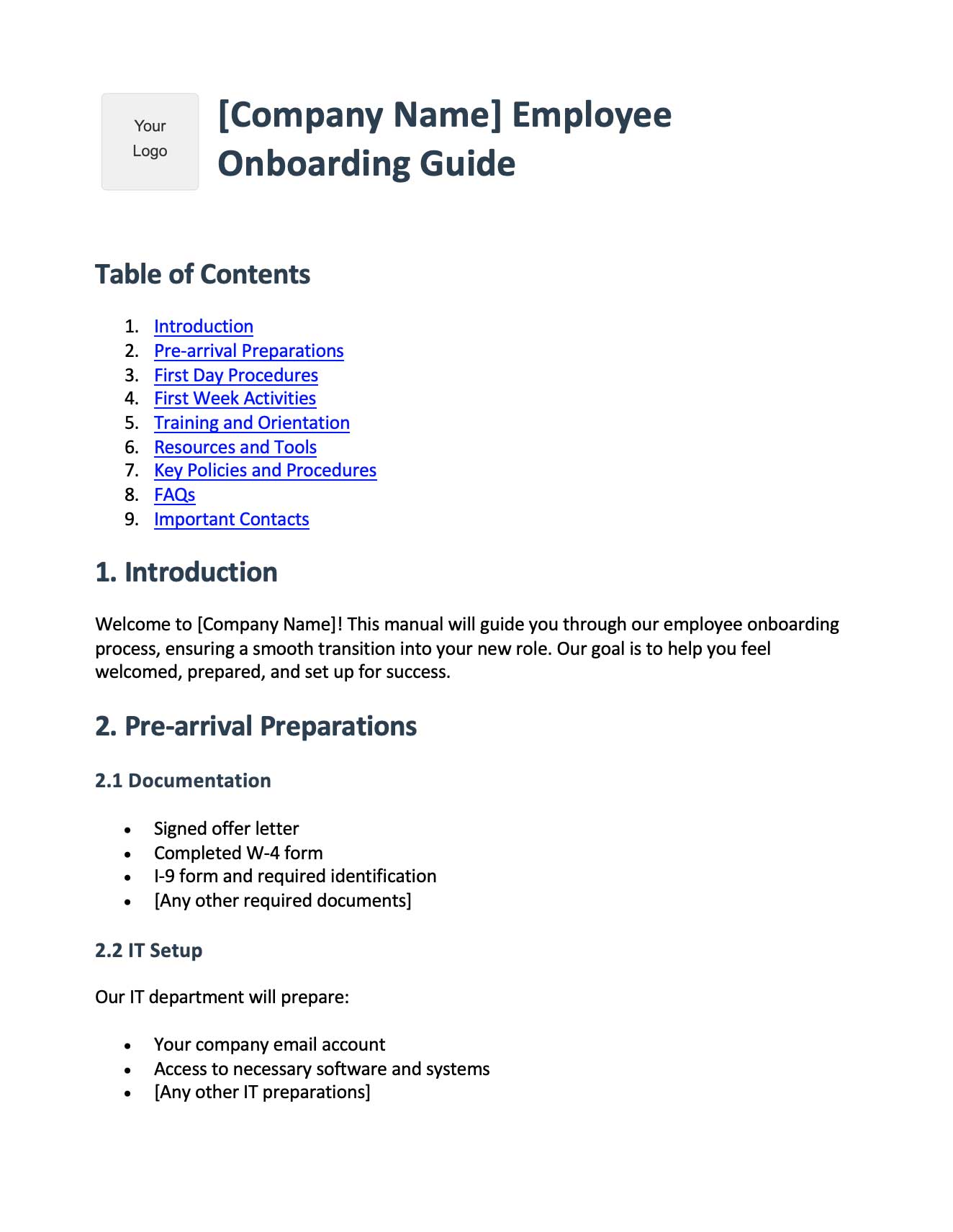
Frequently Asked Questions
What is the customer onboarding process?
The customer onboarding process is the series of steps that takes a new customer from the moment they buy to the moment they get real value and can use your product confidently. It typically spans a sales handoff, welcome and kickoff, setup, first value, adoption, and a transition to ongoing success.
What does customer onboarding mean?
Customer onboarding means guiding a new customer to their first meaningful win with your product and building the confidence to keep getting value on their own. It is distinct from the sale that precedes it and the long-term success relationship that follows it.
What are the main stages of a customer onboarding workflow?
A typical customer onboarding workflow has six stages: the sales-to-success handoff, welcome and kickoff, setup and configuration, first value or activation, adoption and habit, and the transition to ongoing success. Each stage should have a defined owner and a clear 'done' checkpoint.
How is customer onboarding different from customer activation?
Activation is a single moment when the customer hits their first real win, while onboarding is the entire process that gets them to that moment and a little beyond it. If onboarding ends at 'account created,' it has confused setup with value.
How long should customer onboarding take?
It depends on product complexity, but the goal is to reach first value as fast as possible - often within the first days or weeks, not months. Time-to-first-value is one of the most honest onboarding metrics, and shortening it usually improves retention.
What is the difference between customer onboarding and client onboarding?
The terms are used interchangeably. 'Client onboarding process' is more common in services and agencies, while 'customer onboarding process' is more common in software and product companies, but both describe getting a new account from signed to successful.
Why does customer onboarding matter for retention?
Onboarding is where you protect the customer you just spent money to acquire, and acquiring a new customer can cost several times more than keeping an existing one. A poor onboarding experience is one of the most common reasons customers churn before they ever renew.
Who owns the customer onboarding process?
Ownership usually sits with customer success, onboarding specialists, or implementation teams, but it starts with a clean handoff from sales and often involves support and product. The key is that each stage has a single, named owner rather than a shared, fuzzy responsibility.
How do you document a customer onboarding process?
Write an internal onboarding SOP that defines each stage, its owner, and its completion checkpoint, then create self-serve guides for the repeated setup steps customers get stuck on. Recording the setup once and turning it into step-by-step guides means every customer gets the same experience without booking a call.
What tools help with customer onboarding?
Teams use customer success platforms, checklists, and knowledge bases, but the highest-leverage tool is documentation that makes setup self-serve. Glitter AI turns a single screen recording into a step-by-step guide with screenshots and video, so you document each onboarding step once and hand it to every new customer.