
Read summarized version with
A call center quality assurance checklist is the scorecard your team uses to evaluate a single customer interaction against a fixed set of standards - greeting, verification, communication, accuracy, compliance, and the close - so every agent is judged the same way instead of on the reviewer’s mood that afternoon. Get it right and QA turns into coaching. Get it wrong and it turns into a spreadsheet nobody trusts. Jump to the free download.
I’m Yuval, CEO of Glitter AI. Before this I ran Simpo, and our support team went from me answering emails at 1am to a real queue with real agents. The first time I tried to “check quality,” I listened to a few calls, made some mental notes, and told one agent she was doing great and another he needed to “be warmer.” Neither of them got better. Because I wasn’t measuring anything - I was reacting.
The fix wasn’t more listening. It was a checklist. A boring, specific, weighted checklist that turned “be warmer” into “you skipped the empathy statement on 4 of 5 calls.” Now that’s coachable. Here’s the whole thing, plus the template we built so you don’t have to start from a blank page.
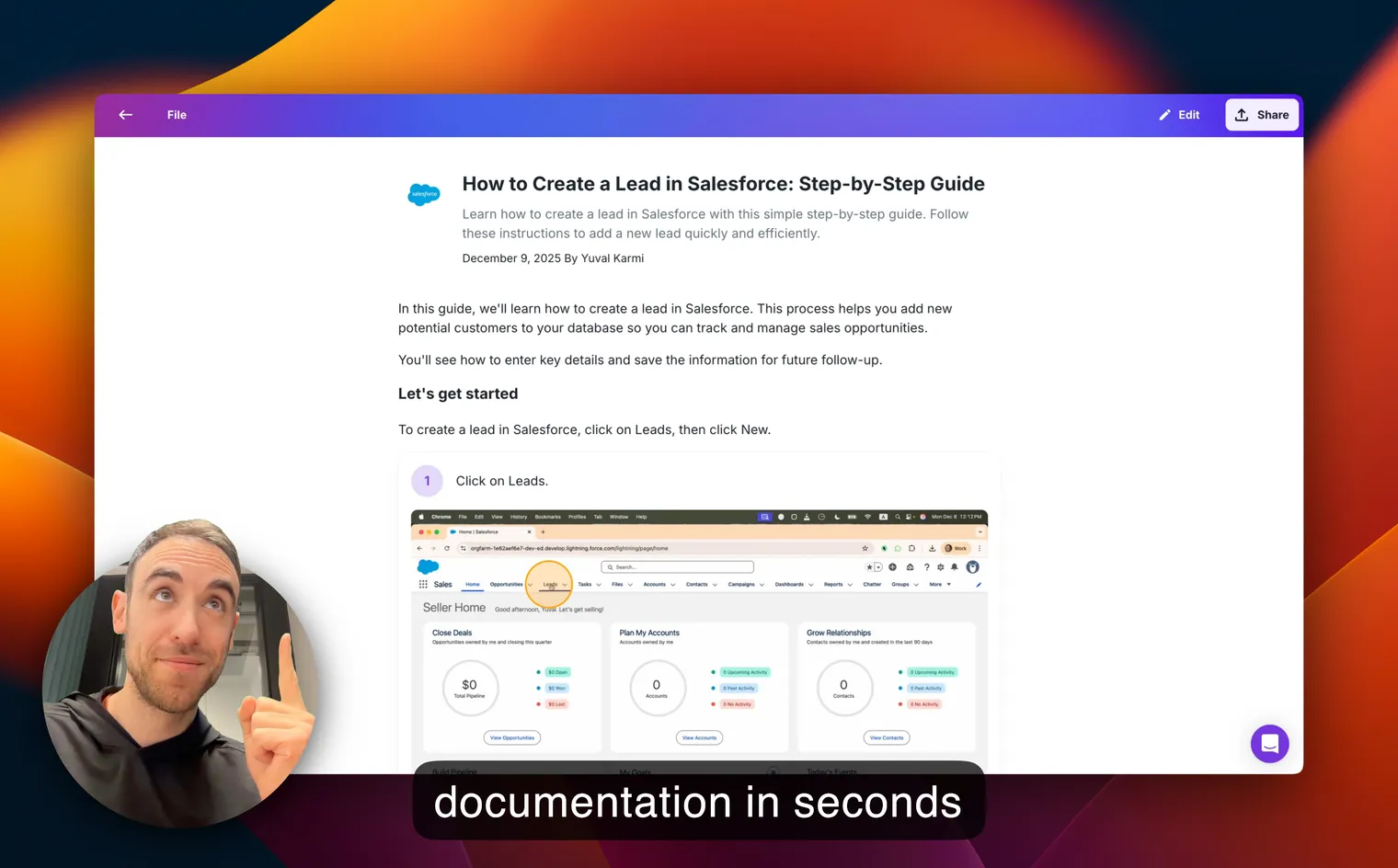
Teach your co-workers or customers how to get stuff done – in seconds.

What a Call Center Quality Assurance Checklist Actually Measures
Let me be precise about the words, because people mix them up. Quality assurance is the ongoing process of monitoring interactions to make sure they meet a defined standard. If you want the textbook version, we keep a definition in our quality assurance glossary entry. The checklist (some teams call it a QA scorecard or an evaluation form) is the instrument you use to do it - the actual list of criteria you mark yes, no, or not-applicable on every reviewed call, chat, or email.
A good scorecard isn’t a vibe check. It measures a handful of distinct things that each fail in different ways:
- Did the agent open correctly? Greeting, identity verification, capturing the reason for contact.
- How did the interaction feel? Tone, empathy, listening, pace - the soft skills that drive CSAT.
- Was the answer right? Accuracy and resolution. A friendly call that gives wrong information still fails the customer.
- Did it stay compliant? Disclosures, data handling, consent. These are usually auto-fail items.
- Did the agent follow the process? Correct dispositions, clean notes, right escalation path when the issue got too big.
- Did they close well? Recap, “anything else,” survey invite.
The trap most teams fall into is scoring only the feeling. Warmth is easy to hear and easy to grade. Accuracy takes actual work to verify. So scorecards drift toward “was the agent nice” and away from “was the customer helped,” almost without anyone noticing. Weight your checklist so accuracy and resolution can’t get drowned out by a pleasant tone.
The Call Center Quality Assurance Checklist
Here’s the checklist I’d build, broken into the six evaluation categories plus a scoring summary. Every line is phrased so a reviewer can mark it yes, no, or N/A without arguing about interpretation.
1. Greeting and Identity Verification
The first 30 seconds set the tone and protect the account.
- Answered within the target time and used the approved branded greeting
- Stated their name and offered to help
- Verified the customer’s identity per policy before discussing account details
- Confirmed or captured the reason for contact in their own words
- Set expectations for how the interaction would go
2. Communication and Soft Skills
This is where CSAT is won or lost. Score what the customer felt, not just what the agent said.
- Used a warm, professional tone appropriate to the situation
- Listened actively and let the customer finish without interrupting
- Showed empathy and acknowledged the customer’s frustration
- Avoided jargon and explained next steps in plain language
- Managed hold time and dead air well
- Personalized the interaction instead of reading a flat script
3. Accuracy and Problem Resolution
The single most important category. If you only had time to score one thing, score this.
- Correctly diagnosed the underlying issue, not just the symptom
- Provided accurate, complete, up-to-date information
- Followed the correct process or knowledge-base article
- Resolved the issue on this contact where possible (first contact resolution)
- Set a clear follow-up plan when it couldn’t be closed
- Confirmed the customer agreed the issue was resolved
4. Compliance and Security
These are your auto-fail items. A single miss here can outweigh a perfect score everywhere else.
- Completed all required disclosures and disclaimers
- Handled payment or sensitive data per policy (e.g., PCI DSS - see the PCI Security Standards Council)
- Followed regulatory scripting (recording notice, consent, etc.)
- Made no unauthorized promises, commitments, or exceptions
- Documented the interaction accurately in the system of record
5. Process and Tool Adherence
- Used the correct disposition or wrap-up codes
- Logged notes clearly enough for the next agent to pick up the thread
- Followed the escalation path when the issue exceeded their scope
- Used approved tools and templates instead of workarounds
- Applied active offers, retention flows, or upsell rules correctly
6. Call Closing
- Recapped the resolution and any next steps
- Asked if there was anything else they could help with
- Delivered the approved closing and thanked the customer
- Invited the survey or feedback where required
Scoring Summary
- Total weighted score recorded (e.g., out of 100)
- Auto-fail check: did any compliance item fail?
- Result marked pass / coach / fail
- Top strength and priority coaching focus written down
- Follow-up or re-review date set
Teach your co-workers or customers how to get stuff done – in seconds.
How to Weight and Score It (So the Numbers Mean Something)
A checklist with no weighting treats “used the branded greeting” and “gave a compliant, correct answer” as equal. They are not. Here’s how I’d set it up.
Assign weights by impact. A simple split that tends to work: accuracy and resolution ~40%, soft skills ~25%, process adherence ~20%, greeting and closing ~15%. Adjust for your business - a regulated financial call center probably pushes more weight into compliance.
Make compliance auto-fail, not just weighted. If an agent skips a legally required disclosure, the call fails regardless of how good the rest was. Weighting alone lets a great call “absorb” a compliance miss, which is exactly the wrong incentive.
Use yes / no / N/A, not a 1-to-5 scale per line. Five-point scales feel precise but invite reviewer drift - one person’s 3 is another’s 4. Binary criteria with a clear definition are faster to score and far easier to calibrate.
Calibrate your reviewers. Every month, have your whole QA team score the same call independently, then compare. If scores are all over the place, your criteria are ambiguous - fix the wording, not the reviewers. Calibration is the difference between a scorecard agents trust and one they resent.
Sample enough, but don’t try to review everything. You can’t listen to every interaction, and you don’t need to. A handful of calls per agent per month, chosen randomly plus a few flagged by low CSAT, tells you most of what you need.
Rolling It Out Without a Revolt
The scorecard is the easy part. Getting agents to actually accept it is where it gets hard, because a QA form can feel a lot like surveillance. A few things that worked for us:
- Share the checklist before you use it. No agent should be scored on a criterion they’ve never seen. Publish the standard first.
- Lead with coaching, not scores. The number is a diagnostic. The conversation - “here’s the one thing to change on your next call” - is the point.
- Let agents self-score. Having an agent grade their own call against the checklist before you review it builds ownership fast.
- Close the loop. When a criterion keeps failing across the team, that’s not an agent problem - it’s a training or documentation gap. Fix the source.
That last point is where documentation matters more than the form itself. If half your team keeps failing “followed the correct knowledge-base article,” odds are the article is missing, outdated, or buried where nobody can find it. This is exactly the problem I built Glitter AI to kill: you record yourself doing the process once - talking through it naturally - and it turns your screen recording and narration into a clean, step-by-step guide plus a video, so the “correct process” is actually written down somewhere an agent can find it mid-call.
For the customer-facing playbooks behind each checklist item, our guide on customer service SOP templates has ready-to-use structures for refunds, escalations, and outages.
Our walkthrough on how to document customer service processes covers turning tribal knowledge into decision trees your agents follow. If your team lives inside a specific tool, pairing the checklist with focused Zendesk training closes the gap between “know the standard” and “know where to click.”
Common Mistakes That Wreck a QA Program
- Scoring only tone. The friendliest agent in the world can still tell customers the wrong thing. Weight accuracy heavily.
- Vague criteria. “Showed good judgment” isn’t a QA line - it’s an opinion. Every item must be markable yes or no.
- No calibration. Without it, an agent’s score depends on which reviewer drew their call. That destroys trust instantly.
- Gotcha reviews. If QA only surfaces when something’s wrong, agents hide problems. Make it routine and developmental.
- A static checklist. Products change, policies change, scripts change. Review your scorecard on a set cadence so it doesn’t grade agents on last year’s process.
Downloads
Grab the free scorecard and start reviewing calls this week. It has every category above, weighting columns, an auto-fail flag, and a scoring summary - fill it in and it’s ready.
Download the Call Center QA Checklist
A free Word scorecard with weighted criteria, auto-fail flags, and a coaching summary. Fill it in and use it today.
Download QA Checklist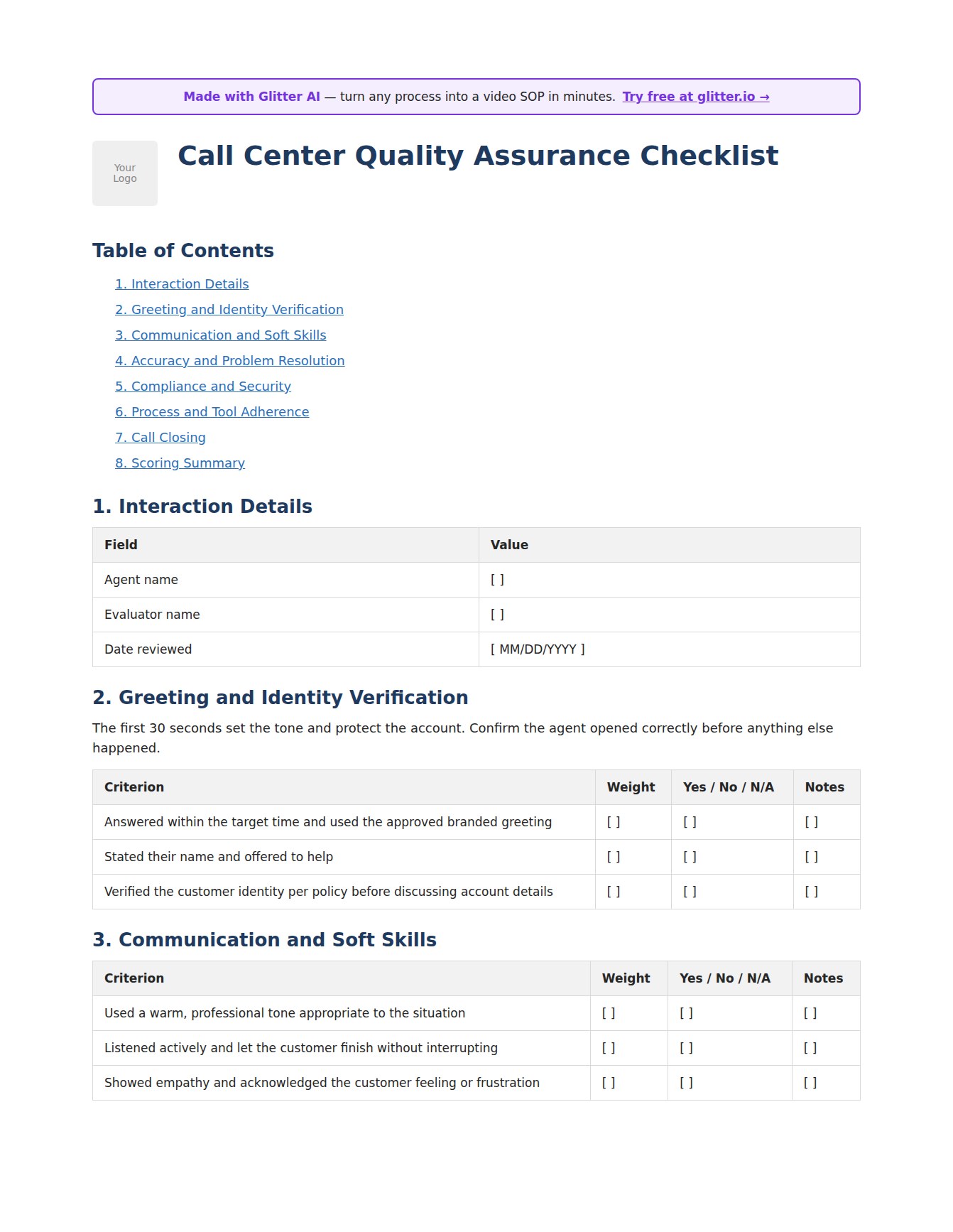
Frequently Asked Questions
What is a call center quality assurance checklist?
It is a scorecard that evaluates a single customer interaction against a fixed set of standards - greeting, verification, communication, accuracy, compliance, process adherence, and closing. Reviewers mark each criterion yes, no, or not-applicable so every agent is scored the same way.
What should a call center QA checklist include?
At minimum: greeting and identity verification, communication and soft skills, accuracy and problem resolution, compliance and security, process and tool adherence, and call closing. Each category should hold a few specific, binary criteria plus a weighted scoring summary.
How do you score a call center QA evaluation?
Assign each criterion a weight by business impact - accuracy and resolution usually carry the most, around 40%. Mark each item yes, no, or N/A, total the weighted score, and treat compliance misses as automatic fails regardless of the rest of the score.
What is an auto-fail in call center QA?
An auto-fail is a criterion so critical that missing it fails the entire evaluation no matter how strong everything else was. These are typically compliance items like required disclosures, consent, or mishandling sensitive payment data.
How many calls should you review per agent?
Most teams review a handful of interactions per agent per month, chosen randomly plus a few flagged by low CSAT or long handle times. You do not need to review every call - a representative sample surfaces most coaching opportunities.
What is reviewer calibration and why does it matter?
Calibration is having multiple reviewers score the same interaction independently and compare results. It matters because inconsistent scoring makes agents distrust the program. If scores diverge, the criteria are ambiguous and the wording should be tightened.
What is the difference between quality assurance and quality control in a call center?
Quality control catches defects after the fact by inspecting completed interactions. Quality assurance is the broader, ongoing process of building standards, monitoring against them, and coaching so quality is consistent by design rather than caught by luck.
How often should you update a call center QA checklist?
Review it on a set cadence - quarterly is common - and immediately after any major change to products, policies, scripts, or compliance rules. A static checklist ends up grading agents on a process that no longer exists.
Can QA scoring improve CSAT?
Yes, when it drives coaching rather than punishment. Tying scorecard results to specific, actionable feedback helps agents fix the exact behaviors - like skipping empathy statements or giving incomplete answers - that pull customer satisfaction down.
Do I need QA software or is a checklist enough?
A well-built checklist in a shared document is enough to start and works for most small and mid-size teams. Dedicated QA software adds automation, sampling, and reporting once your call volume outgrows manual review, but the scorecard criteria stay the same.
QA isn’t about catching agents doing something wrong. It’s about making the right way to handle a call so clear, and so well-documented, that doing it right becomes the easy path. Start with the checklist above, publish the standard, and turn every review into one specific thing to change next time.
Yuval / Founder & CEO, Glitter AI