
Read summarized version with
If you’ve ever tried to train someone on Xero, you already know how it goes.
You sit next to them. You click through screens. You say things like “okay, now go to this menu, then click here, then make sure you select the right account code.” They nod along. You move on. Two days later they’re back at your desk asking how to do the exact same thing. Xero training shouldn’t be this painful, but for most teams, it is.
I’m Yuval, founder of Glitter AI. Through building a tool that helps teams create training guides from screen recordings, I’ve talked to dozens of Xero teams who all describe the same problem. And honestly, how to train your team on Xero is less about Xero itself and more about fixing a fundamentally broken approach to training.
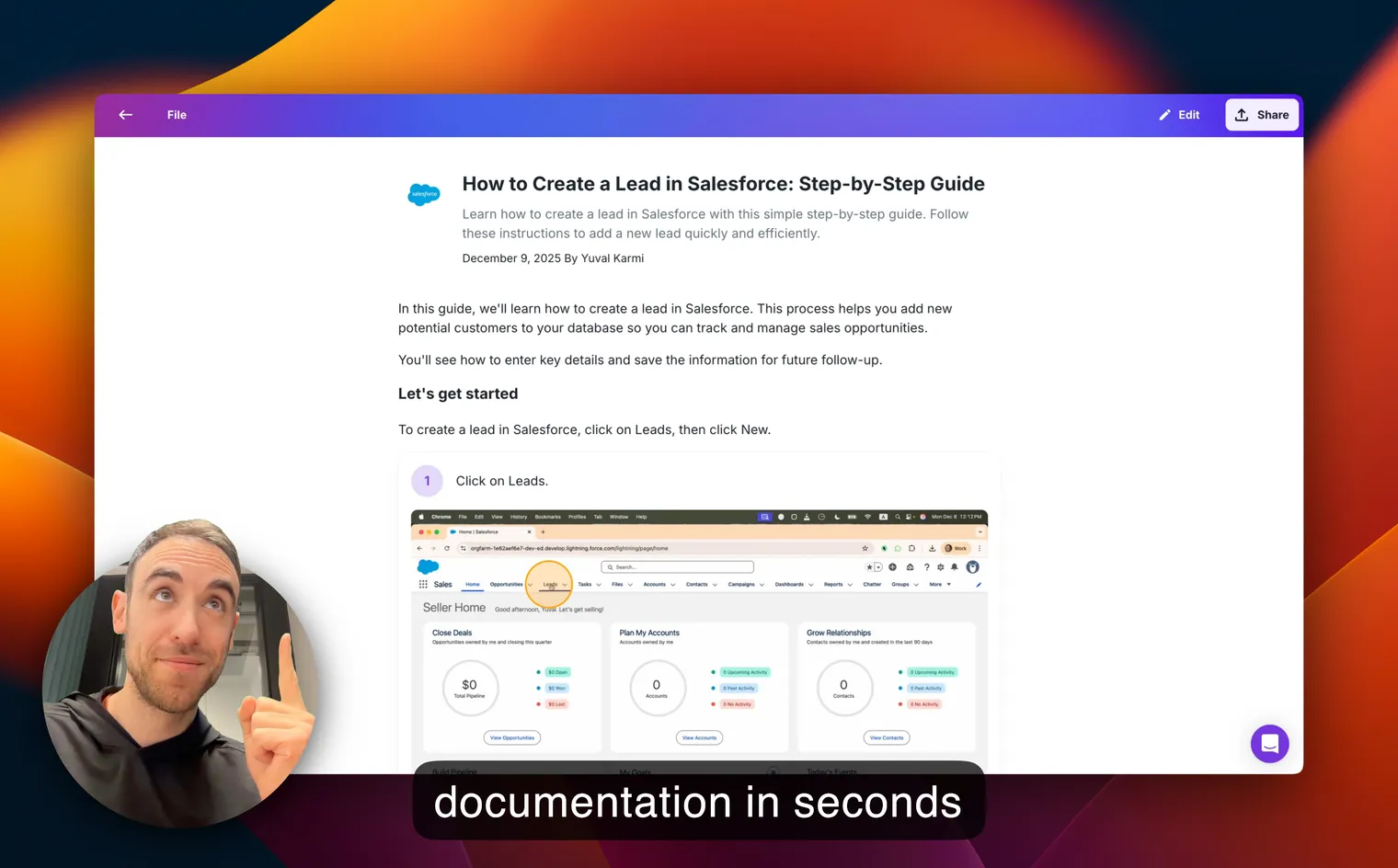
Teach your co-workers or customers how to get stuff done – in seconds.

The Real Problem Isn’t Xero – It’s Tribal Knowledge
Here’s what I keep seeing, over and over.
Someone on your team – let’s call her Sarah – has been running your Xero instance for three years. She knows which account codes go with which expense types. She knows every quirk of your bank reconciliation process. She knows which suppliers need purchase orders and which don’t. She knows the exact sequence of steps for month-end close.
All of that lives in Sarah’s head.
Then Sarah gets promoted. Or goes on maternity leave. Or leaves for another company. Suddenly your entire accounting operation is held together with Slack messages, half-remembered conversations, and frantic Google searches.
This is undocumented know-how living only in people’s heads in action, and it’s probably the single biggest risk in any accounting operation. It’s not a Xero problem – it’s a people problem. Xero is powerful software with a ton of features, but that power means there are dozens of ways to do things, and your team needs to know your way.
The real price you pay when processes are never written down is real. Late payments because nobody knows the AP workflow. Botched reconciliations because the new person doesn’t understand your chart of accounts. Expense claims stuck in limbo because the approval process was never written down.
Why Traditional Xero Software Training Falls Short
Most teams try one of three approaches when figuring out how to use Xero for their business. None of them work particularly well.
Approach 1: Sit Next to Me
The shadow method. Your new hire follows an experienced person around for a week, watching them click through Xero. Problem is, people can only absorb so much through observation. By day three, everything from day one is a blur. And the trainer loses an entire week of productivity.
Approach 2: Write It All Down
Someone (usually the most reluctant writer on the team) gets tasked with creating an SOP document. They open a Google Doc and start typing: “Step 1: Log in to Xero. Step 2: Navigate to Accounts Payable.” By step 14, they’ve lost the will to live. The doc ends up either too vague to be useful or so detailed that nobody reads it.
I’ve written about why this happens in document processes even if you’re not a writer. The short version: most people aren’t technical writers, and we shouldn’t expect them to be.
Approach 3: Point Them to Xero’s Help Docs
Xero has decent documentation. But it’s generic. It doesn’t know that your company uses specific account codes, or that you have a custom approval workflow, or that certain clients always need manual adjustments. Your team needs to learn your Xero accounting software setup, not Xero in the abstract.
None of these approaches capture the full picture. What your team actually needs is to see exactly what you do, hear why you do it, and have a reference they can come back to whenever they need it.
Record your screen, talk through the steps, and Glitter creates the guide automatically
A Better Way: Record Once, Train Forever
Here’s what I’ve seen work with the best teams using Glitter.
Instead of writing documentation or doing live training, you just do the thing. Open Xero, start a Glitter recording, and walk through the process while talking out loud. Explain what you’re clicking and why. Mention the gotchas. Point out the stuff that trips people up - it’s the same method teams use to capture Salesforce CRM workflows, Power BI reporting, Sage 100 accounting procedures, and Clover POS steps.
When you stop recording, Glitter automatically generates a complete training guide with:
- Video of your entire walkthrough
- Annotated screenshots of each key step
- Written instructions pulled from what you said and did
- Voiceover so people can watch and listen
One recording. Four formats. Every learning style covered.
This matters because people learn differently. Some prefer video. Others want to scan written steps. Most want screenshots they can glance at while doing the task themselves. By combining all of these from a single recording, you’re not picking one format - you’re covering all of them, whether the workflow lives in Xero, Caselle Connect, or a tool like Front.
I’ve written more about why this multi-format approach works in my post on building step-by-step visual guides for your team.
The 7 Xero Workflows You Should Document First
Not everything in Xero needs a training guide. Start with the workflows your team touches most and the ones that cause the most confusion. Here’s where I’d begin.
1. Creating and Sending Invoices
This is usually the first thing new team members need to learn. Walk through creating an invoice from scratch – selecting the contact, adding line items, choosing the right account codes, setting payment terms, and sending it out. Cover your naming conventions, how you handle recurring invoices, and what to do when a client disputes an amount.
Pro tip: Record yourself handling a tricky invoice, not just a simple one. Edge cases are where people actually get stuck.
2. Bank Reconciliation
Bank reconciliation in Xero is powerful but can feel intimidating to someone new. Xero pulls in bank feeds automatically and suggests matches, but your team needs to know how to handle transactions that don’t match cleanly. Record yourself working through a real reconciliation session – matching straightforward transactions, creating new ones for unmatched items, and splitting transactions that cover multiple categories.
This is one of those tasks where watching someone do it once is worth ten pages of written instructions.
3. Accounts Payable
Your AP process probably has several steps: receiving a bill, coding it to the right account, getting approval, scheduling payment, and marking it as paid. Walk through the full lifecycle of a bill in Xero. If you use purchase orders, show how those connect. If you have approval workflows, demonstrate exactly how they work.
For a deeper dive into documenting AP processes, check out my walkthrough on documenting accounting procedures.
4. Expense Claims
Expense claims seem simple on the surface but generate endless questions. How do employees submit claims? What categories should they use? Who approves them? How do approved claims get paid? Record the process from both sides – the employee submitting the claim and the admin reviewing and approving it.
5. Running Financial Reports
Your team needs to know how to pull the reports that matter to your business. Walk through generating a profit and loss statement, a balance sheet, and whatever custom reports you run regularly. Show them how to set date ranges, filter by tracking categories, and export to PDF or Excel. And don’t skip over what the reports actually mean – context is what makes the numbers useful.
6. Setting Up New Contacts and Suppliers
Every new client or supplier needs to be set up correctly in Xero. Show how to create a new contact, fill in the essential fields (payment terms, default account codes, tax settings), and explain your naming conventions. A supplier set up wrong on day one creates reconciliation headaches for months.
7. Month-End Close
This is the big one. Month-end close is usually a multi-step process involving reconciling all bank accounts, reviewing outstanding invoices, processing accruals, running reports, and verifying everything balances. It’s also the process most likely to live entirely in someone’s head.
Record your entire month-end close process. Yes, it’ll be a longer recording. But having a complete walkthrough of your close process is probably the single most valuable training asset your accounting team can have.
Document every workflow so training doesn't depend on one person
How to Structure Your Xero Training Program
Once you’ve recorded the core workflows, you need a plan for how people actually work through them. Here’s the structure I’d recommend.
Week 1: Foundations
Start new team members with the basics. Contacts and suppliers, simple invoicing, and navigating the Xero dashboard. These are low-risk tasks where mistakes are easy to spot and fix. Send them the relevant Glitter guides and let them practice in a demo company or sandbox environment if you have one.
Week 2: Core Workflows
Move into bank reconciliation and accounts payable. These are the daily tasks that keep the books running. Have them work through the guides, then do the real thing with someone nearby to answer questions.
Week 3: Advanced Tasks
Expense claims, financial reports, and any custom workflows specific to your business. By this point they should be comfortable navigating Xero and ready to handle more complex processes.
Week 4: Month-End Close
Have them shadow someone through a full month-end close first, using the recorded guide as a reference. Then have them lead the next close with supervision. Two months in, they should be able to handle it on their own.
This is essentially a documented-training approach applied specifically to Xero. The guides do the heavy lifting. Your experienced team members provide context and answer questions. Nobody’s spending a full week doing nothing but training.
Tips for Recording Better Xero Training Guides
I’ve seen many teams create training content. The best recordings tend to share a few things in common.
Talk Like a Human
Don’t script your recordings. Just talk naturally, the way you’d explain something to a colleague sitting next to you. Say things like “I always double-check this field because it’s easy to pick the wrong account code” or “this part is confusing but here’s why it works this way.” The imperfections make it feel real and relatable.
Show the Mistakes
If you accidentally click the wrong thing during a recording, don’t start over. Show how you catch and fix the mistake. That’s often more valuable than a perfect walkthrough because it teaches people what to watch out for.
Keep Each Guide Focused
Don’t try to cover everything in one recording. One workflow per guide. “How to create and send an invoice” is a guide. “How to do everything in Xero” is a nightmare. Short, focused guides are easier to record, easier to update, and easier to find when someone needs them.
I’ve talked about this principle in what makes employee training actually work – breaking training into focused modules dramatically improves retention.
Name Things Clearly
“Xero - Creating Invoices for New Clients” is a good title. “Training Video 4” is not. When someone’s panicking because they can’t remember how to process a supplier payment, they need to find the right guide in seconds.
Update When Things Change
Xero updates their interface regularly. When they do, re-record the affected guides. It takes five minutes with Glitter, and it keeps your training library from turning into a graveyard of outdated screenshots.
Building a Complete Xero Knowledge Base
As someone who built Glitter, I’ve seen our best teams document 5+ different operational workflows across their business. The ones who stick around aren’t creating one guide – they’re building an entire knowledge base for how their company runs.
Your Xero training guides are just the starting point. Once you have invoicing, reconciliation, and month-end close documented, you’ll naturally want to capture other processes too. Xero payroll training is a big one – documenting how you handle pay runs, leave management, and tax filings. Then there’s client onboarding, tax season prep, and everything in between.
This is how you get new hires up to speed quicker using good docs – not by writing more, but by capturing what you already know how to do.
The goal isn’t perfection. It’s making sure that when someone leaves, gets sick, or just takes a well-deserved vacation, the rest of the team can keep things running without missing a beat.
Why Multi-Format Guides Beat Single-Format Training
Let me be direct about something. A written SOP alone won’t cut it for Xero training. A screen recording by itself won’t either. Here’s why the combination matters.
Video captures the flow. People see how fast you move through certain steps, where you pause to think, and the overall rhythm of a workflow. It’s the closest thing to sitting next to an expert.
Screenshots capture the details. When someone’s in the middle of a task and needs to check they’re looking at the right screen, they don’t want to scrub through a video. They want to glance at a screenshot and confirm.
Written steps capture the logic. Why you chose that account code. What the approval threshold is. When to use one method versus another. Text is searchable, scannable, and easy to reference.
Voiceover captures the context. The spoken explanation carries nuance that written text often misses – the “watch out for this” warnings, the “this is important because” reasoning.
When all four formats come from a single recording, they stay in sync. The screenshot matches the video frame which matches the written step which matches the spoken explanation. That consistency is what makes training actually stick.
Video, screenshots, written steps, and voiceover -- all generated automatically
Getting Started Today
You don’t need to document everything at once. Here’s what I’d do if I were starting from scratch.
- Pick the workflow that causes the most questions. For most teams, that’s bank reconciliation or month-end close.
- Open Xero, start a Glitter recording, and just do the task. Talk through what you’re doing and why. Don’t overthink it.
- Review the generated guide. Make any quick edits to the written steps if needed.
- Share it with your team. Next time someone asks how to do that thing, send them the guide instead of explaining it again.
- Repeat. One guide per week. In two months, you’ll have a complete Xero training library.
The teams that get the most out of their training aren’t the ones with the most polished documentation. They’re the ones who actually have documentation at all. Start messy. Start today. Your future self (and your future hires) will thank you.
Frequently Asked Questions
How long does Xero training take for a new hire?
Most teams need 2-4 weeks of Xero training to get a new hire comfortable with core tasks like invoicing, bank reconciliation, and expense claims. With documented Xero software training guides that combine video, screenshots, and written steps, you can cut that timeline roughly in half because new team members can learn at their own pace and revisit guides whenever they need a refresher. The exact timeline depends on the complexity of your Xero accounting software setup and how many custom workflows your team uses.
What Xero features should I train my team on first?
Start with the tasks your team will use daily: creating and sending invoices, bank reconciliation, and navigating the dashboard. Then move to accounts payable, expense claims, and setting up new contacts. Save advanced features like financial reporting, month-end close procedures, and custom tracking categories for after they're comfortable with the basics. Prioritize the workflows that generate the most questions from your current team.
Can I use Xero's built-in help documentation for training?
Xero's help documentation is useful for understanding general features and learning how to use Xero at a basic level, but it won't cover your specific setup. Your team needs to learn your chart of accounts, your approval workflows, your naming conventions, and your month-end close process. Generic documentation can supplement your internal Xero training, but it shouldn't replace guides that show exactly how your company uses the software.
How do I train remote employees on Xero?
Screen-recorded training guides are ideal for remote teams because they can be accessed from anywhere, at any time. Record yourself walking through each Xero workflow with narration explaining what you're doing and why. Tools like Glitter automatically generate video, screenshots, and written steps from a single recording. Remote employees can work through the guides at their own pace and revisit them whenever needed without scheduling live training sessions across time zones.
What's the biggest mistake teams make when training on Xero?
The biggest mistake is relying entirely on live, one-on-one training with no documentation. When training happens only through verbal explanation, knowledge disappears the moment the trainer is unavailable. The second biggest mistake is creating text-only documentation that lacks visual context. Xero is a visual application with many menus and screens, so training materials need screenshots and video to be genuinely useful.
How often should I update my Xero training guides?
Update your guides whenever Xero releases interface changes that affect your workflows, whenever your internal processes change (new account codes, different approval thresholds, updated suppliers), and do a general review at least quarterly. If you're using a tool like Glitter, re-recording a workflow takes just a few minutes, which makes regular updates practical rather than painful.
Should I create a Xero demo or sandbox environment for training?
If your Xero plan supports it, a demo company is helpful for letting new hires practice without affecting real data. They can create test invoices, try bank reconciliation with sample transactions, and explore the interface without fear of making mistakes. However, demo environments have limitations since they won't perfectly mirror your live setup. The best approach is to combine practice in a demo environment with recorded guides showing your actual production workflows.
How do I handle Xero training for bank reconciliation specifically?
Bank reconciliation is best taught through a recorded walkthrough of an actual reconciliation session. Show how Xero pulls in bank feeds, how to match suggested transactions, how to handle unmatched items by creating new transactions, how to split transactions across multiple accounts, and how to deal with common discrepancies. Cover your specific rules for categorizing transactions and any custom bank rules you've set up. A visual Xero training guide with screenshots of each step is far more effective than written instructions alone.
What's the best way to document Xero month-end close procedures?
Record your entire month-end close process as a series of short, focused guides rather than one massive recording. Break it into stages: reconcile all bank accounts, review and clear outstanding invoices, process accruals and adjustments, run and review financial reports, and perform final verification checks. Each guide should show the exact steps in your Xero instance with narration explaining the reasoning behind each action. This modular approach makes it easier to update individual steps when your process changes.
How many Xero training guides does a typical team need?
Most small-to-mid-size teams need between 7 and 15 core guides to cover their essential Xero workflows. This typically includes guides for invoicing, bank reconciliation, accounts payable, expense claims, financial reporting, contact management, and month-end close. Some teams add guides for payroll, inventory, project tracking, or multi-currency transactions depending on their needs. Start with the 5-7 workflows your team uses most frequently and expand from there.