
Read summarized version with
The first manufacturing SOP I ever read on a real production floor was three years out of date and nobody knew it.
I’m Yuval, CEO of Glitter AI. I didn’t come up through manufacturing. My background is software. But over the last few years I’ve watched a lot of ops teams try to write down how their lines actually run, and the factory floor is where the gap is widest between “we have an SOP for that” and “the SOP describes what we actually do.”
That outdated SOP I mentioned? The line had changed tooling. The setup parameters in the document were for the old fixture. A new operator followed it to the letter, ran a setup that hadn’t been valid since the previous fiscal year, and scrapped half a shift of parts before anyone noticed. The document was technically there. It was just lying.
This post is the template I’d hand that plant. It’s a free, fill-in manufacturing SOP template you can download, with a walkthrough of every section and why it’s there, building on our broader guide to writing an SOP for manufacturing. Want the file right now? Skip to the downloads section. Otherwise, let’s build one your floor will actually follow.
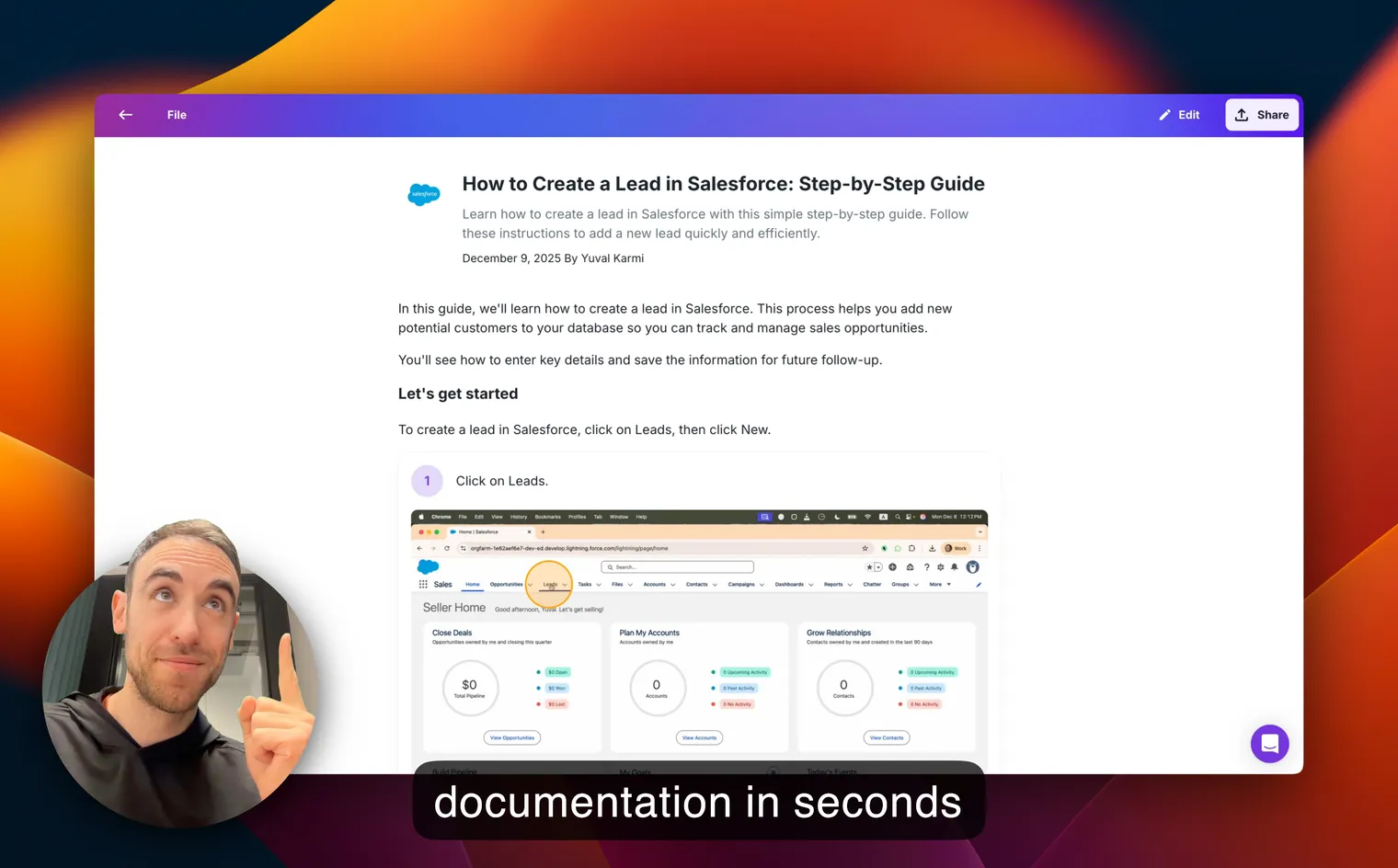
Teach your co-workers or customers how to get stuff done – in seconds.

Why Most Manufacturing SOP Templates Fail on the Floor
Most templates you’ll find online were written for an auditor, not an operator.
They’re heavy on policy language and light on the actual sequence of actions at the machine. They tell you a procedure “shall ensure conformance to applicable quality standards” and say nothing about which gauge to grab, what the reading should be, or who to call when it’s out of tolerance at 2am on second shift.
A good manufacturing SOP does two jobs at once. It satisfies the quality system, whether that’s ISO 9001, IATF 16949, AS9100, or whatever you’re certified to. And it gets a new operator from “I’ve never touched this machine” to “I’m running good parts” without a supervisor hovering over their shoulder all shift. According to the ISO Survey, ISO 9001 alone now covers more than 1.3 million certified organizations across more than 170 countries - which means most of your customers and supply chain partners are already operating under documented, controlled procedures and expecting you to do the same.
The difference between an SOP and a work instruction matters here. The SOP is the controlled, governed document: scope, responsibilities, quality plan, safety, records. The work instruction is the click-by-click or step-by-step detail of the operation itself. A good manufacturing SOP template has room for both: a procedure section detailed enough to act on, wrapped in the control structure your audit needs.
The Manufacturing SOP Template Structure
Here’s the section structure I recommend, and what each one is actually for. The downloadable template at the bottom follows this exact order.
1. Document Control
This is the header block that makes the SOP a controlled document instead of a loose Word file someone emailed around.
It needs: SOP number, revision, the work center or line it governs, the process owner, effective date, and next review date. The single most important field here is revision, because the failure I described at the top of this post was a revision-control failure, not a writing failure. The content was fine for a version of the line that no longer existed.
2. Purpose and Scope
Purpose is one sentence: what this procedure produces or controls and why it exists. “To set up and run the CNC lathe for Part #1234 so every unit meets print tolerance and the line stays safe.”
Scope is the boundary. Which line, which part numbers, which shifts, and explicitly what this SOP does not cover. Most of the floor confusion I’ve seen comes from scope ambiguity. An operator uses a part-A setup SOP for part B because nobody wrote down that it didn’t apply.
3. Responsibilities
A simple role/responsibility table: operator, line lead, quality technician, maintenance. The rule I’d enforce is that every responsibility has exactly one owner. “Quality” is not an owner. A specific role is. If two roles can both authorize a restart after a line stop, sooner or later you get a restart nobody authorized.
4. Definitions, PPE, Equipment, and Prerequisites
Four short sections that front-load everything an operator needs before they touch anything:
- Definitions - abbreviations like FAI, NCR, LOTO spelled out once
- PPE - required protective equipment, with the single biggest hazard called out as a warning
- Equipment, tooling, materials - machine asset numbers, fixture IDs, gauges with calibration IDs, raw material part numbers
- Prerequisites and setup - work order verified, parameters loaded, tooling verified against the setup sheet, previous shift handoff reviewed
Calibration IDs in the equipment section sound like bureaucracy until an auditor asks you to prove the gauge that passed a lot was in cal. Then they’re the whole ballgame.
Teach your co-workers or customers how to get stuff done – in seconds.
5. The Procedure Itself
This is the part most templates get wrong by being too vague. Break it into four phases:
- Startup / setup - power-on sequence, warm-up, parameter confirmation. Include the value the operator should see and what to do if it’s out of range.
- First-article approval - run the first piece, measure against print, get Quality or Lead sign-off before production. This one gate prevents most full-shift scrap events.
- Production run - steady-state operation, cycle expectations, in-process check frequency, safe load/unload.
- Shutdown / changeover - safe shutdown, machine state, cleanup, material reconciliation, shift handoff notes.
Each step should describe what the operator does and what they should see. “Confirm spindle speed reads 1,800 RPM ± 50; if outside that range, stop and notify the line lead” is a usable step. “Ensure proper machine operation” is not.
6. Quality Control and Inspection Points
A table, not a paragraph. Checkpoint, characteristic, spec and tolerance, frequency, and where it gets recorded. This is your quality control procedure content living inside the procedure: first article, in-process, and final inspection, each with its gauge and its record.
7. Deviations and Nonconforming Material
What happens when a check fails. How to tag, segregate, and quarantine the parts. Who dispositions them (use-as-is, rework, scrap) and on what form. When a stop-work or corrective action gets triggered.
Put a hard stop here. If any check is out of tolerance or any safety device is bypassed, the process stops and the line lead is notified before anything continues. Write it down so it’s a rule, not a judgment call made under production pressure.
8. Safety, Training, Records, References, Revision History
The closing sections that make the document auditable and maintainable:
- Health, safety, environmental - LOTO reference, machine guarding, spill/waste handling, e-stop locations. Tie this to your broader safety SOP program.
- Training and competency - what sign-off is required before someone runs this unsupervised
- Records and retention - every record produced, how long it’s kept, where
- References - print numbers and revisions, related SOPs, applicable standards
- Revision history - the change log that would have caught my opening story
How to Actually Roll This Out
A template is the easy 20%. Adoption is the other 80%, and it’s where most manufacturing documentation programs quietly die.
Here’s the sequence I’ve seen work:
- Start with your highest-risk line, not your easiest one. The SOP that prevents a scrap event or an injury pays for itself right away. The American Society for Quality puts quality costs - scrap, rework, inspection, and failure - at typically 15 to 20 percent of annual sales for a typical manufacturer, so the financial case for getting a procedure right is never abstract. The SOP for the process that already runs fine can wait.
- Write the procedure section by watching someone do the job. Not from memory at a desk. Stand at the machine, or record it. The gap between “how we think it’s done” and “how it’s done on third shift” is where defects live.
- Get one owner per SOP. Same rule as responsibilities. A document with no owner is a document nobody updates.
- Set the review date and honor it. Tie reviews to triggers: a tooling change, a parameter change, a customer complaint, an audit finding. The revision field only works if something forces it to advance.
- Make it findable at the machine. An SOP in a binder in the quality office isn’t a control. It’s a relic. It needs to be where the work happens.
If you want the deeper theory behind all of this, my complete manufacturing SOP guide walks through writing procedures the floor actually follows, and manufacturing SOP best practices covers the governance side. For filled-in examples rather than a blank template, see SOP for manufacturing: examples and templates. The general mechanics of writing any standard operating procedure are covered in our guide to how to write an SOP.
The Glitter Angle: The Procedure Section Is the Hard Part
Look back at the template structure. The control sections (document control, scope, responsibilities, references) you write those once and they barely change.
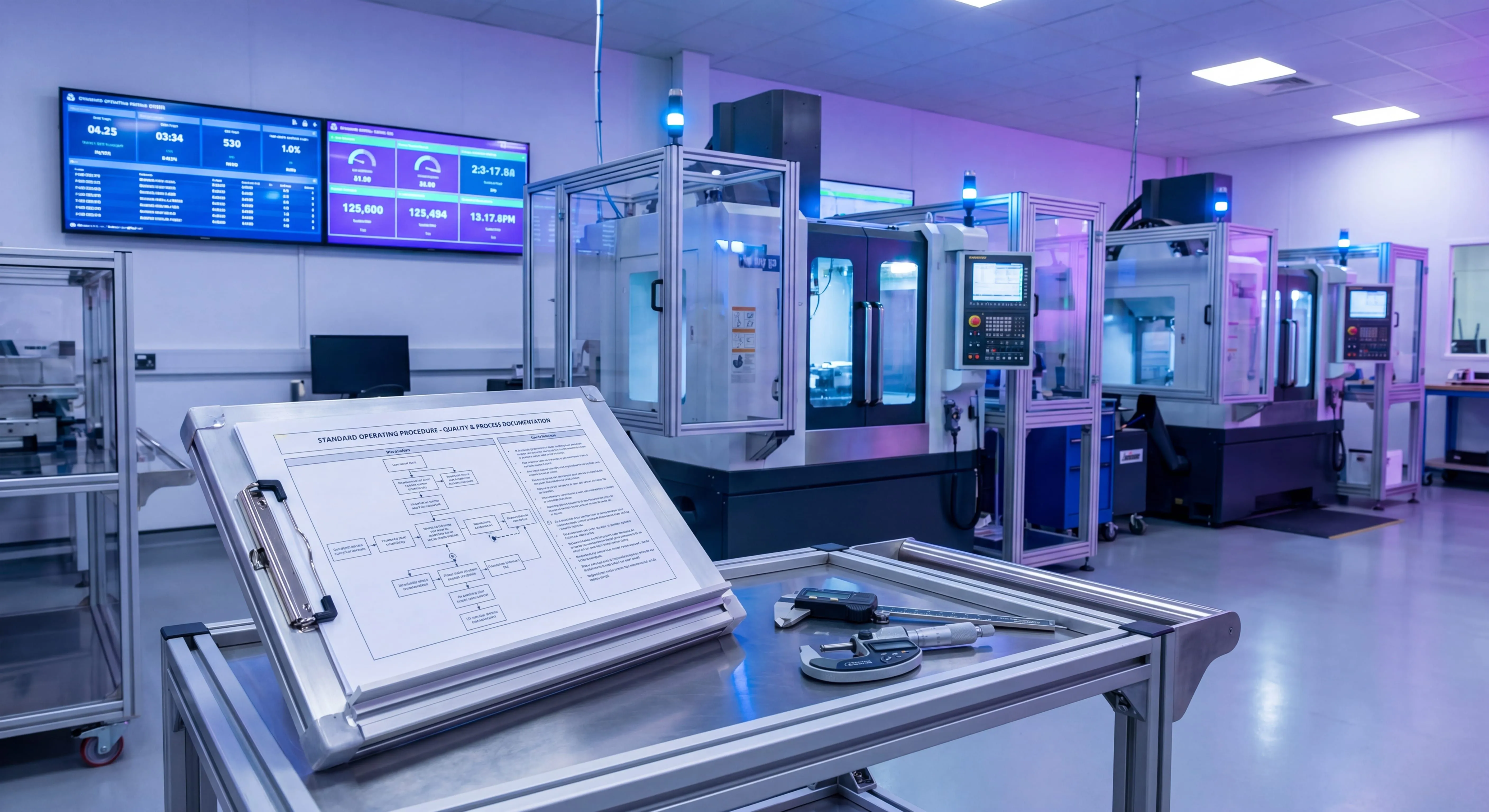
The section that goes stale, the one that caused my opening story, is the procedure itself. The actual step-by-step of running the machine. That’s the part that changes every time tooling changes, parameters change, or the line gets re-laid-out. It’s also the most painful part to document by hand. Someone stands at the machine with a phone, takes photos, transcribes steps, annotates screenshots of the HMI, and six weeks later it’s wrong again.
That’s the problem we built Glitter for. You record the process being run once: the setup, the HMI screens, the inspection. Glitter watches, identifies each step, captures the visuals, and writes the step-by-step procedure for you. When the line changes, you re-record instead of rewriting. The control structure stays in your template, and the procedure detail stops being a manual writing project.
I won’t pretend it writes your quality plan or your safety section for you. Those need an engineer and an EHS lead. But the “do this, then this, then check that” core of the SOP, the part that’s really just how the work is done? That part doesn’t have to rot anymore.
This connects to the broader lean manufacturing idea that standardized work is the baseline for improvement. You can’t improve a process you haven’t actually captured.
Teach your co-workers or customers how to get stuff done – in seconds.
Downloads
Skip the blank page. This is a free Word template built for the production floor: document control, PPE, setup, first-article, the quality plan table, deviations, safety, and a revision log.
Manufacturing SOP Template
A free Word template structured for manufacturing: document control block, purpose and scope, responsibilities, PPE, equipment and tooling, prerequisites, a four-phase procedure section, a quality control inspection table, nonconforming material handling, EHS, training, records retention, and revision history.
Download Manufacturing SOP Template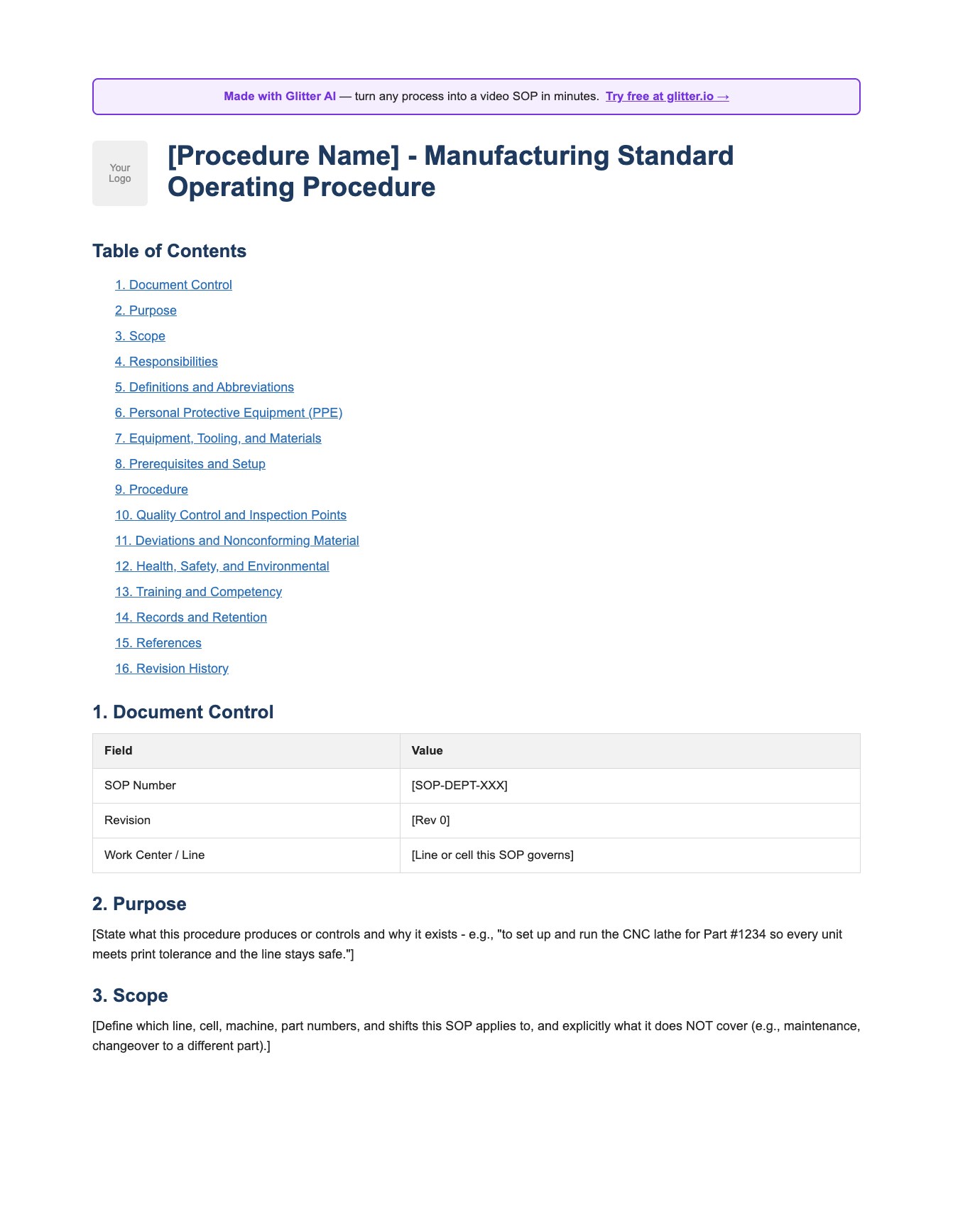
Generic SOP Template
A clean, role-agnostic SOP template in Word format - purpose, scope, responsibilities, equipment, procedure, quality control, references. Useful for support processes around the line that don't need the full manufacturing structure.
Download SOP Template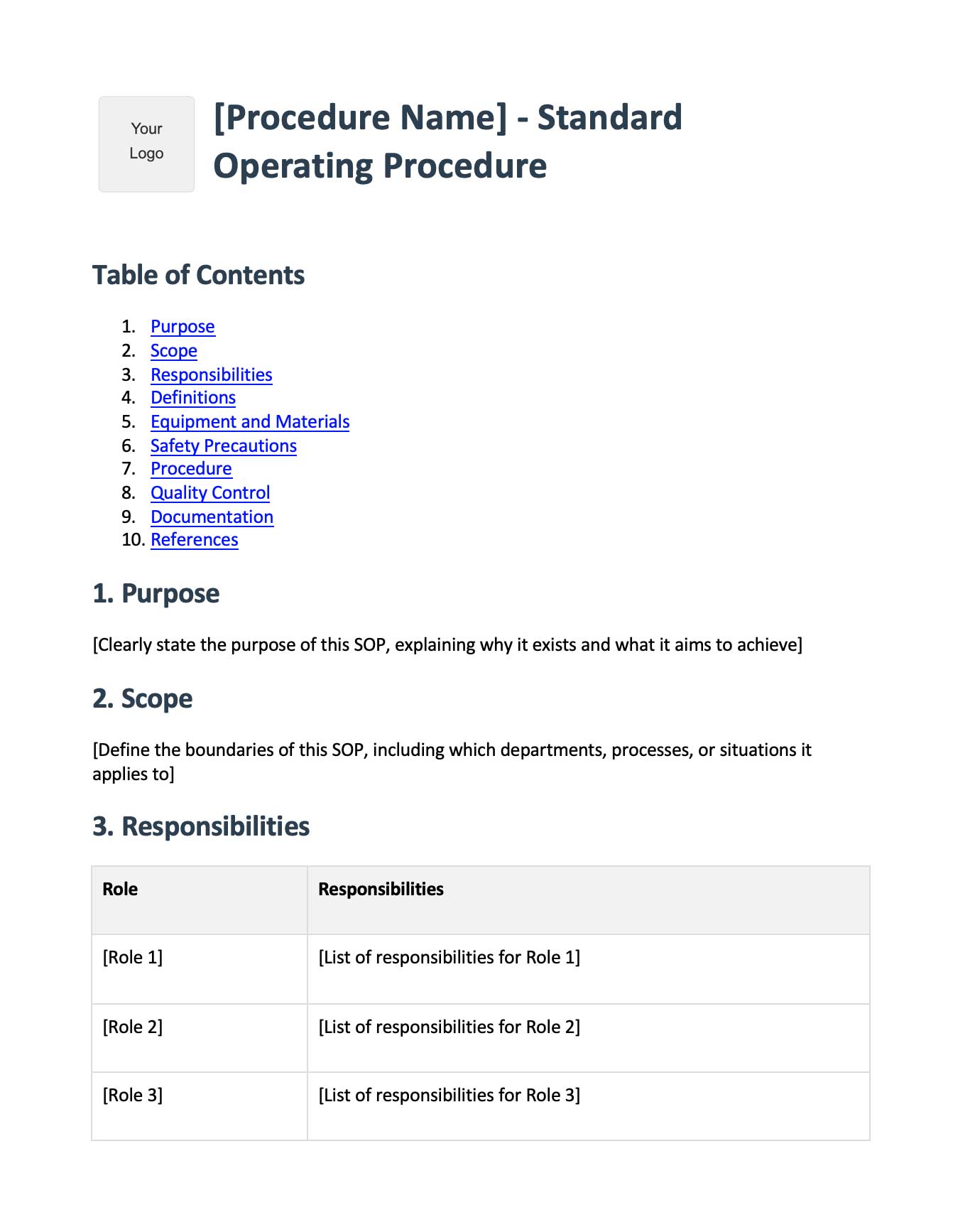
Frequently Asked Questions
What is a manufacturing SOP template?
A manufacturing SOP template is a reusable document structure for writing standard operating procedures on a production floor. It includes a document control block, purpose and scope, responsibilities, PPE and safety, equipment and tooling, a step-by-step procedure, a quality inspection plan, nonconforming material handling, and a revision history. It gives every line a consistent, auditable format.
What should a manufacturing SOP include?
A manufacturing SOP should include document control (number, revision, owner, dates), purpose and scope, a role-by-role responsibilities table, definitions, required PPE, equipment and tooling with calibration IDs, prerequisites and setup, a phased procedure (startup, first-article, production, shutdown), a quality control inspection table, deviation handling, safety, training requirements, records retention, references, and a revision log.
Is this manufacturing SOP template free?
Yes. The Word template linked in this post is free to download and adapt. It uses bracketed placeholders for every field you fill in - SOP number, line, part numbers, parameters, tolerances - so you can customize it for your specific machine, product, and quality system before using it in production.
What is the difference between a manufacturing SOP and a work instruction?
A manufacturing SOP is the controlled, governed document covering scope, responsibilities, quality, and safety for a process. A work instruction is the detailed step-by-step of how to perform one specific operation. A complete SOP template contains a procedure section detailed enough to act on, wrapped in the control structure your audit requires.
How do you write a manufacturing SOP that operators actually follow?
Write the procedure section by observing the job at the machine, not from memory at a desk. Use concrete, observable instructions ("confirm spindle speed reads 1,800 RPM ± 50") instead of vague ones ("ensure proper operation"). Front-load PPE, equipment, and prerequisites, and make the document findable where the work happens - not in a binder in the quality office.
How does a manufacturing SOP support ISO 9001 or IATF 16949?
Quality standards like ISO 9001, IATF 16949, and AS9100 require controlled documents with defined revision control, ownership, training records, and inspection plans. A manufacturing SOP template with a document control block, quality inspection table, records retention section, and revision history satisfies these requirements while still being usable by an operator on the floor.
How often should a manufacturing SOP be reviewed?
Review a manufacturing SOP at least annually, and immediately when something changes the process: tooling or fixture changes, parameter changes, a line re-layout, a customer complaint, or an audit finding. Tie the revision field to these triggers so the document version always matches the current state of the line.
Who owns a manufacturing SOP?
A manufacturing SOP should have one named process owner - typically a process engineer, production supervisor, or line lead - not a department. One specific person is accountable for keeping it current, approving revisions, and answering questions about it. Shared ownership is how SOPs go stale.
What is a first-article inspection in a manufacturing SOP?
First-article inspection (FAI) is a gate in the procedure where the first piece off a new setup is measured against the print and signed off by Quality or the line lead before full production starts. Building this gate into the SOP prevents a bad setup from producing a full shift of scrap before anyone catches it.
How do you handle nonconforming material in a manufacturing SOP?
The SOP should define a hard stop: if any quality check is out of tolerance or a safety device is bypassed, stop the process and notify the line lead before continuing. It should also specify how to tag, segregate, and quarantine nonconforming parts, who dispositions them (use-as-is, rework, or scrap), on what form, and when a corrective action is triggered.