
Read summarized version with
The most expensive maintenance lesson I ever watched someone learn ran to about $40,000 and four days of downtime. A bearing on a critical motor let go. Not because nobody knew it needed greasing. Because the one tech who knew the route, the interval, and the exact grease happened to be on vacation, and the checklist for it lived in his head.
That’s the recurring pattern with preventive maintenance. The failure almost never happens because the task was impossible. It happens because the task was invisible: not scheduled, not assigned, or not written down anywhere a second person could find it.
A good preventive maintenance checklist fixes precisely that. It turns “we should probably check that” into a task with an asset, a frequency, and an owner.
I’m Yuval, CEO of Glitter AI, and I spend a lot of time with operations and maintenance teams who want PM to be boring and predictable rather than a scramble after something breaks. So here’s the full preventive maintenance checklist, organized by asset type and frequency, with a free downloadable Word maintenance checklist template you can assign owners to and reuse. For equipment-level routines, our machine maintenance checklist broken into daily, weekly, and monthly tasks goes deeper. Skip to the downloads section below if you just want the template.
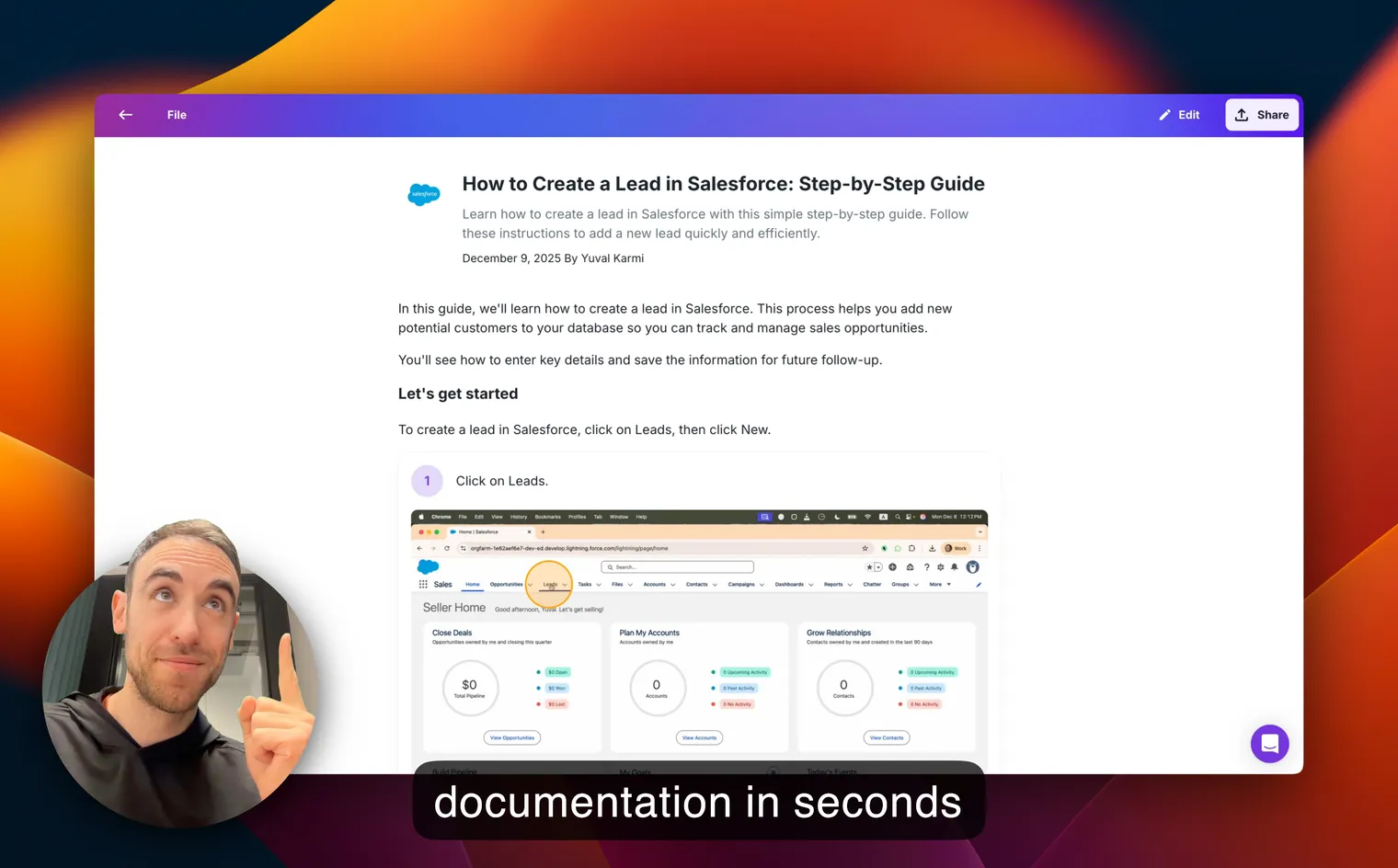
Teach your co-workers or customers how to get stuff done – in seconds.

What a Preventive Maintenance Checklist Actually Does
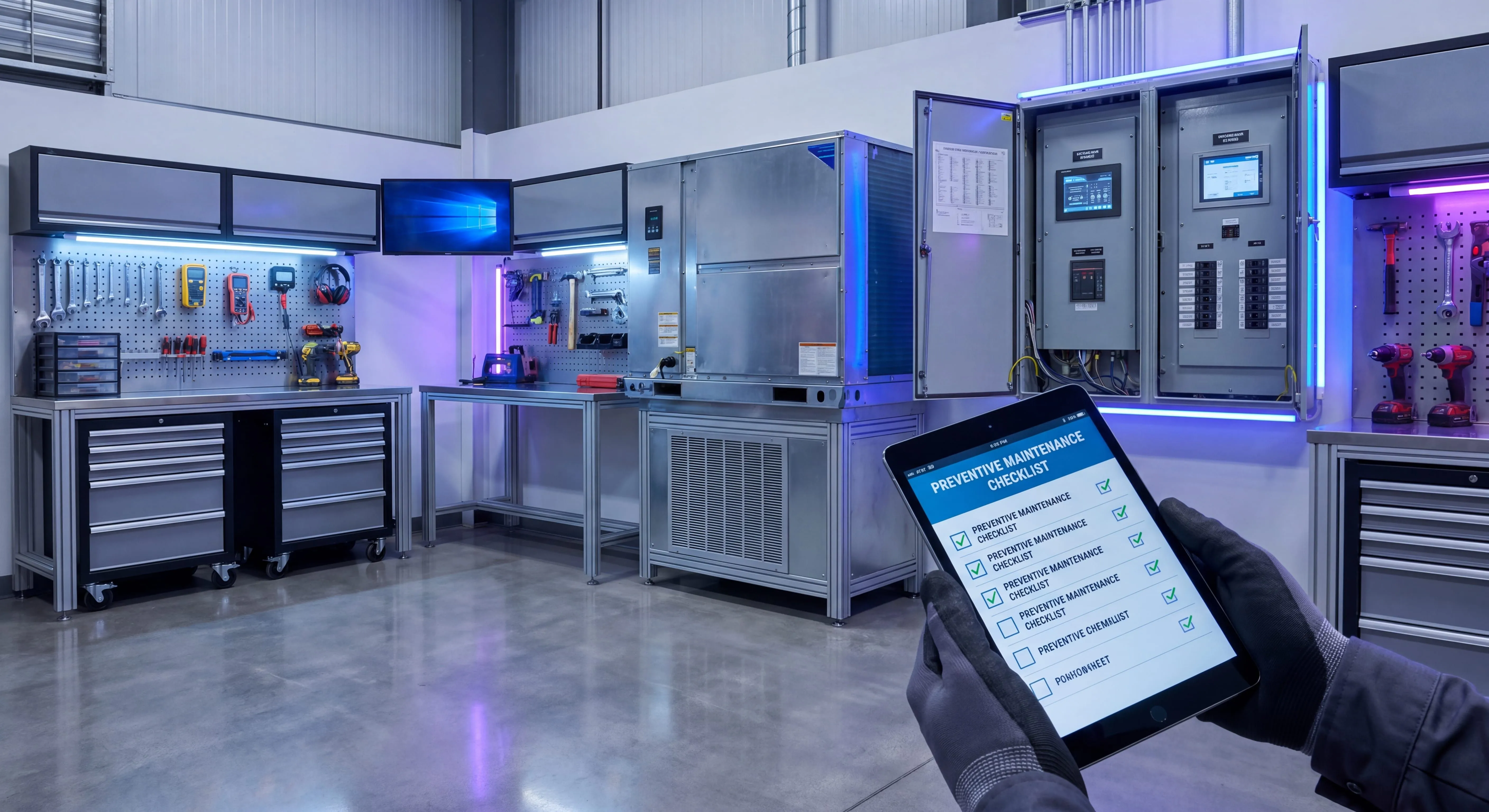
A preventive maintenance checklist is the organized list of inspection, cleaning, lubrication, calibration, and replacement tasks your team performs on a fixed schedule to keep assets running before they fail. It maps each task to a specific asset, a frequency (daily, weekly, monthly, quarterly, annual), and a named owner.
Reactive maintenance waits for the breakdown. Preventive maintenance assumes the breakdown is coming and gets in front of it on a calendar. The checklist is what makes that calendar real instead of aspirational. Organizations that make the switch from purely reactive programs to scheduled preventive work cut maintenance costs by 12% to 18% on average, per the U.S. Department of Energy. It’s the operational backbone of a CMMS, the day-to-day expression of total productive maintenance, and the foundation for building a full preventive maintenance program, where equipment care becomes part of how the whole team works rather than something one person does on a good week.
Here’s the principle I’d tape to the wall. A task isn’t preventive maintenance until it has an owner and a date. “We check the filters” is a hope. “Maria replaces the HVAC filters on the first Monday of every month and logs it” is a program.
The Full Preventive Maintenance Checklist by Asset Type
Work these groups on the frequency listed. The high-frequency stuff, daily walkarounds and weekly cleaning, catches the obvious problems early. The lower-frequency deep work, annual teardowns and certifications, catches the slow ones before they turn into the $40,000 ones.
1. HVAC and Air Handling
- Monthly: Replace air filters; check thermostat calibration and setpoints.
- Quarterly: Clean condenser and evaporator coils; inspect belts and pulleys for wear and tension; lubricate motor and fan bearings.
- Semi-annual: Check refrigerant charge and inspect for leaks; clear and flush condensate drain lines.
- Annual: Test economizer and dampers; full system performance and airflow test.
Filters are the most skipped PM task I see, and they happen to be the cheapest one on the list. A clogged filter quietly drives up energy cost and shortens equipment life for months before anyone notices.
2. Electrical Systems
- Monthly: Visual inspection of panels for heat, corrosion, or arcing; test emergency and exit lighting; inspect and exercise the backup generator.
- Quarterly: Check and tighten panel and breaker connections.
- Annual: Thermographic (infrared) scan of panels; test ground fault and breaker trip functions; load-bank test the backup generator.
The infrared scan is the one teams tend to underestimate. A loose connection that’s invisible to the eye shows up as a hot spot on a thermal camera weeks before it turns into a fire or an outage.
3. Mechanical and Production Equipment
- Daily: Walkaround for leaks, noise, and vibration; check fluid and lubricant levels.
- Weekly: Clean equipment and clear debris; inspect guards, sensors, and safety interlocks.
- Monthly: Lubricate per the manufacturer schedule; inspect belts, chains, couplings, and alignment.
- Quarterly: Calibrate gauges and controls; vibration analysis on critical rotating equipment.
- Annual: Full teardown inspection and overhaul assessment.
Always follow lockout/tagout before any service on powered equipment. The daily walkaround feels too simple to matter, but it’s the highest-ROI task on this entire list. Most catastrophic failures announce themselves first: a noise, a smell, a leak that someone walked past.
Teach your co-workers or customers how to get stuff done – in seconds.
4. Fleet and Powered Vehicles
- Daily: Pre-use inspection of tires, fluids, lights, and brakes.
- Weekly: Check battery, charge level, and connections.
- Monthly: Inspect brakes, hydraulics, and steering.
- Quarterly: Rotate tires; inspect forks, masts, and lift mechanisms.
- By hours/miles or annual: Oil and filter changes per interval; annual safety and emissions inspection.
Forklifts and yard vehicles are where the daily pre-use inspection gets skipped most. It’s also where a skipped check most directly puts a person at risk. When unplanned downtime does hit, Aberdeen research puts the cost across manufacturing at an average of $260,000 per hour - which makes a five-minute pre-shift walkaround one of the best returns on time anywhere in operations.
5. Building and Facility
- Monthly: Check doors, dock levelers, and overhead doors.
- Quarterly: Inspect roof, gutters, and drains; check plumbing and water heaters; test sump pumps; inspect exterior lighting and parking surfaces; pest control inspection.
- Semi-annual: Sealing, caulking, and weatherproofing inspection.
Facility tasks are easy to put off because nothing breaks today. The roof drain you didn’t clear in October is the flooded warehouse in January.
6. Safety and Life Systems
- Monthly: Inspect fire extinguishers; test smoke and CO detectors; check eyewash stations, safety showers, and first aid kits.
- Quarterly: Test fire alarm and pull stations; inspect sprinkler system and control valves.
- Annual: Full fire suppression system certification.
Life-safety inspections usually carry legal and code requirements, so confirm the exact frequency and documentation rules for your jurisdiction. This is the one section where “we usually get to it” doesn’t cut it.
7. IT and Infrastructure
- Weekly: Verify backups completed and test a restore; check server room temperature and humidity.
- Monthly: Test UPS battery and runtime; apply firmware and security patches.
- Quarterly: Clean and inspect rack cooling and airflow; review capacity and network health.
- Annual: Full disaster recovery failover test.
A backup you’ve never restored isn’t a backup. It’s a guess. The weekly restore test is the IT equivalent of the daily equipment walkaround.
How to Make This Checklist Actually Stick
A checklist that lives in one technician’s head works fine, right up until that technician is on vacation the week the bearing fails. Here’s how to make yours survive a person being out, a new hire, or a busy week.
Assign one owner per task. Not “maintenance.” A person. “Someone will grease the motor” is how the motor doesn’t get greased.
Pin the frequency to a trigger, not a vibe. Calendar date, run hours, or cycle count. “When we get around to it” is not a frequency.
Document the work the way it actually runs. This is the part most teams skip, and it’s the part that costs the most. PM turns into tribal knowledge because the how lives in people’s heads: the exact grease, the torque spec, the order you isolate the system, which valve you close first. That’s the gap I built Glitter AI to close. Instead of writing a maintenance manual nobody updates, a technician records themselves performing the task once and Glitter AI turns it into a step-by-step guide with screenshots. The next person follows the guide instead of reverse-engineering it under pressure. If you want the broader picture on capturing hands-on procedures so anyone can repeat them, my guide on visual work instructions covers exactly that, and the process documentation primer explains how this fits across operations.
The goal isn’t a thicker binder. It’s that the answer to “who knows how to do this, and where is it written down” is never “just one person, and it isn’t.” NIST research found that organizations running reactive-heavy programs experience 3.3 times more downtime than those with structured maintenance strategies - so building the checklist habit pays off faster than most teams expect.
Teach your co-workers or customers how to get stuff done – in seconds.
Downloads
Here’s the full preventive maintenance checklist as a free Word template. It already has every asset group above, with Task, Frequency, Owner, and Done columns so you can assign work, set intervals, and track completion:
Download the Preventive Maintenance Checklist
A free Word template covering HVAC, electrical, mechanical, fleet, facility, safety, and IT, with Frequency, Owner, and Done columns. Assign tasks, set intervals, and reuse it every cycle.
Download Preventive Maintenance Checklist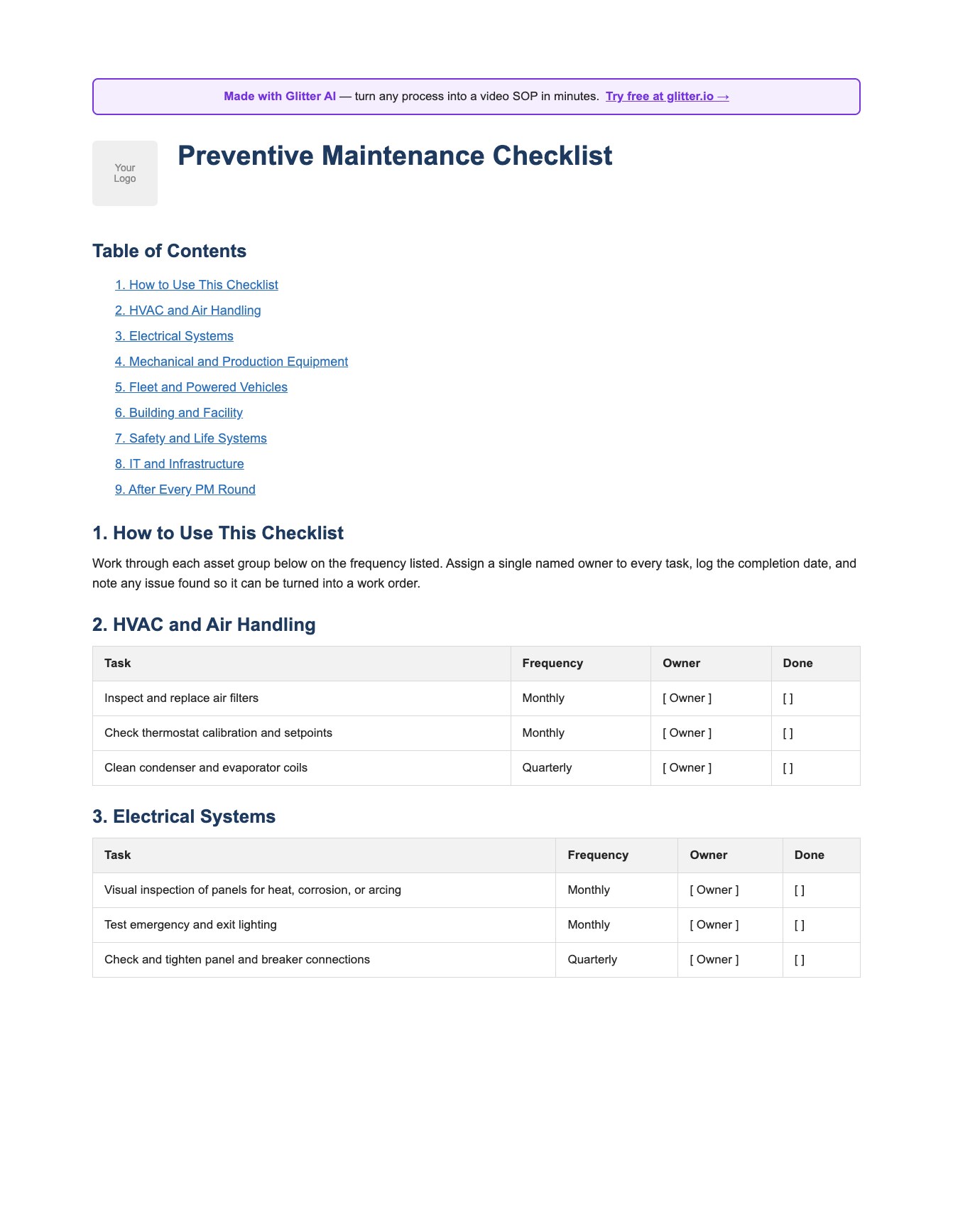
Frequently Asked Questions
What is a preventive maintenance checklist?
A preventive maintenance checklist is the organized list of inspection, cleaning, lubrication, calibration, and replacement tasks a team performs on a fixed schedule to keep assets running before they fail. Each task is mapped to a specific asset, a frequency, and a named owner.
What should be included in a preventive maintenance checklist?
A complete checklist covers HVAC and air handling, electrical systems, mechanical and production equipment, fleet and powered vehicles, building and facility, safety and life systems, and IT and infrastructure. Each task should list its frequency, an owner, and a place to log completion.
How often should preventive maintenance be performed?
Frequency depends on the asset and how hard it runs. Common intervals are daily walkarounds and fluid checks, weekly cleaning and backup tests, monthly filter and lubrication tasks, quarterly calibration, and annual teardowns or certifications. Critical and high-runtime assets are inspected more often.
What is the difference between preventive and reactive maintenance?
Reactive maintenance waits for an asset to break and then repairs it. Preventive maintenance assumes failure is coming and performs scheduled tasks to prevent it. Preventive maintenance costs less over time because planned downtime is far cheaper than unplanned downtime.
How do I create a preventive maintenance schedule?
Start by listing every asset, then pull each manufacturer's recommended service intervals. Group tasks by frequency, assign a named owner to each one, tie the trigger to a calendar date or run hours, and track completion. A CMMS or a reusable checklist template keeps the schedule from slipping.
What assets need preventive maintenance?
Any asset whose failure causes downtime, safety risk, or cost: HVAC, electrical systems and generators, production and rotating equipment, fleet and lift vehicles, the building envelope, fire and life-safety systems, and IT infrastructure including backups and UPS units.
What is a CMMS and do I need one for preventive maintenance?
A CMMS is a computerized maintenance management system that tracks assets, schedules preventive maintenance, and manages work orders. You can run preventive maintenance with a checklist and a calendar, but a CMMS automates scheduling, history, and reporting as the asset count grows.
Why does preventive maintenance fail in practice?
It usually fails not because tasks are hard, but because they are invisible: not scheduled, not assigned to a named person, or only documented in one technician's head. A checklist with an owner, a frequency, and a logged completion date for every task fixes most of this.
How do you document preventive maintenance procedures?
The most reliable approach is to capture each task as a step-by-step visual guide while someone performs it, including specs, tools, and order of operations. That way any technician can repeat the procedure correctly instead of relying on one person's memory.
Is there a free preventive maintenance checklist template?
Yes. The free downloadable Word template in this post covers HVAC, electrical, mechanical, fleet, facility, safety, and IT, with Frequency, Owner, and Done columns so maintenance teams can assign work, set intervals, and reuse it every cycle.