
Read summarized version with
The first time I had to actually understand the accounting process, I was staring at a screen from our financial reporting process that said our cash balance was fine and our books said we were losing money, and I had no idea how both could be true at the same time.
I’m Yuval, founder and CEO of Glitter AI. Not an accountant. But run a startup long enough and you end up sitting across from one, and they say things like “that’s just an accrual” or “it’ll wash out at close,” and you nod along like you follow. I didn’t, for a long time. What finally made it click was seeing the whole thing as a process - a repeatable cycle that runs every period, same steps, same order, every time, sitting right on top of the day-to-day bookkeeping process.
That’s what this post is. The accounting process explained, start to finish, in plain language. No CPA exam, no jargon for its own sake. Just the cycle: how a transaction turns into a journal entry, how that lands in the ledger via the general ledger process, and how it all rolls up into the financial statements you actually care about.
Teach your co-workers or customers how to get stuff done – in seconds.

What is the accounting process?
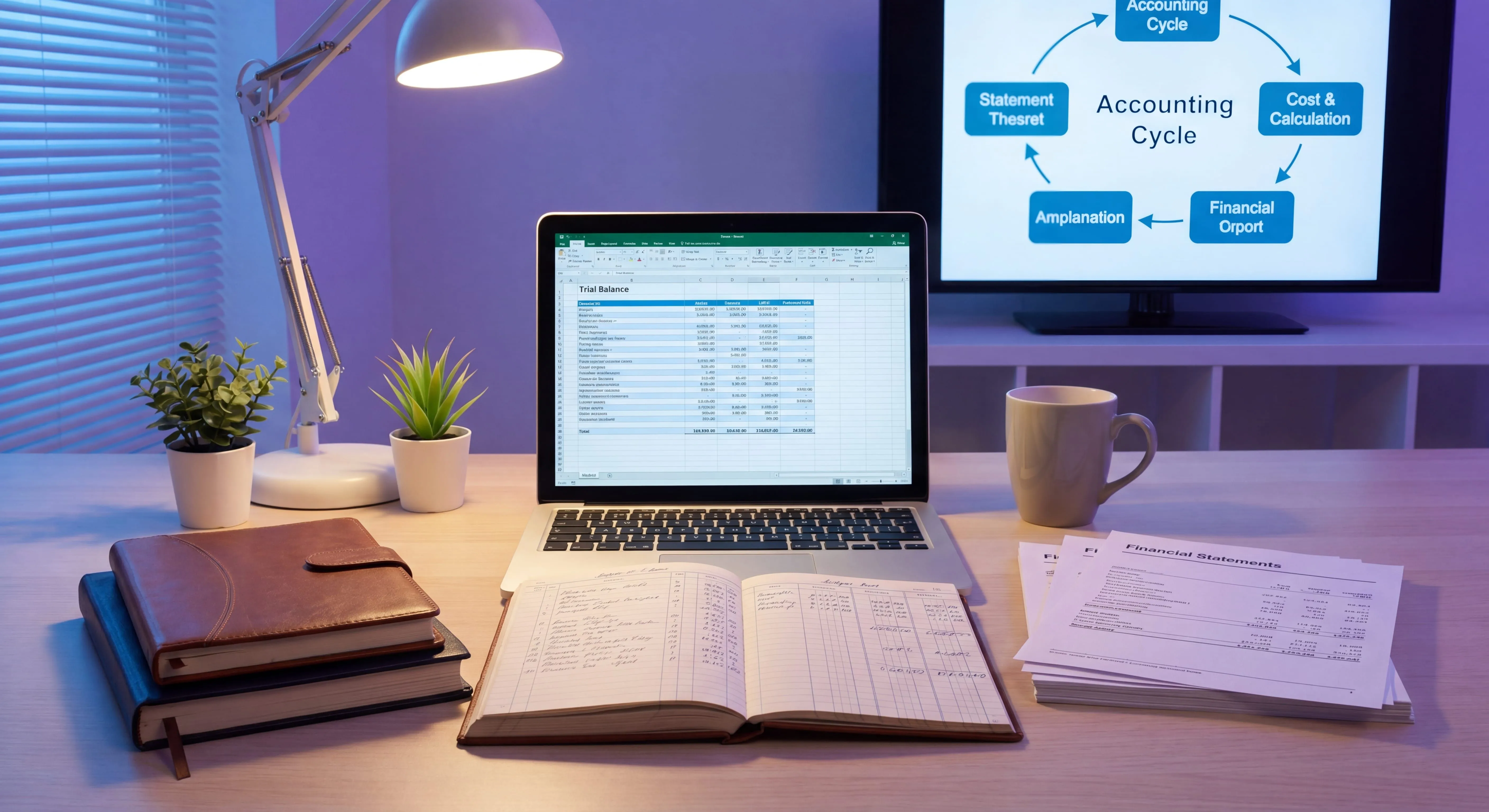
The accounting process is the cycle a business repeats every period to turn raw financial events into accurate financial statements. It starts when something with a dollar value happens - a sale, a bill, a payroll run - and it ends when the books are closed and you have a clean income statement, balance sheet, and cash flow statement.
People also call it the accounting cycle, and “cycle” is the word that matters. It isn’t a one-time setup. It runs monthly, quarterly, and annually, in the same sequence, forever. The whole point of the structure is that anyone following the steps should land on the same numbers. That’s also why it maps so cleanly onto a documented procedure - if you’ve ever seen an accounting SOP, it’s basically this cycle written down so it doesn’t live in one person’s head.
Here’s the part most explanations skip. The accounting process is valuable because it’s boring and repeatable. The discipline is the product. Skip a step or do it out of order and the errors don’t announce themselves - they quietly compound until close, when you’re the one staring at two numbers that disagree. A Gartner survey of controllership professionals found that roughly a third of accountants make several financial errors every week - most of them while doing manual work, misinterpreting data, or reviewing records under time pressure.
The steps in the accounting process
The accounting cycle is usually taught as eight steps. Some textbooks merge or split a couple, but the substance doesn’t change. Here’s the full sequence:
- Identify and analyze transactions
- Record journal entries
- Post to the general ledger
- Prepare an unadjusted trial balance
- Make adjusting entries
- Prepare an adjusted trial balance
- Prepare the financial statements
- Close the books
Let me walk through each one the way it actually runs.
Step 1: Identify and analyze transactions
Before anything gets recorded, you have to decide what counts. Not every business event is an accounting transaction. A signed contract for future work isn’t - no money has moved and no obligation has been incurred yet. An invoice you received is, even if you haven’t paid it.
So step one is collecting source documents - invoices, receipts, bank feeds, payroll reports - and asking, for each one: did this change the financial position of the business, and by how much? This is where accounts payable and accounts receivable feed the cycle. Every vendor bill that runs through your accounts payable SOP and every customer invoice from your accounts receivable workflow enters here.
Get this step wrong and everything downstream is wrong. Garbage in, garbage out, except the garbage doesn’t surface for three weeks.
Step 2: Record journal entries
Once a transaction is identified, you record it as a journal entry. This is where double-entry accounting shows up: every entry hits at least two accounts, and debits must equal credits.
Say you pay a $1,200 software bill. You credit Cash $1,200 (cash goes down) and debit Software Expense $1,200 (an expense goes up). The entry balances. If you buy a $5,000 laptop fleet on a company card, you debit Equipment $5,000 and credit Cash $5,000 - same idea, different accounts.
The journal is the chronological record - every transaction, in the order it happened, with a date, the accounts touched, the amounts, and a short description. It gets called the “book of original entry” because it’s the first place a transaction is formally written down.
Teach your co-workers or customers how to get stuff done – in seconds.
Step 3: Post to the general ledger
The journal is organized by time. The ledger is organized by account. Posting is the step where you take each journal entry and file its debits and credits into the individual accounts they affect.
The general ledger is the master set of all accounts - Cash, Accounts Receivable, Accounts Payable, Revenue, every expense category, equity, and so on. After posting, you can look at any single account and see every transaction that touched it and its running balance. That’s the view you need for the next step.
In software like QuickBooks or Xero, posting happens automatically the moment you save a journal entry or categorize a bank transaction. The step still exists - the system just does the filing for you. Knowing it’s happening is what keeps you from getting confused later about why a number looks the way it does.
Step 4: Prepare an unadjusted trial balance
At the end of the period, you pull the ending balance of every ledger account into one report and total the debits and the credits. This is the trial balance, and its job is a sanity check: if total debits don’t equal total credits, something is mathematically broken and you find it now, before it pollutes the statements.
It’s called unadjusted because it’s the raw picture, before you’ve accounted for things that happened but haven’t been recorded yet. A balanced trial balance doesn’t mean the books are right. You can post a wrong entry that still balances perfectly. All it means is the arithmetic holds - a necessary check, not a sufficient one.
Step 5: Make adjusting entries
This is the step that confused me the longest, and it’s the one that separates real accounting from glorified checkbook-balancing. Adjusting entries capture economic activity that happened during the period but didn’t get recorded by a normal transaction.
The common ones:
- Accruals - revenue you earned but haven’t billed, or expenses you incurred but haven’t been billed for. The work happened in this period, so the books should reflect it now, not whenever the invoice shows up.
- Deferrals - cash that moved before the activity happened. You paid annual insurance up front; each month you expense one-twelfth and carry the rest as prepaid.
- Depreciation - spreading the cost of a big asset across the years it’s actually used, instead of dumping it all into one month.
This is where accrual accounting earns its keep. It matches revenue and expenses to the period they belong to, so the statements show what really happened, not just what hit the bank account. It’s also why my cash balance and my books once told me two different stories. Both were “right.” They were just answering different questions.
Step 6: Prepare an adjusted trial balance
Same report as step 4, run again, now that the adjusting entries are in. Debits and credits should still tie out. If they do, the adjusted trial balance becomes the clean foundation the financial statements are built directly from. If they don’t, you’ve caught a problem in the adjustments before it became a problem in the statements - which is the whole point of running it twice.
Step 7: Prepare the financial statements
Now the cycle pays off. From the adjusted trial balance you produce the three core statements, and the order matters because each feeds the next:
- Income statement - revenue minus expenses for the period. The bottom line is net income.
- Statement of retained earnings (or equity) - takes that net income and rolls it into equity, less any distributions.
- Balance sheet - assets, liabilities, and equity at the period’s end. Assets must equal liabilities plus equity. Always.
- Cash flow statement - reconciles net income back to the actual change in cash, which, because of all those accruals and deferrals, is almost never the same number as net income.
This is the output everyone outside accounting actually looks at. Everything in steps 1 through 6 exists just so these statements can be trusted.
Step 8: Close the books
Closing zeroes out the temporary accounts - revenue, expenses, and any draws - and rolls their net effect into retained earnings. Temporary accounts measure this period only, so they have to start the next period at zero. Permanent accounts (assets, liabilities, equity) carry their balances forward; that’s the continuity from one period to the next.
Many teams then run a post-closing trial balance to confirm only permanent accounts have balances and everything still ties. After that, the period is locked, and the cycle starts over with the next period’s first transaction.
The month-end close is where this step lives in practice, and it’s the part most likely to hinge on one person who “just knows” the order to do things in. I’ve watched a planned week off stall an entire close because the sequence was never written down anywhere. A 2025 month-end close benchmark backs this up: half of finance teams still need more than five business days to close, even though most consider three to five days an acceptable standard.
Why the accounting process belongs in writing
Here’s what I keep coming back to. The accounting process is a repeatable sequence that produces the same result when it’s followed consistently. That’s pretty much the textbook definition of something that should be documented, not memorized.
When the cycle lives only in one person’s head, every absence is a risk, every handoff loses something, and every new hire relearns it from scratch. The work itself is stable. The knowledge usually isn’t. A decent process documentation habit turns “ask Dana, she knows the close” into “follow the procedure.” Building a real accounting SOP guide for each recurring step does the same. That’s the difference between a process that survives staffing changes and one that doesn’t.
You don’t need fancy tooling to start. You need the cycle written down once, in the order it actually runs, with the specifics of your chart of accounts and your software. The accounting process is standardized by design. The only question is whether yours is standardized on paper or only in someone’s memory.
Teach your co-workers or customers how to get stuff done – in seconds.
Frequently Asked Questions
What is the accounting process?
The accounting process is the repeating cycle a business follows to turn financial transactions into accurate financial statements. It runs from identifying transactions through journal entries, the ledger, trial balances, adjustments, statements, and closing the books each period.
What are the steps in the accounting process?
The accounting process has eight steps: identify and analyze transactions, record journal entries, post to the general ledger, prepare an unadjusted trial balance, make adjusting entries, prepare an adjusted trial balance, prepare financial statements, and close the books.
What is the difference between the accounting process and the accounting cycle?
They are the same thing. "Accounting cycle" emphasizes that the steps repeat every period in the same order, while "accounting process" refers to the overall sequence. Both describe how transactions become financial statements.
Why is double-entry accounting used in the accounting process?
Double-entry accounting requires every transaction to debit at least one account and credit another by equal amounts. This keeps the books balanced and makes errors easier to catch, since total debits must always equal total credits.
What is a trial balance and why is it prepared twice?
A trial balance lists every account's ending balance to confirm total debits equal total credits. It is prepared before adjusting entries (unadjusted) as a math check and again after them (adjusted) to give a clean basis for the financial statements.
What are adjusting entries in the accounting process?
Adjusting entries record activity that happened during the period but was not captured by a normal transaction, such as accruals, deferrals, and depreciation. They make the financial statements reflect what actually occurred, not just what hit the bank account.
What financial statements does the accounting process produce?
The accounting process produces the income statement, the statement of retained earnings or equity, the balance sheet, and the cash flow statement. They are prepared in that order because each one feeds into the next.
What does closing the books mean?
Closing the books zeroes out temporary accounts like revenue and expenses and rolls their net effect into retained earnings, so the next period starts fresh. Permanent accounts such as assets and liabilities carry their balances forward.
How long does the accounting process take each period?
It depends on transaction volume and automation, but most teams complete the cycle as part of the month-end close, typically within five to ten business days. Documented procedures and accounting software meaningfully shorten that time.
Why should the accounting process be documented?
The accounting process is standardized and repeatable, which makes it ideal to document. Writing it down protects against errors, removes single points of failure when staff are out, and speeds up onboarding new finance team members.