

Read summarized version with
The best maintenance person on most teams is also the worst documented.
I’ve seen it over and over. There’s one tech who knows that pump never wants to be primed the way the manual says, who knows the conveyor bearing runs hot for the first hour and that’s fine, who knows exactly which breaker to throw before anyone touches the line. All of that lives in their head. And the day they’re out sick, on vacation, or finally retire, that knowledge walks out with them. A Plant Engineering maintenance survey found that operational error and insufficient maintenance time together account for roughly 20% of unplanned equipment failures - and both trace directly back to procedures that aren’t documented well enough for anyone other than the expert to follow.
A maintenance SOP is how you stop that from happening. It’s the difference between “ask Dave” and “follow the procedure.” I’m Yuval, founder and CEO of Glitter AI. I’ve spent years watching teams try to capture this kind of operational knowledge the hard way, and most of them do it the slow way. This post is the practical version: what a maintenance SOP actually is, how to structure it, how to write one, and how to do it without burning your whole week typing. A lot of what makes a maintenance SOP actually useful comes down to capturing the tacit judgment calls a tech makes without thinking twice.
That’s usually where a short interview with the technician pays off too, especially for the failure modes and quirks that never made it into the equipment manual.
Teach your co-workers or customers how to get stuff done – in seconds.


What is a maintenance SOP?
A maintenance SOP is a standard operating procedure that documents exactly how a specific maintenance task gets done, start to finish, the same way, every time, by anyone qualified to do it.
That last part matters. An SOP isn’t a reminder for the person who already knows how. It’s a set of instructions complete enough that a competent technician who has never done this particular task can do it correctly and safely on the first try.
If you want the broader definition, our process documentation glossary entry covers the general concept. A maintenance SOP is that idea applied to one thing: keeping equipment running.
The tasks worth turning into SOPs usually fall into a few buckets:
- Preventive maintenance: scheduled inspections, lubrication, filter changes, calibration
- Corrective maintenance: replacing a failed part, clearing a jam, repairing a known failure mode
- Operational tasks: startup, shutdown, changeover, cleaning between runs
- Safety-critical procedures: lockout/tagout, confined space entry, working at height
Not every task needs its own SOP. The ones that do tend to be frequent, risky, costly to get wrong, or handled by more than one person. If only one person ever does it and a bad job doesn’t really cost you anything, write it down later. Everything else, write it down now.
Why most maintenance SOPs fail
Before structure, a quick honest word: most maintenance SOPs don’t fail because they’re missing a section. They fail because nobody reads them.
I’ve watched this happen. A binder gets created during some audit scramble, goes on a shelf, and the real procedure stays in someone’s head. Six months later the binder is wrong, because the equipment got modified and nobody touched the doc. Now it’s worse than useless. It’s actively misleading.
So as you read the rest of this, keep two things in mind. First, the SOP has to be where the work happens, on a phone or tablet at the machine, not in a binder in an office. Second, the SOP has to be easy enough to update that updating it actually happens. A perfect document that’s out of date beats nothing by exactly zero.
The structure of a good maintenance SOP
Here’s the structure I’d use for almost any maintenance SOP. It isn’t bureaucracy. Every section earns its place by answering a question a technician will actually have.
1. Header / identification
The boring-but-necessary metadata:
- Title: specific. “Replace HVAC-3 Belt,” not “HVAC Maintenance”
- SOP ID / number: so it can be referenced and tracked
- Asset or equipment: make, model, and asset tag
- Version and date: so people know if they’re looking at the current one
- Author and approver: accountability
- Review date: when this is due for a check
2. Purpose and scope
One or two sentences on what this procedure accomplishes and when it applies. Just as important: when it doesn’t apply. “This covers the monthly belt inspection on HVAC-3. It does not cover motor bearing replacement; see SOP-114.”
3. Safety
This goes near the top, not buried at the end. List the hazards, the required PPE, and the energy-control steps before any work begins. If the task requires lockout/tagout, the LOTO steps belong here, explicitly, not as a vague “follow LOTO procedures” line. For a deeper treatment of safety inside a procedure, our guide on writing a preventive maintenance procedure walks through lockout/tagout step structure in detail.
4. Tools, parts, and materials
Everything needed before starting, with specifics: torque wrench (not “a wrench”), part number for the belt, the exact lubricant grade. The point is that the technician gathers everything once instead of stopping halfway through the job to go hunt for a part.
5. Step-by-step procedure
The core. Numbered, sequential, one action per step. This is where most SOPs go wrong by being too vague (“inspect the belt”) or too dense (a paragraph per step). I’ll cover how to write these well in the next section.
6. Verification and acceptance criteria
How does the technician know the job is done correctly, not just done? “Belt deflection is 1/2 inch at midpoint under 10 lb of force.” Measurable, not “looks good.”
7. Records and references
What to log (in your CMMS or on the work order), where, and links to related SOPs, manuals, or schematics.
Teach your co-workers or customers how to get stuff done – in seconds.
How to write a maintenance SOP, step by step
Structure is the skeleton. Here’s the actual process for putting one together.
Step 1: Pick one task and watch it get done
Don’t write from memory, and don’t write from the equipment manual. Watch your best technician actually do the task. Memory skips steps, because the expert’s brain has already automated them. And manuals describe the ideal machine, not the one on your floor with the modification from 2019 and the quirk everyone quietly works around.
The watching step is where the real SOP comes from. Everything the expert does without thinking is exactly what the new person doesn’t know.
Step 2: Capture every step in order
Write down each physical action as it happens. Not “service the unit” but “1. Lock out main disconnect. 2. Verify zero energy with meter. 3. Remove four 10mm bolts on access panel.” If you’re filming or screen-recording the process, even better; you can pull the steps from the recording instead of scribbling and missing things.
Step 3: Add the decisions, not just the actions
Real maintenance has branches. “If the bearing temperature is above 180°F, stop and tag the asset out of service. If below, continue to step 8.” Capture those. The decision points are usually where an inexperienced person gets it wrong, so they’re the most valuable part of the SOP.
Step 4: Write for the person who has never done this
Re-read every step and ask: would someone who has never touched this machine know exactly what to do? Replace “tighten properly” with the torque spec. Swap “the usual filter” for the part number. Trade “check it’s working” for the acceptance criterion. Vagueness is the enemy here. It’s how SOPs quietly slide back into “ask Dave.”
Step 5: Add visuals at the steps that need them
A photo of the correct belt routing beats two paragraphs describing it. A screenshot of the right CMMS screen beats “log it in the system.” You don’t need a picture for every step. You need one wherever words alone are ambiguous. This is the single biggest quality difference between an SOP people follow and one they don’t.
Step 6: Have someone else run it
Hand the draft to a technician who didn’t write it and have them do the task using only the SOP, no help. Every time they pause, ask a question, or do something the doc didn’t say, that’s a gap. Fix it. This one test catches more problems than any review meeting.
Step 7: Put it where the work happens and set a review date
Get it onto the device the tech uses at the machine. Set a review date (annually at minimum, or after any equipment change). Assign an owner. An SOP without an owner and a review date is a future out-of-date SOP.
If you want the general-purpose version of this writing process beyond maintenance specifically, our how to write an SOP guide covers the same discipline applied to any department.
Maintenance SOP vs. work instruction vs. checklist
These get used interchangeably and they shouldn’t be:
- SOP: the full procedure (purpose, safety, tools, steps, verification). The authoritative document.
- Work instruction: a tightly focused subset, usually the step-by-step for one narrow task. We break the distinction down in SOP vs. work instructions.
- Checklist: the field-friendly summary used during the actual job, derived from the SOP.
In practice, you want all three pointing at the same source of truth. The SOP is the master. The checklist is what the tech ticks through at the machine. When the SOP changes, the checklist regenerates from it, not the other way around.
The fastest way to capture a maintenance SOP
Here’s the honest problem with everything I just described: it’s a lot of typing. The reason maintenance knowledge stays trapped in people’s heads is that writing it down the old way takes hours per procedure. Type a step, take a photo, crop it, label it, paste it in, repeat forty times. Your best tech doesn’t have hours. They have a work order queue. And the economics of skipping it are brutal: Deloitte research found that documenting and structuring maintenance processes can reduce the time required to plan and execute maintenance by 20-50%, simply because technicians stop losing time hunting for information or improvising steps they’re unsure about.
This is the exact problem I built Glitter AI to solve. Instead of writing the SOP, you do the task while Glitter records, and it turns the recording into a structured, step-by-step guide. Screenshots and actions get captured automatically, ready to edit into a clean SOP. The expert just does their job once. The documentation falls out of it.
That changes the economics. When capturing a procedure costs minutes instead of an afternoon, you actually do it, for the pump, the conveyor, the changeover, all of it, before the person who knows it leaves.
Teach your co-workers or customers how to get stuff done – in seconds.
It works for digital procedures too. A lot of modern maintenance is really CMMS work: closing work orders, logging meter readings, scheduling PMs. If you’re standing up that side of things, our CMMS implementation guide covers the rollout, and the same capture approach documents the software steps as cleanly as it does the wrench work. (See also our broader take on digital SOPs.)
Downloads
Want a starting point you can fill in today? Grab the free SOP template below and use the structure from this post to build your first maintenance SOP.
Download the SOP Template
A free Word template you can fill in and ship today, structured exactly like the maintenance SOP outlined above.
Download SOP Template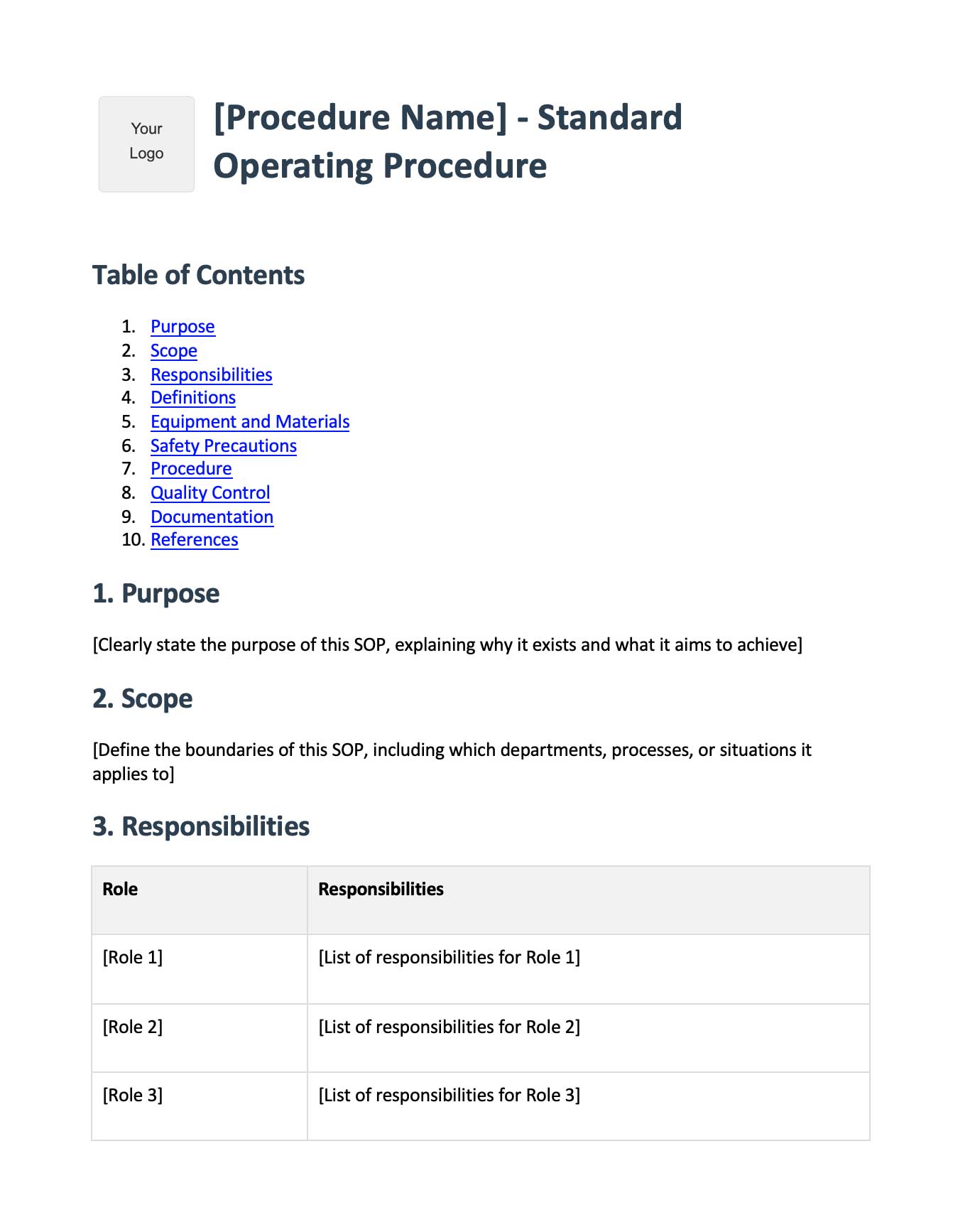
Putting it together
A maintenance SOP isn’t a binder you make for an audit. It’s how one person’s hard-won knowledge becomes something the whole team can use, repeat, and improve. Get the structure right, write it for the person who’s never done the task, test it with a real technician, and put it where the work happens.
And make capturing it cheap enough that it actually gets done. That last part is the one most teams skip, and it’s the one that decides whether your maintenance knowledge survives the next retirement.
Frequently Asked Questions
What is a maintenance SOP?
A maintenance SOP (standard operating procedure) is a document that describes exactly how to perform a specific maintenance task the same way every time. It includes safety steps, required tools and parts, a numbered procedure, and verification criteria so any qualified technician can complete the task correctly.
What should a maintenance SOP include?
A solid maintenance SOP includes a header with asset and version details, purpose and scope, a safety section with hazards and lockout/tagout steps, a tools and parts list, the numbered step-by-step procedure, verification and acceptance criteria, and records and references. The safety section should appear near the top, not at the end.
How do I write a maintenance SOP?
Watch your best technician perform the task, capture every step in order including decision points, write each step for someone who has never done it, add visuals where words are ambiguous, then have a different technician run the procedure using only the SOP to find gaps. Finally, put it where the work happens and assign an owner and review date.
What is the difference between a maintenance SOP and a work instruction?
An SOP is the full authoritative procedure including purpose, safety, tools, steps, and verification. A work instruction is a narrower, tightly focused subset that covers the step-by-step for one specific task. Both should point to the same source of truth, with the SOP as the master document.
How detailed should maintenance SOP steps be?
Each step should contain one action and enough specificity that a technician who has never done the task could follow it. Replace vague phrases like 'tighten properly' with the torque spec, and 'the usual filter' with the exact part number. Vagueness is the most common reason maintenance SOPs fail to be followed.
How often should a maintenance SOP be reviewed?
Review a maintenance SOP at least annually, and immediately after any equipment modification, failure mode change, or safety incident related to the task. Assign an owner and a review date so updates actually happen. An out-of-date SOP can be more dangerous than no SOP at all.
Should maintenance SOPs include photos?
Yes, at the steps where words alone are ambiguous. A photo of correct belt routing or the right CMMS screen prevents errors that paragraphs of text cannot. You do not need a photo for every step, just wherever a visual removes ambiguity. This is the biggest quality difference between SOPs that get followed and ones that don't.
Which maintenance tasks need an SOP?
Prioritize tasks that are frequent, safety-critical, costly to get wrong, or performed by more than one person. Preventive maintenance, corrective repairs of known failure modes, equipment startup and shutdown, and lockout/tagout procedures are common candidates. A one-off task done by a single person with low consequences can wait.
Where should maintenance SOPs be stored?
Store maintenance SOPs where the work actually happens, accessible on a phone or tablet at the equipment, not in a binder in an office. They should also link to the CMMS or work order system so technicians can log completion and readings in the same workflow.
How can I create maintenance SOPs faster?
Instead of typing each step and manually adding screenshots, record the task while an expert performs it once and convert the recording into a structured step-by-step guide. Glitter AI captures the actions and screenshots automatically, turning hours of documentation work into minutes so SOPs actually get created before knowledge leaves the team.