

Read summarized version with
A small-business owner once told me her entire bookkeeping system was “the shoebox and the panic.”
The shoebox held receipts. The panic showed up every April, when her accountant asked for a year of records and she realized the shoebox was the records. She wasn’t lazy, and she wasn’t bad at her job. She just never had a list of what bookkeeping actually requires, and when. So it all collapsed into one terrible week a year.
That’s the thing about bookkeeping. The work itself isn’t hard. What breaks people is that it stays invisible until it’s overdue, and by then it’s a forensic project instead of a ten-minute habit. The ACFE’s 2024 Report to the Nations found that organizations lose a median of $145,000 per occupational fraud case, and frauds go undetected for a median of 12 months. Consistent bookkeeping habits are what make that 12-month window shorter.
I’m Yuval, CEO of Glitter AI. I spend a lot of time with small teams who’d rather their books be boring and current than dramatic and late. So here’s the full bookkeeping checklist, broken down by daily, weekly, monthly, quarterly, and yearly tasks, plus a free downloadable version you can assign owners to and reuse. Jump to the downloads section if you just want the template.
Teach your co-workers or customers how to get stuff done – in seconds.


What a Bookkeeping Checklist Actually Does
A bookkeeping checklist is the recurring set of tasks that keeps your financial records accurate, organized, and ready for tax time, grouped by how often each task needs to happen. It covers recording transactions, reconciling accounts, chasing invoices, paying bills, and the periodic close that turns raw data into financial statements you can actually trust.
Why split it by frequency? Because the single biggest mistake I see isn’t doing a task wrong. It’s doing a daily task monthly. Categorizing one transaction is trivial. Categorizing four hundred of them after the fact, with no memory of what half of them even were, is how books go bad. A good checklist puts each task at the cadence where it’s still cheap.
If you want the full narrative of how these pieces connect into a repeatable system, I wrote a companion walkthrough on the bookkeeping process. This post is the checklist itself, so nothing slips through.
The Daily Bookkeeping Checklist
Daily tasks are small on purpose. None of these should take more than a few minutes, and that’s the whole point. They keep the books current so nothing has to be reconstructed later.
- Record the day’s sales (cash, card, and online).
- Capture and file receipts and bills as they arrive, not in a shoebox.
- Log any cash or petty cash payments.
- Glance at the bank balance and flag anything you don’t recognize.
- Send invoices for work delivered that day.
The receipts one carries the most weight. A photographed receipt with a category takes ten seconds today and is unrecoverable nine months from now. Most “messy books” problems are really missed-daily-habit problems wearing a disguise.
The Weekly Bookkeeping Checklist
Weekly is where the books go from “recorded” to “reconciled.” This is the rhythm that keeps cash flow in view.
- Enter and categorize all bills and expenses.
- Reconcile the week’s bank and credit card transactions.
- Record customer payments and update accounts receivable.
- Follow up on overdue invoices before they become bad debt.
- Schedule or approve vendor payments due that week.
- Confirm the accounting data backup or sync actually ran.
The follow-up step is the one people skip and later regret. A 15-day-overdue invoice and a 90-day-overdue invoice cost you wildly different amounts, and the only thing separating them is whether someone actually looked. Tips - including flagged anomalies from routine review - are the detection method in 43% of fraud cases according to the ACFE, beating internal audit, management review, and account reconciliation combined. Consistent review is a process, not a personality trait.
Teach your co-workers or customers how to get stuff done – in seconds.
The Monthly Bookkeeping Checklist
Monthly is the close, and knowing how to close the books is what this section comes down to. Here you prove the numbers, not just record them. Treat every balance sheet account as something that needs an owner and a reconciliation.
- Reconcile every bank account to its statement.
- Reconcile credit card and merchant processor accounts.
- Review the aged accounts receivable report and follow up on what’s old.
- Review the aged accounts payable report and confirm nothing missed cutoff.
- Record recurring journal entries (depreciation, accruals, prepaids).
- Reconcile payroll liabilities and confirm tax remittances cleared.
- Review the profit and loss statement for anything that looks wrong.
- Review the balance sheet and tie out the key accounts.
- Lock the period once it’s been reviewed and approved.
Reconciliation is the heartbeat of monthly bookkeeping. If you only adopt one new habit from this whole post, make it this one: every month, every account ties back to an independent source. Skipping reconciliation on the accounts that “never change” is exactly how a wrong balance hides for a year. For a closer look at how this should work end to end, the month-end close checklist breaks the close out area by area.
The Quarterly Bookkeeping Checklist
Quarterly tasks are mostly about taxes and stepping back to look at trends.
- File quarterly payroll and sales tax returns.
- Make estimated income tax payments.
- Review financials against budget and the prior quarter.
- Reconcile loans, lines of credit, and interest expense.
- Review inventory counts and adjust for variances, if you carry stock.
- Clean up the chart of accounts and any uncategorized transactions.
The variance review pays off the most here. Monthly numbers tell you what happened. The quarterly comparison tells you whether it’s a pattern. That’s the point where bookkeeping stops being compliance and starts being useful.
The Yearly Bookkeeping Checklist
The annual list is the one most people do under duress. It doesn’t have to go that way, not if the other lists were running all year.
- Reconcile all accounts and finalize the year-end close.
- Issue 1099s to contractors and W-2s to employees by the deadline.
- Compile the year-end financial statement package.
- Gather records and schedules for your tax preparer.
- Review fixed assets, depreciation, and any disposals.
- Write off uncollectible receivables and bad debt.
- Archive the year’s records and the audit trail.
- Set next year’s budget and bookkeeping calendar.
Notice how short and calm that list looks once the monthly closes were actually done. Year-end is only a fire drill when it’s the first time anyone touched the books all year.
How to Make This Checklist Actually Stick
Three things separate a checklist that works from one that gets ignored after week two.
One owner per task, not a team. “Finance handles it” is how a task quietly becomes nobody’s job. The same logic holds whether you’re documenting bookkeeping or any finance SOP: a named owner is the difference between a process and a hope.
Write down how you do each task, not just that it exists. “Reconcile the bank account” means nothing to a new hire. The actual clicks, the actual report, the actual where-it-lives is what makes bookkeeping survive someone leaving. This is the whole reason process documentation exists, and it’s what we built Glitter AI to make painless. You do the task once while it records, and you get a step-by-step guide anyone can follow.
Keep the audit trail as you go. Reconciled accounts, approvals, and support stored while you work are worth ten times the same thing reconstructed later. A clean audit trail is the difference between a calm tax season and a billable scramble.
Here’s the deepest version of all this: a good bookkeeping checklist makes the work knowable, not heroic. It shouldn’t depend on the one person who’s done it forever. If it does, it isn’t a checklist yet.
Teach your co-workers or customers how to get stuff done – in seconds.
Downloads
Here’s the full checklist as a free Word template. It already has every cadence above, with Owner and Done columns so you can assign tasks and reuse it all year:
Download the Bookkeeping Checklist
A free Word template covering daily, weekly, monthly, quarterly, and yearly bookkeeping tasks, with Owner and Done columns and a roles table. Assign owners, check off tasks, and reuse it.
Download Bookkeeping Checklist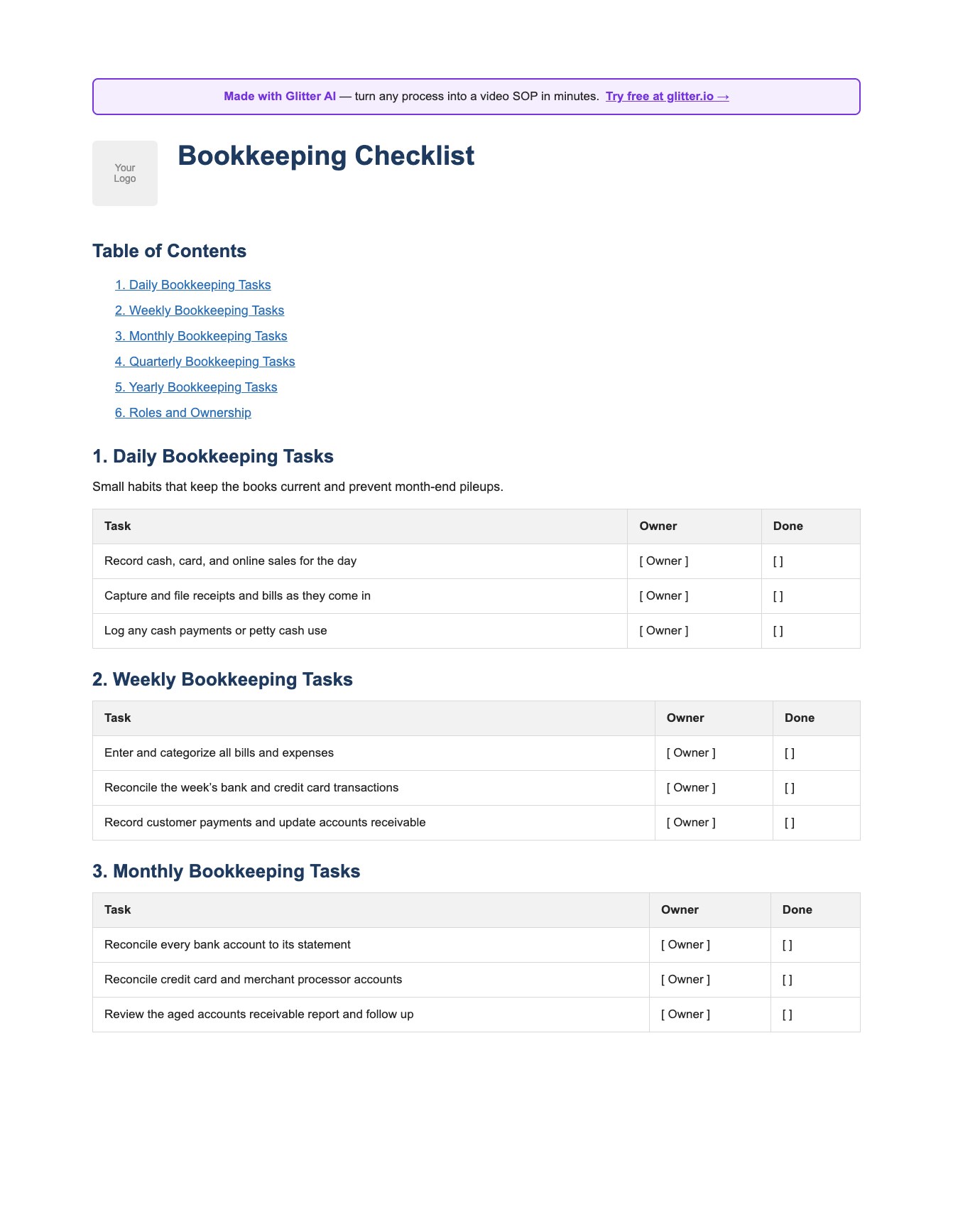
Frequently Asked Questions
What is a bookkeeping checklist?
A bookkeeping checklist is the recurring set of tasks that keeps financial records accurate and tax-ready, grouped by how often each task happens. It typically covers daily, weekly, monthly, quarterly, and yearly bookkeeping work such as recording transactions, reconciling accounts, chasing invoices, and the periodic close.
What are the daily bookkeeping tasks?
Daily bookkeeping tasks include recording the day's sales, capturing and filing receipts and bills, logging cash payments, checking the bank balance for anything unexpected, and sending invoices for work delivered that day. These are kept small so the books stay current and nothing has to be reconstructed later.
What should be on a monthly bookkeeping checklist?
A monthly bookkeeping checklist should include reconciling every bank and credit card account, reviewing aged receivables and payables, recording recurring journal entries, reconciling payroll liabilities, reviewing the profit and loss and balance sheet, and locking the period once it has been reviewed and approved.
How often should bookkeeping be done?
Bookkeeping should run on multiple cadences: a few minutes of recording daily, reconciliation and bill entry weekly, a full close monthly, tax and trend review quarterly, and year-end finalization annually. Doing a daily task only monthly is the most common reason books fall behind.
What is the difference between the bookkeeping process and a bookkeeping checklist?
The bookkeeping process is the end-to-end narrative of how records flow from transaction to financial statement. The checklist is the concrete, frequency-grouped list of tasks to tick off. Teams use the process to understand the system and the checklist to execute it consistently.
What bookkeeping tasks are done quarterly?
Quarterly bookkeeping tasks include filing payroll and sales tax returns, making estimated income tax payments, comparing financials against budget and the prior quarter, reconciling loans and interest, reviewing inventory, and cleaning up the chart of accounts and uncategorized transactions.
What is the year-end bookkeeping checklist?
Year-end bookkeeping includes reconciling all accounts and finalizing the close, issuing 1099s and W-2s, compiling the financial statement package, preparing records for the tax preparer, reviewing fixed assets and depreciation, writing off bad debt, archiving records, and setting next year's budget and calendar.
Why is reconciliation so important in bookkeeping?
Reconciliation confirms that your recorded balances agree with independent sources such as bank and credit card statements. Skipping reconciliation on low-activity accounts is the most common way an incorrect balance hides for months, so every account should have an owner and a monthly reconciliation.
Can a small business do its own bookkeeping with a checklist?
Yes. Many small businesses keep accurate books in-house by following a consistent daily, weekly, monthly, and yearly checklist with one named owner per task. A documented checklist also makes it easy to hand bookkeeping to a new hire or bookkeeper without losing accuracy.
How do I keep a bookkeeping checklist from being ignored?
Assign a single named owner to each task instead of a team, document how each task is actually performed rather than just that it exists, and keep the audit trail as you go. A checklist that depends on one person's memory is not yet a reliable checklist.