

Read summarized version with
I once asked an accounting manager to send me her month-end close checklist. She sent back a screenshot of a sticky note.
To be fair, the sticky note worked. She closed the books in four days, every month, without drama. The problem was that the sticky note lived on her monitor, and the rest of the close lived in her head. When she took two weeks off, close took nine days and three accounts didn’t tie out.
That’s the thing about a close checklist. Almost everyone technically has one. Few have one that survives a person being out, a new hire onboarding, or a controller asking “did we actually reconcile that?”
I’m Yuval, CEO of Glitter AI, and I spend a lot of time with accounting ops teams who want their close to be boring and repeatable. So here is the full month-end close checklist, organized by area, with a free downloadable version you can assign owners to and reuse. Jump to the downloads section if you just want the template.
Teach your co-workers or customers how to get stuff done – in seconds.


What a Month-End Close Checklist Actually Does
A month-end close checklist is the ordered list of tasks your accounting team works through after the calendar month ends, the work that finalizes the books and produces accurate financial statements. It covers cutoffs, reconciliations, journal entries, accruals, review, and the sign-off that locks the period.
If you want the full step-by-step narrative of how these pieces fit together over close week, I wrote a companion walkthrough on the month-end close process. This post is the checklist itself, broken down area by area so nothing slips.
Here’s the principle I’d tattoo on every close: a good checklist makes the close knowable, not heroic. Every task has an owner. Every balance sheet account has a reconciliation. Every exception has a note. If running it depends on one specific person’s memory, it isn’t a checklist yet. Only about 33% of organizations automate most or all of their financial close with workflows - meaning the majority of teams still depend on manual coordination that a well-run checklist is designed to replace.
The Full Month-End Close Checklist by Area
Work these areas roughly in this order. The early areas feed the later ones, and reconciliations are far less painful once cash, AP, and AR are clean.
1. Pre-Close Preparation
Before day one of close, set the stage:
- Publish the close calendar and assign an owner to every task.
- Communicate transaction cutoff dates to every department.
- Confirm all subledgers are posted through period end.
- Collect outstanding receipts, invoices, and expense reports.
- Verify the prior month is locked and roll balances forward.
Most “messy close” problems are really pre-close problems wearing a disguise. Those accruals you scramble to book on day three? They usually trace back to a cutoff nobody communicated.
2. Cash and Bank
- Reconcile every bank account to its statement.
- Investigate or clear stale outstanding checks and deposits.
- Record bank fees, interest, and any unrecorded transactions.
- Reconcile credit card and merchant processor accounts.
- Confirm petty cash and cash-on-hand counts.
Cash first, always. It’s the one account you can verify against an independent source, so it anchors everything else.
3. Accounts Payable
- Confirm every vendor invoice for the period is entered.
- Complete three-way matching on open purchase orders.
- Accrue for goods or services received but not yet invoiced.
- Reconcile the AP subledger to the GL control account.
- Review the aged payables report for coding errors.
If three-way matching is fuzzy on your team, the three-way match control explains itself cleanly once you see it, and my walkthrough of the accounts payable workflow shows where it sits in the wider AP flow.
4. Accounts Receivable
- Confirm all customer invoices for the period are issued.
- Apply cash receipts and clear unapplied payments.
- Review aged receivables and the bad debt reserve.
- Record deferred or unearned revenue adjustments.
- Reconcile the AR subledger to the GL control account.
Unapplied cash is the silent killer here, which is why disciplined cash application matters so much. It makes AR look wrong and revenue look incomplete, and it almost always surfaces during review, exactly when it’s most expensive to fix. The accounts receivable process post goes deeper on collections and cash application.
5. Payroll and Compensation
- Record all payroll runs and employer tax expense.
- Accrue unpaid wages, PTO, bonuses, and commissions.
- Reconcile payroll liabilities and benefit accounts.
- Confirm 401(k) and benefits remittances are recorded.
Payroll accruals are where the calendar bites you. A pay period that straddles month end needs a wage accrual, and “we’ll true it up next month” is how a year of small errors quietly compounds.
Teach your co-workers or customers how to get stuff done – in seconds.
6. Prepaid Expenses and Accruals
- Amortize prepaid expenses like insurance, software, and rent.
- Book recurring accruals such as utilities and professional fees.
- Reverse prior-period accruals where applicable.
- Review the accrual schedule for completeness.
Keep a standing accrual schedule. You want booking accruals to be mechanical, not a monthly act of remembering.
7. Fixed Assets and Depreciation
- Capitalize new asset additions from the period.
- Record monthly depreciation and amortization.
- Process disposals, retirements, and gain or loss entries.
- Reconcile the fixed asset register to the GL.
8. Inventory (if applicable)
- Reconcile the inventory subledger to the GL.
- Record cost of goods sold for the period.
- Adjust for shrinkage, obsolescence, or count variances.
9. Intercompany and Equity
- Reconcile and eliminate intercompany balances.
- Confirm intercompany transactions agree on both sides.
- Record equity, contribution, and distribution entries.
Intercompany only hurts when one side books and the other doesn’t. A quick agreed-balance confirmation before close beats a painful elimination scramble in the middle of it.
10. General Ledger and Journal Entries
- Post all standard and adjusting journal entries.
- Confirm every manual entry has support and approval.
- Review the GL for unusual or suspense account activity.
- Confirm intercompany and eliminations are balanced.
Every manual journal entry should have backup and a second set of eyes. This is also where your record of who did what and when is won or lost: if an auditor can’t reconstruct why an entry exists, you’ll be re-explaining it months later from memory.
11. Reconciliations
- Complete and review all balance sheet reconciliations.
- Document and assign owners for every reconciling item.
- Obtain reviewer sign-off on each reconciliation.
The rule I push hardest: every balance sheet account gets a reconciliation and an owner, even when activity is zero. “We don’t reconcile that one because nothing changes” is exactly how a wrong balance sits undetected for a year.
12. Review and Variance Analysis
- Run a preliminary trial balance and scan for anomalies.
- Perform month-over-month and budget variance analysis.
- Investigate and explain material variances.
- Document review notes and follow-up items.
Variance analysis is your detective control. A number that didn’t move when it should have is as suspicious as one that jumped.
13. Financial Statements and Reporting
- Generate the income statement, balance sheet, and cash flow.
- Tie financial statements back to the trial balance.
- Prepare the close package and management commentary.
- Distribute reporting to stakeholders by the due date.
14. Close Sign-Off and Lock
- Obtain controller or CFO review and approval.
- Lock the accounting period to prevent back-posting.
- Archive support, reconciliations, and the audit trail.
- Hold a close retrospective and log process improvements.
The retrospective is the step everyone skips. It’s also the one that actually shortens close. Five minutes of “what slowed us down this month” adds up to a faster close over a year. Top-performing companies complete their monthly close in about 6 working days versus 12 for average companies - a gap that widens even further at quarter-end and year-end. The difference is almost always process discipline, not headcount.
How to Make This Checklist Stick
A checklist on a sticky note works until the person with the sticky note is out. Here is how to make yours survive turnover.
Assign one owner per task. Not a team. A person. “Accounting will reconcile the bank accounts” is how a task becomes nobody’s job.
Make exceptions visible. A reconciling item with no note and no owner isn’t reconciled, it’s deferred. Write the note.
Document it once, the way it actually runs. Most close documentation rots because it describes the close someone wished they ran, not the one they actually run. This is the gap I built Glitter AI to close. Instead of writing a 20-page close manual nobody opens, you record yourself doing the close once and Glitter AI turns it into a step-by-step guide with screenshots. The next person follows the guide instead of inheriting a sticky note. If you want the broader finance documentation picture, my guide to accounting SOPs covers the whole department.
Teach your co-workers or customers how to get stuff done – in seconds.
Downloads
Here’s the full checklist as a free Word template. It already has every area above, with Owner and Done columns so you can assign tasks and reuse it every period:
Download the Month-End Close Checklist
A free Word template covering all 14 close areas, with Owner and Done columns and sign-off fields. Assign owners, check off tasks, and reuse it every month.
Download Month-End Close Checklist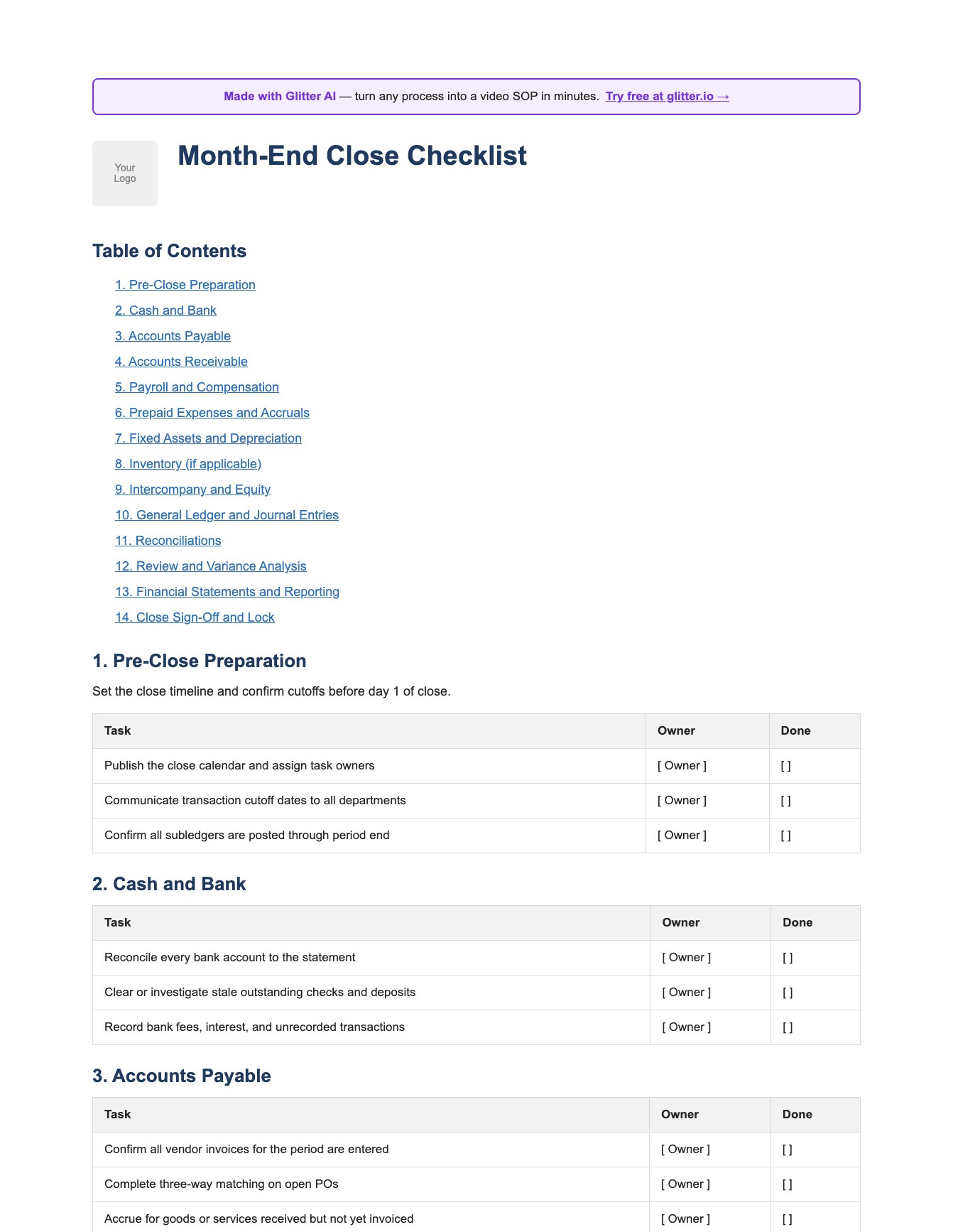
Frequently Asked Questions
What is a month-end close checklist?
A month-end close checklist is the ordered list of accounting tasks completed after the month ends to finalize the books, organized by area such as cash, AP, AR, payroll, accruals, fixed assets, reconciliations, and reporting. It ensures nothing is missed before financial statements are produced.
What should be included in a month-end close checklist?
A complete checklist covers pre-close preparation, cash and bank, accounts payable, accounts receivable, payroll, prepaid expenses and accruals, fixed assets, inventory, intercompany and equity, general ledger and journal entries, reconciliations, variance analysis, financial statements, and final sign-off and period lock.
How long should the month-end close take?
Most teams target a close of three to seven business days, with high-performing teams closing in two to four days. The biggest driver of speed is whether cutoffs, ownership, and reconciliations are documented and repeatable rather than dependent on one person's memory.
What is the correct order for month-end close tasks?
Start with pre-close preparation and cutoffs, then cash and bank, then AP and AR, then payroll, accruals, and fixed assets. Post journal entries, complete reconciliations, run variance analysis, produce financial statements, and finish with review, sign-off, and locking the period.
What is the difference between the month-end close process and the checklist?
The process is the end-to-end narrative of how a close runs over close week, including timing and dependencies. The checklist is the concrete, area-by-area list of tasks to tick off. Teams use the process to understand the flow and the checklist to execute it consistently.
Why are reconciliations so important during the close?
Reconciliations confirm that GL balances agree with independent support such as bank statements and subledgers. Skipping reconciliations on accounts that 'never change' is a common way wrong balances go undetected for months, so every balance sheet account should have an owner and a reconciliation.
How can I speed up my month-end close?
Communicate cutoffs early, assign one owner per task, keep standing accrual and reconciliation schedules, document the close the way it actually runs, and hold a short retrospective each month to remove recurring bottlenecks.
What are the most common month-end close mistakes?
Common mistakes include missed transaction cutoffs, unapplied cash in AR, payroll periods that straddle month end without an accrual, manual journal entries without support, intercompany that only one side booked, and skipping reconciliations on low-activity accounts.
Who should own each month-end close task?
Every task should have a single named owner, not a team. Reconciliations need a preparer and an independent reviewer, and the controller or CFO provides final review and sign-off before the period is locked.
Is there a free month-end close checklist template?
Yes. The free downloadable Word template in this post covers all 14 close areas with Owner and Done columns and sign-off fields, so accounting teams can assign tasks, track completion, and reuse it every period.