
Read summarized version with
The most avoidable production stoppage I ever heard about came down to a grease fitting. One CNC machine, one lubrication point, one operator who knew it needed a shot of grease every Friday. He left for a new job. Nobody else knew the fitting existed, because the only place that task lived was in his head. Six weeks later the spindle bearing failed mid-run and took the line down for two days.
That’s the pattern with machine maintenance. The failure almost never happens because the task was hard. It happens because the task was invisible: tied to a person instead of the machine, never written down where the next operator could find it. According to a Plant Engineering maintenance survey, mechanical failures and lubrication-related breakdowns consistently rank among the top causes of unplanned downtime in manufacturing facilities - problems that documented, routine checklists are specifically designed to prevent.
A machine maintenance checklist fixes exactly that. It pins every inspection, cleaning, and lubrication task to a specific machine, a frequency, and a named owner, so the knowledge survives the person.
I’m Yuval, CEO of Glitter AI. I spend a lot of time with production and maintenance teams who want machine care to be boring and predictable instead of a fire drill after something seizes. So here’s a full per-machine maintenance checklist, organized by daily, weekly, and monthly tasks, with a free downloadable version you can assign owners to and reuse. Want the template? Jump straight to the downloads section.
Teach your co-workers or customers how to get stuff done – in seconds.


What a Machine Maintenance Checklist Actually Is
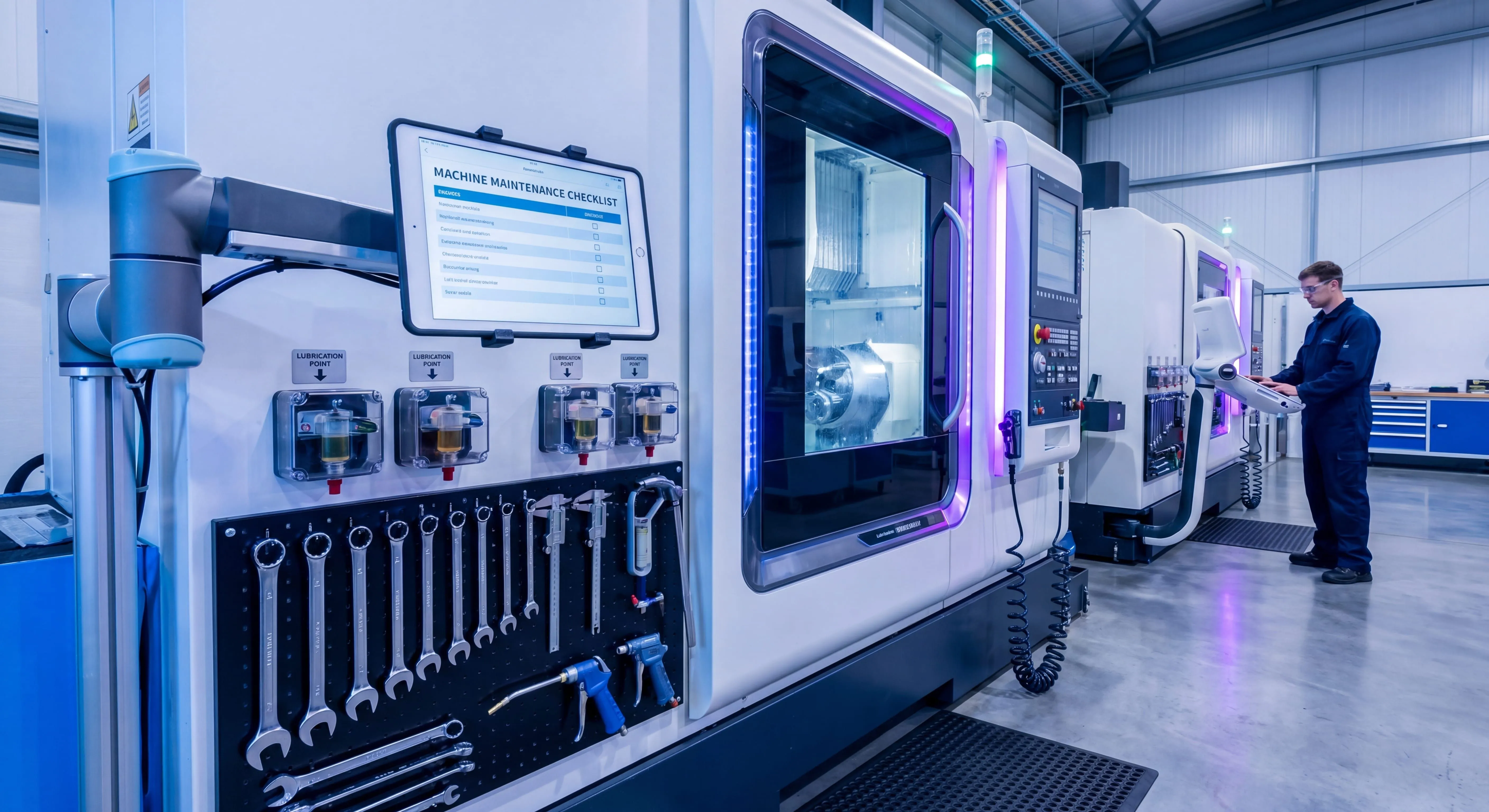
A machine maintenance checklist is the organized, per-machine list of inspection, cleaning, lubrication, calibration, and replacement tasks your team performs on a fixed schedule to keep a specific machine running before it fails. The key word is per-machine. You fill in one copy for each asset, tied to its serial number and location, not one generic list for the whole floor.
Think of this as the machine-level companion to a broader routine preventive maintenance checklist. That one works at the asset-type level: HVAC, electrical, fleet. The machine maintenance checklist zooms all the way in to one press, one CNC mill, one packaging line, with the daily and weekly tasks the operator actually runs at the start of a shift.
Here’s the principle I’d tape to the machine itself: a task isn’t maintenance until it has an owner and a date. “We grease the spindle” is a hope. “The first-shift operator greases spindle fitting B every Friday and initials the log” is a program. A checklist is just the tool that turns the first sentence into the second.
Why Daily, Weekly, and Monthly
Machine failures don’t arrive on one schedule, so the checklist can’t either. Splitting tasks by frequency is what lines the checklist up with how machines actually wear.
- Daily tasks catch the obvious, fast-moving problems: a leak, a loose guard, an odd noise, a low fluid level. These are the cheapest checks on the list and the ones that prevent the dramatic failures.
- Weekly tasks catch the things that build up over days: contamination, belt wear, drifting tension, minor damage that a daily walkaround misses at a glance.
- Monthly and longer tasks catch the slow degradation: bearing wear, alignment drift, calibration loss, the failures that take weeks to develop and one bad day to surface.
Skip the daily layer and you’re betting on a monthly inspection to catch a problem that started on day three. That gap is where the expensive failures live.
Daily Machine Maintenance Checklist (Start of Shift)
Run these at the start of every operating shift. Follow lockout/tagout before reaching into any guarded or powered area.
- Walkaround for leaks, loose parts, and visible damage
- Check fluid, coolant, and lubricant levels against the marked range
- Listen and feel for unusual noise or vibration at idle and load
- Verify guards, E-stops, and safety interlocks are in place and functional
- Check air and hydraulic pressure gauges against spec
- Clear chips, debris, and obstructions from the work area and travel paths
- Confirm the HMI shows no active faults or alarms
The daily list should take an operator a few minutes, not half an hour. If it’s longer than that, you’ve buried weekly tasks in the daily column and people will stop doing it.
Weekly Machine Maintenance Checklist
- Deep clean machine surfaces, guards, and enclosures
- Inspect belts, chains, and hoses for wear, cracking, and tension
- Top off all lubrication points per the lube chart
- Inspect cables, connectors, and wiring for chafing or damage
- Test safety devices: light curtains, mats, interlocks
- Review and log operator-reported issues from the week
Teach your co-workers or customers how to get stuff done – in seconds.
Monthly Machine Maintenance Checklist
- Lubricate bearings and slides per the manufacturer schedule
- Inspect and adjust belt, chain, and coupling alignment
- Check and tighten electrical and terminal connections
- Inspect pneumatic and hydraulic seals, fittings, and filters
- Calibrate critical gauges, sensors, and controls
- Inspect tooling, fixtures, and wear parts
- Review run hours and cycle counts against PM intervals
Quarterly and Annual Tasks
The longer intervals are where overhauls and certifications live: filter and fluid replacement, vibration analysis on rotating assemblies, infrared scans of electrical panels, full teardown inspection of critical components, and instrument recalibration. None of this belongs on the operator’s daily card. It belongs on the maintenance team’s planned schedule, ideally tracked in a computerized maintenance management system so interval-based and run-hour-based tasks fire automatically instead of relying on someone remembering. Industry survey data shows teams that shift the majority of their maintenance to planned work - rather than firefighting - consistently report 20-35% lower total maintenance costs compared to primarily reactive operations.
How to Build a Checklist for Your Machine
A generic list gets you started. A list tied to your specific machine is what actually heads off failures. Here’s the build order I’d recommend.
- Start from the manufacturer manual. The OEM maintenance schedule is the non-negotiable backbone. Lubrication intervals, wear-part replacement, and torque specs come straight from it. Everything else is additive.
- Add the failure history. Pull the last 12 to 24 months of work orders for that machine. Recurring failures tell you exactly which inspections to add and how often. The bearing that fails every nine months needs a vibration check long before month nine.
- Add operator knowledge. The person who runs the machine every day knows the early warning signs the manual doesn’t mention: the pitch the motor makes before a belt goes, the spot that always leaks first. Capture that before the operator leaves.
- Assign frequency and an owner per task. Every line gets a frequency and a single named owner. Shared ownership is no ownership.
- Set acceptance criteria. “Check coolant level” is ambiguous. “Coolant level within the marked operating band” is a pass/fail an operator can apply in two seconds without judgment.
This is also where a machine maintenance checklist and an equipment maintenance log part ways. The checklist is the forward-looking list of what to do; the log is the historical record of what was done and what was found. You need both, and the log is what feeds step 2 the next time you revise the checklist.
The Real Problem Isn’t the Checklist, It’s Adoption
I’ve watched teams build a beautiful per-machine checklist and have it quietly die in three months. Not because the tasks were wrong. Because every task meant something slightly different to every operator, and the one person who did it the “right” way was the one who left.
“Inspect belt tension” is not an instruction. It’s a category. One operator presses it with a thumb, another uses a gauge, a third eyeballs it. The checklist looks complete on paper while the actual work drifts.
The fix that’s worked for the teams I talk to: record each task once, the right way, as a step-by-step guide the operator can pull up at the machine. Not a binder nobody opens. A short visual guide that shows exactly where the fitting is, which gauge to use, and what “in spec” looks like. The checklist says what and when. The guide says how, the same way, every time, no matter who’s on shift. That’s the core idea behind 5S and total productive maintenance too: machine care becomes part of how the whole team works, not tribal knowledge one person carries out the door.
This is exactly what we built Glitter AI for. You do the task once while it records, and you get a clean step-by-step guide with screenshots that any operator can follow, linked right off the checklist line. The checklist stays short; the knowledge stops walking out the door.
Teach your co-workers or customers how to get stuff done – in seconds.
Downloads
Grab this free machine maintenance checklist to get started. It’s a per-machine Word template with a machine identification block, daily/weekly/monthly/quarterly task tables, an issue-and-work-order log, and a sign-off section, so you can fill in one copy per machine and assign owners today.
Download the Machine Maintenance Checklist
A free per-machine Word template with daily, weekly, and monthly tasks you can assign owners to and reuse.
Download Machine Maintenance Checklist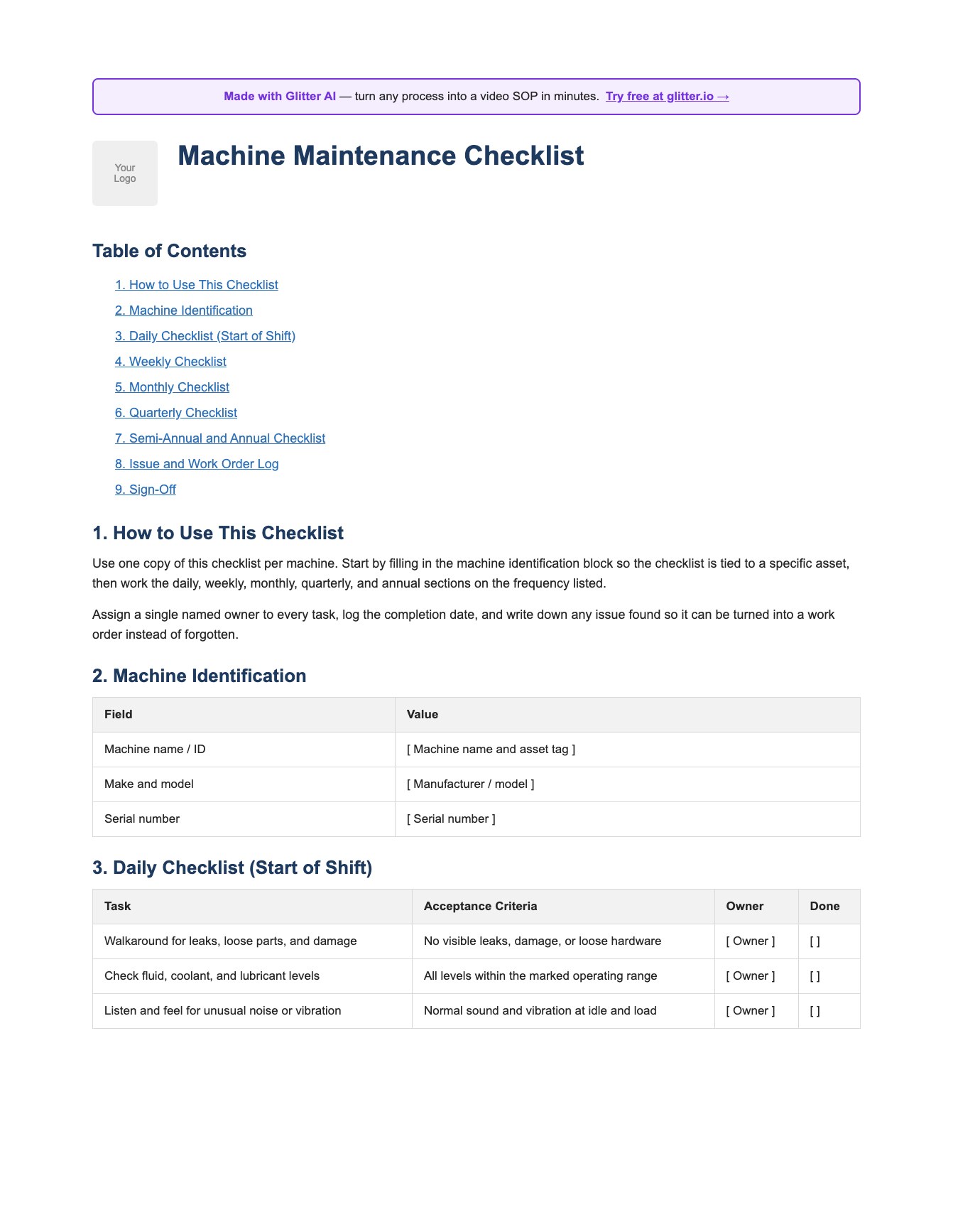
For a broader, multi-asset version covering HVAC, electrical, and facility systems, see the preventive maintenance checklist. If you want to formalize the whole program around it, the preventive maintenance program guide walks through asset inventory, criticality, and KPIs.
Frequently Asked Questions
What is a machine maintenance checklist?
A machine maintenance checklist is a per-machine list of inspection, cleaning, lubrication, and calibration tasks performed on a fixed schedule to keep a specific machine running before it fails. Each task is tied to one machine, a frequency, and a named owner.
What should a daily machine maintenance checklist include?
A daily machine maintenance checklist should include a leak and damage walkaround, fluid and lubricant level checks, listening for unusual noise or vibration, verifying guards and E-stops, checking pressure gauges, clearing debris, and confirming no active HMI faults. It should take only a few minutes per shift.
How often should machines be maintained?
Machine maintenance runs on layered frequencies: daily checks at the start of each shift, weekly cleaning and inspections, monthly lubrication and calibration, and quarterly or annual overhauls. The exact intervals come from the manufacturer manual, the machine's failure history, and how hard it runs.
What is the difference between a machine maintenance checklist and a preventive maintenance checklist?
A preventive maintenance checklist works at the asset-type level across the whole facility, such as HVAC, electrical, and fleet. A machine maintenance checklist zooms in to one specific machine and includes the daily and weekly tasks the operator performs at the start of a shift.
Who should be responsible for machine maintenance tasks?
Every task should have a single named owner, not shared ownership. Daily and weekly tasks usually belong to the machine operator, while monthly, quarterly, and annual tasks belong to the maintenance team. Shared ownership of a task almost always means no one does it.
How do I create a machine maintenance checklist for a specific machine?
Start from the manufacturer maintenance manual, add tasks based on the machine's failure history from past work orders, capture operator knowledge of early warning signs, assign a frequency and owner to each task, and set pass/fail acceptance criteria so checks are objective.
What is the difference between a machine maintenance checklist and an equipment maintenance log?
The checklist is the forward-looking list of what to do and when. The equipment maintenance log is the historical record of what was actually done and what was found. You need both, and the log feeds the next revision of the checklist.
Should machine maintenance checklists be on paper or digital?
Digital checklists are easier to assign, track, and audit, and they connect each task to a step-by-step guide showing how to do it. Paper works for a single machine but breaks down across a floor because completion and findings are hard to roll up and act on.
Why do machine maintenance checklists fail to stick?
Checklists usually fail not because the tasks are wrong but because each task means something different to every operator and the knowledge lives in one person's head. Recording each task once as a step-by-step guide keeps the work consistent through turnover and shift changes.
Does a machine maintenance checklist replace a CMMS?
No. A checklist defines the per-machine tasks and frequencies, while a CMMS schedules them, tracks completion, and triggers interval-based and run-hour-based work automatically. The checklist is the content; the CMMS is the system that makes sure it actually runs on time.